I Stopped Using AI as a Tool. I Hired It as a Team.
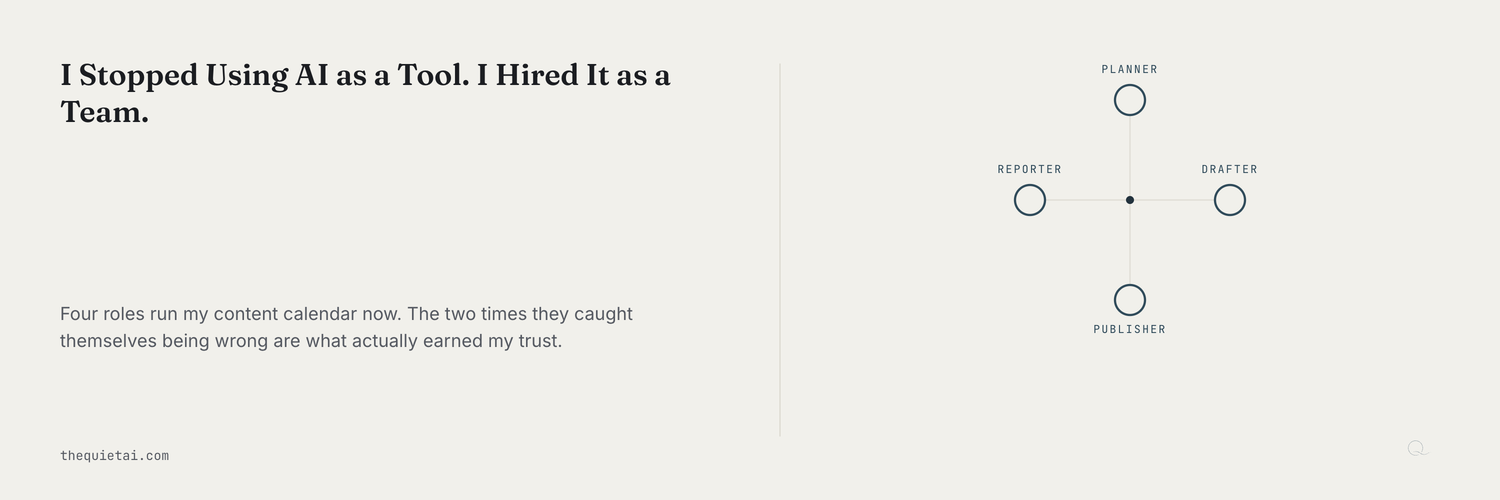
Four roles run my content calendar now. The two times they caught themselves being wrong are what actually earned my trust — not the parts that just worked.
We call it all “AI,” and the word is hiding a decision nobody tells you you’re allowed to make.
A chatbot. An autocomplete for your brain. One word for a dozen different relationships you could have with the thing. You can use it as a tool — something you pick up for one job and put back down. Or you can let it hold a piece of your actual work, standing, the way a person would. The moment you do that, you don’t get an assistant. You get a team.
Where it actually started
Not with a plan. With a mess.
My first Instagram looked messy, no matter how hard I tried — one piece at a time, by hand, every post its own small project starting from nothing. That frustration is the whole reason any of what follows exists. I didn’t set out to build a system. I set out to stop doing the same thing over and over, badly, alone.
The fix wasn’t a better tool. It was asking AI to hold things, the way you’d hand a role to a person — not a task to a tool.
The Planner
Not a to-do list. A planner that already knows the shape of the week before I open my eyes.
Three separate calendars — YouTube, social, articles — get built out ahead of time, never improvised the morning of. I look at the run sheet, decide what’s fresh and what’s already been tried, and approve or change it. The week exists before the week starts.
The Drafter
I don’t start from a blank page anymore. I edit a proposal.
Something arrives already shaped — a first pass at the idea, not an empty box waiting for me to fill it. My job shrank from “write this” to “is this right,” which is a smaller job and a more honest use of my actual attention.
The Publisher
Three calendars, one clock. On a live day, posts go out at 6am, 7:30am, 9am, noon, and 3pm — and I don’t carry any of those times in my head. Nobody has to remember to hit publish, because remembering was never supposed to be the job.
The Reporter — and the two times it told me the truth
This is the one I trust most, and it’s not because it’s never wrong. It’s because when something is wrong, it says so.
It reads back what actually happened — a real reporting pass, ranked by actual reach, not a guess at what probably did well. Twice, it caught something I hadn’t:
It found a YouTube post that had gone out twice and flagged it, so it could be removed.
It found a batch of articles that had all published a day early, on the same day, and flagged that too. Not fixed quietly on camera. Caught, named, handed back to me.
That’s the whole difference. A tool covers for you. A teammate tells you the truth.
Three days of material, every two days
The output is three days’ worth of material made every two days, and I want to be honest about the other side of that: setting this up well is more complicated than most people assume it is. I’m not going to pretend it was one afternoon and a prompt.
What it bought me isn’t a number — nobody handed me a hours-saved figure and I’m not going to invent one. It’s what the system actually gives back: the week runs without me holding all of it in my head at once. Mental freedom, not automation for its own sake.
What this actually changes
If you’re still asking AI to make you one thing at a time, you’re not using it wrong. You’re just not using all of it yet.
That’s not four tools. That’s a team.
More of what this actually looks like, at thequietscribe.com.