
Five Rules That Stopped Costing Me a Day
A locked rule isn’t advice — it’s removed from the decision surface entirely, and that’s what makes parallel dispatch survive contact with reality.
For most of last year, my daily content pipeline was a renegotiation. Each morning the same five questions came up. Where does the brief get pasted. Where does the dashboard live. Which worker owns which artifact. What fields does the worker get, what does it have to ask for. Small questions, each one burning tokens and drifting the answer by a few degrees, because a small judgment call on a tired Tuesday is not the same call as on a focused Monday.
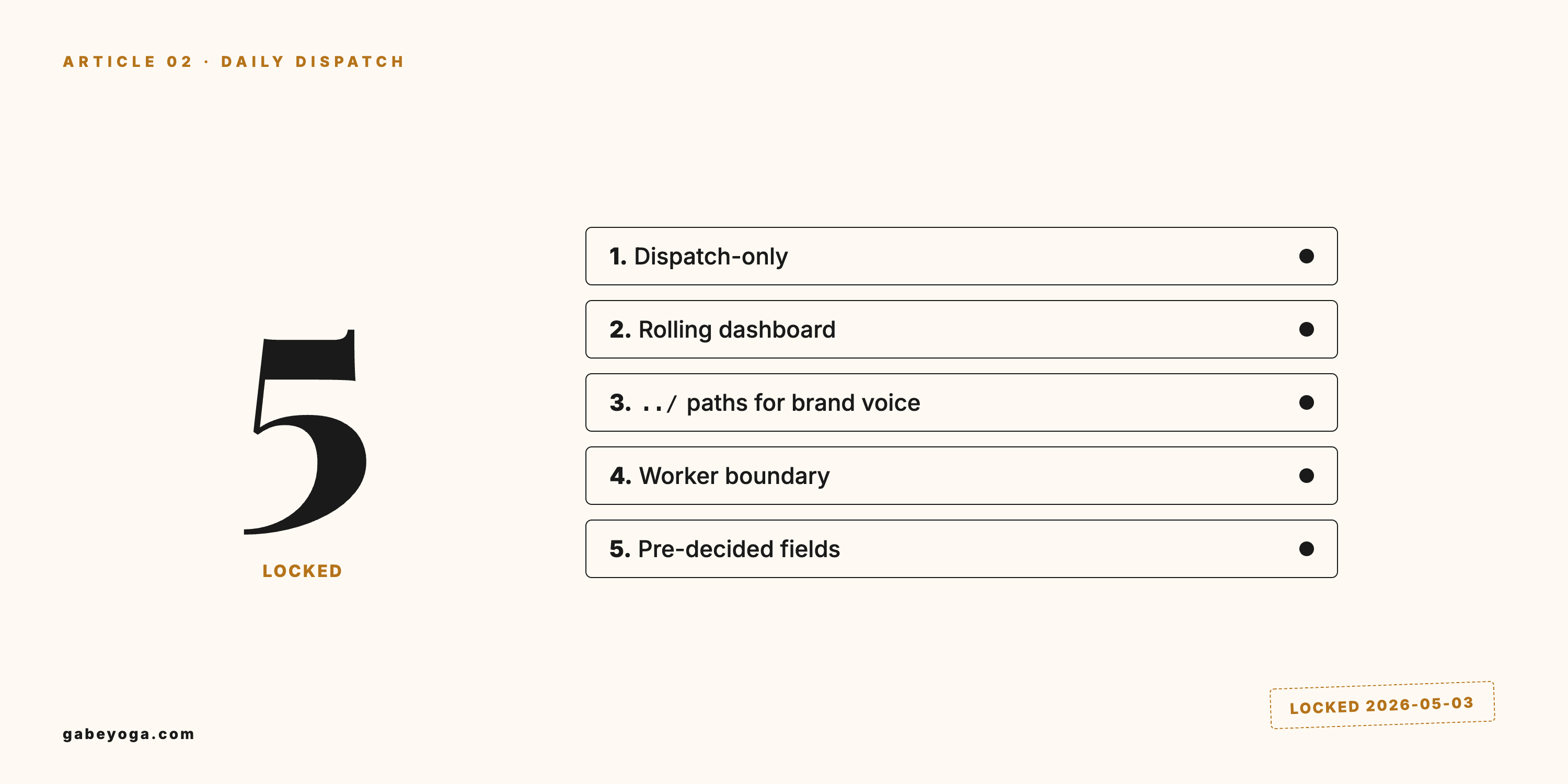
Five rules ended that. They were locked on 2026-05-03 and have not been re-litigated since.
What “locked” means
A locked rule is not advice. It is not a default that can be overridden in context. It is removed from the decision surface entirely. The orchestrator session does not consider alternatives, does not weigh tradeoffs, does not ask the operator to confirm.
The cost of the daily pipeline was never in the work. It was in the decisions about the work. Lock the decisions, and the work becomes mechanical.
The five
1. Dispatch-only. The orchestrator never executes a daily piece. It writes the brief, picks the worker, hands off. If the orchestrator finds itself reaching for the actual artifact, the lock is broken and a worker should have been dispatched instead.
2. Rolling dashboard. One file. daily/THIS-WEEK.html. Refreshed in place. No per-day Markdown brief unless explicitly requested with the full brief trigger. The dashboard is the daily artifact for routine flow.
3. ../ paths for brand voice. Workers do not own brand voice. Brand voice lives in one reference file at the project root. Workers reach for it via relative path when they need it. They never copy it into the sandbox. A copy is a fork waiting to happen.
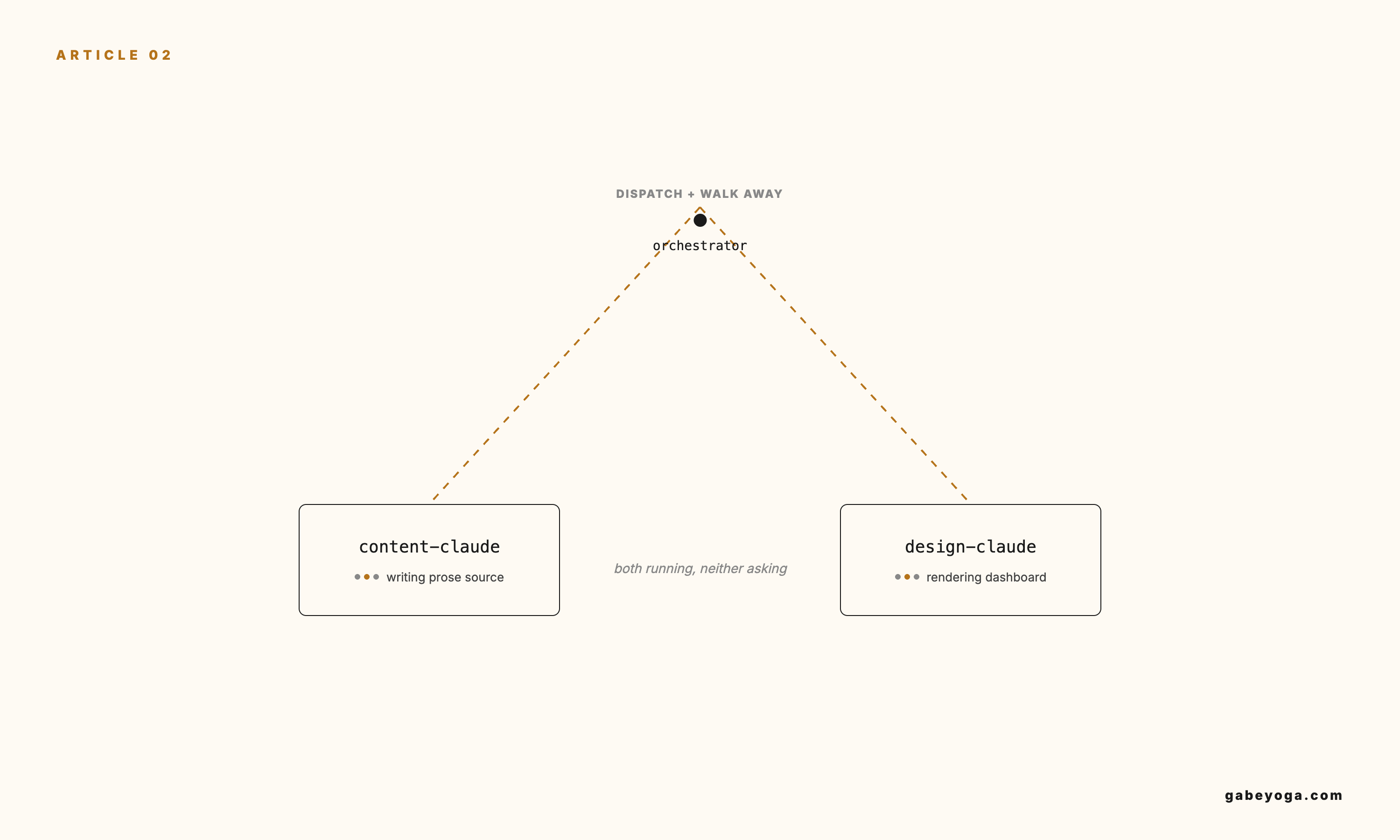
4. Worker boundary. content-claude writes prose source MDs. design-claude alone produces the dashboard HTML and visual assets. Neither crosses. When the boundary blurs, the same artifact gets produced twice in shapes that diverge, and the operator pays the reconciliation cost.
5. Pre-decided fields. Before any dispatch, five fields are decided by the orchestrator: slug, phrase, category, caption-source, photo-source. Never deferred to the worker. A deferred field is a worker stopping mid-execution to ask. A pre-decided field is the worker shipping without round-trips.
The shape of a locked dispatch
Sanitized paste-snippet.
Worker: [worker-name]
Brief: [path-to-brief]
Slug: [decided]
Phrase: [decided]
Category: [decided]
Caption source: [path-to-prose-MD]
Photo source: [path-or-id]
Output: [exact-target-path]
Returns: [list-of-files-expected-back]
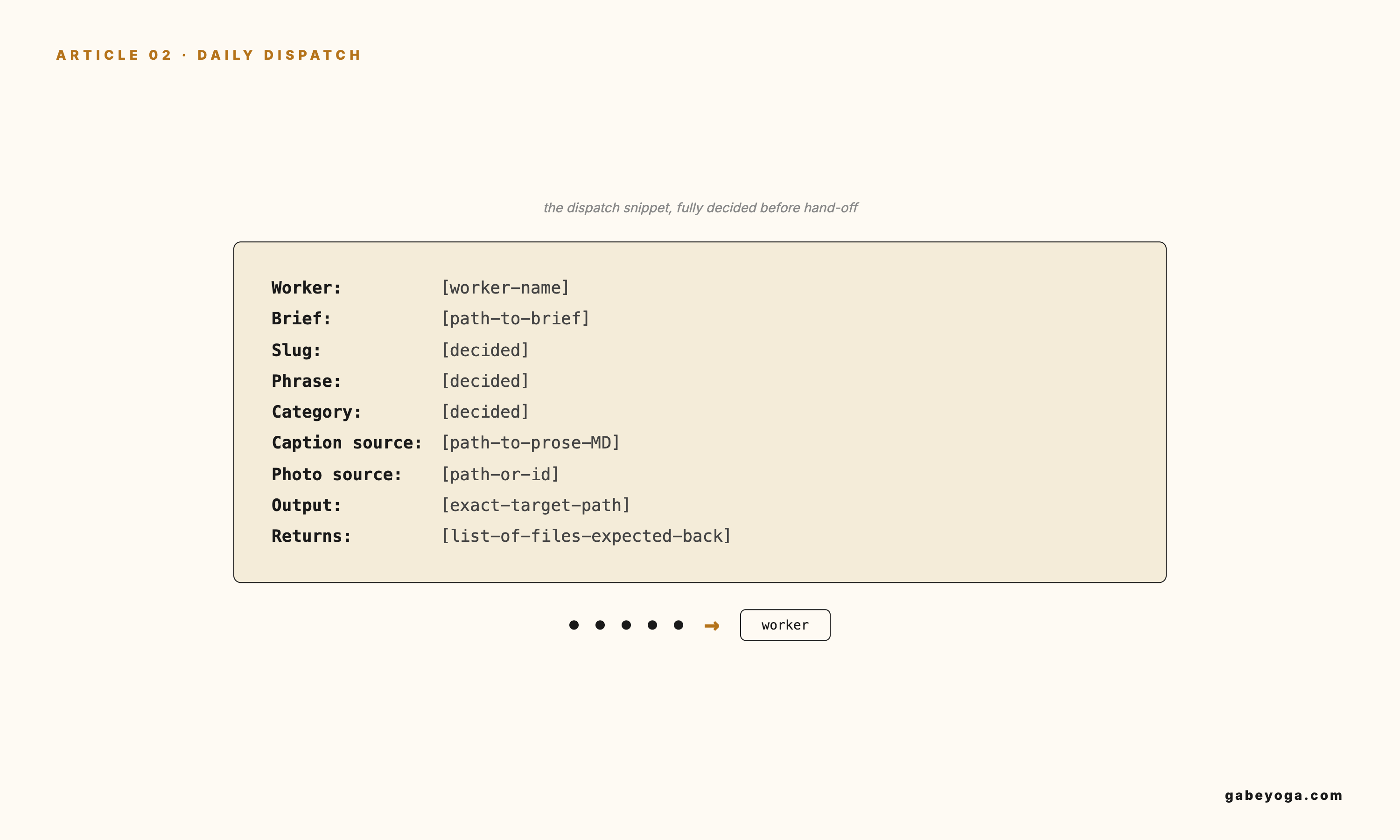
That is the entire interface between orchestrator and worker on a daily piece. The lock turns the dispatch from a writing task into a values-filling task. The five rules above are what make that snippet sufficient.
Why locking is the gate to parallelism
Two workers running in parallel cannot stop and ask. They cannot both turn to the orchestrator for clarification, because the orchestrator is not babysitting them; it dispatched both and moved on. The only way parallel dispatch is safe is if every field the workers could possibly ask about has already been decided.
The five rules are what make parallel dispatch survive contact with reality. Without them, parallelism becomes a race between two workers to ask the same ambiguous question, with the operator paying the round-trip cost twice.
What this costs
The lock has a real cost. The orchestrator now carries the decision surface that the workers used to carry. That surface is concentrated, repeated, and visible — and concentrated decisions are the only kind that can be templated, automated, or eventually moved into a hook. A decision that happens once a day in the orchestrator becomes improvable. A decision scattered across five workers can only be remembered.
The lock also makes voice drift legible. When voice drifts on a locked rule, you know which rule broke. When voice drifts inside a judgment-call workflow, the drift hides inside the judgment, and you catch it three posts later when a caption lands wrong.
Two companions in this series: The orchestrator is not the worker and Three categories of external workers.