
Four Things People Call a Detox
One of them has a randomized trial behind it that I can show you, and it has no juice in it.
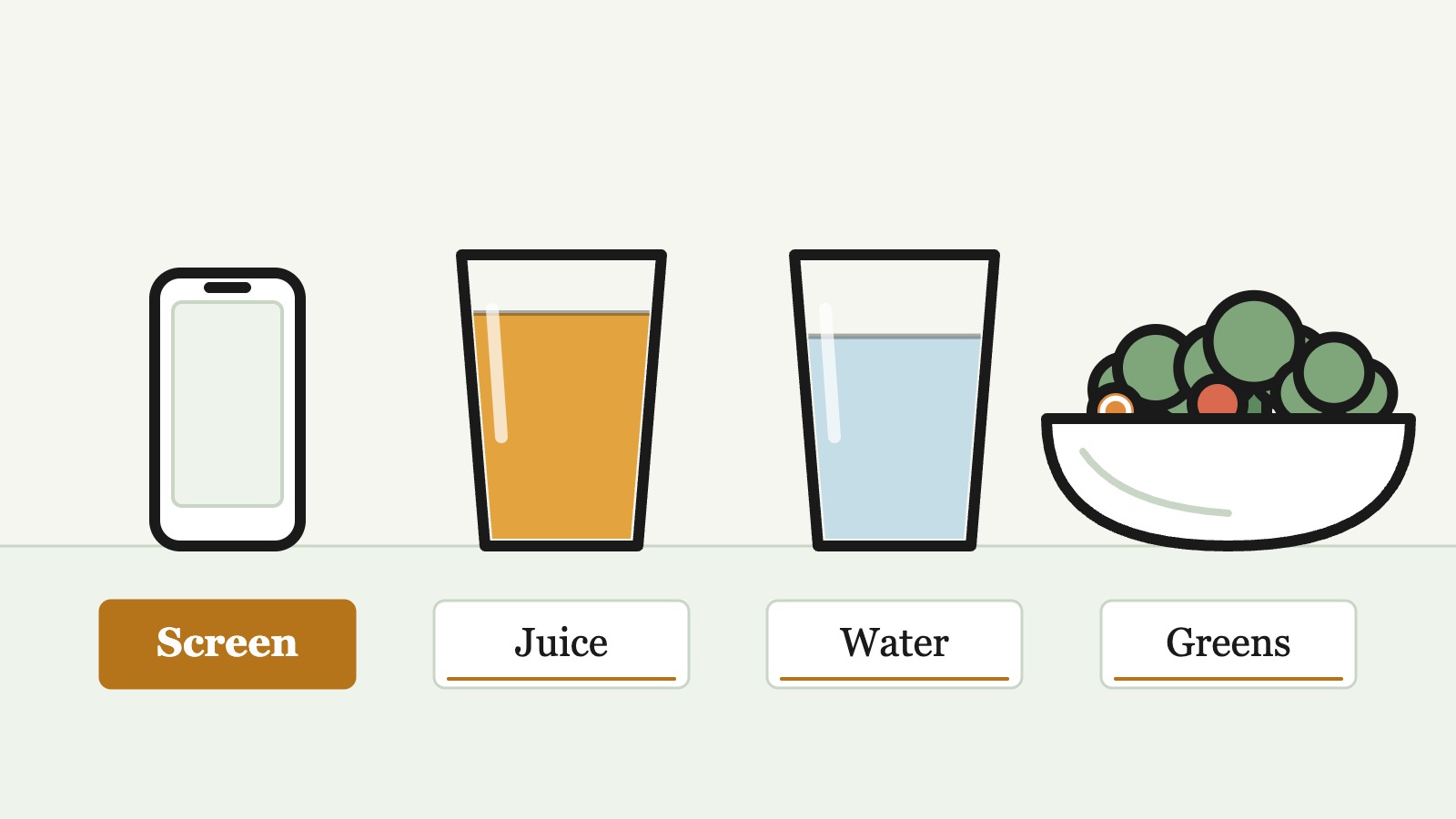
Ask ten people what a detox is and you get ten answers. A week of juice. A weekend without your phone. A lot of water. A plate of greens.
People ask what the benefits of a detox are. The honest answer is a shorter list than the labels promise, and it starts somewhere you might not expect. So here are the four, in the order the evidence earns, each with what it is sold as, what is actually supported, and one caution.
None of what follows says a juice, a glass of water or a plate of greens removes toxins from your body. I’ll show you why I won’t say it.
A screen break

Sold as: a reset for your head.
What is supported: this is the one where I can point to a randomized trial. Researchers (Pieh and colleagues, in BMC Medicine, 2025) took 111 healthy students and split them into two groups, 58 and 53. The group asked to keep smartphone screen time to two hours a day or less for three weeks reported better well-being, fewer depressive symptoms and better sleep than the group that carried on as usual. The students started at about 276 minutes a day. The effects were small to medium in size.
Now the limits, because they belong in the same breath. The trial was not blinded, so the students knew which group they were in. Every outcome was self-reported. Only smartphone time was measured. The sample was small and relatively healthy, and it was students. One result, the difference in stress, only just reached significance (p = 0.050).
So read it as one trial, one group, one reduction target. It does not say two hours is the right number for you, and it does not say screens cause depression. The authors describe improvements in mental health through smartphone use reduction, measured over three weeks, with a follow-up six weeks later.
Caution: a trial in healthy students is not a treatment. If you are struggling, your doctor comes before any phone setting.
A juice cleanse

Sold as: a way to remove toxins, lose weight, promote health.
What is supported: the National Center for Complementary and Integrative Health (NCCIH) says only a small number of detox programs have been studied in people, and the studies with positive results were low quality: design problems, few participants, or no peer review. It points to a 2015 review that found no compelling research supporting detox diets for eliminating toxins, and a 2017 review saying juicing and detox diets can cause initial weight loss through low calorie intake, with weight regained once normal eating resumes. There are no studies of long-term effects.
So there is no good evidence that a juice cleanse removes toxins. What it reliably changes is how many calories you eat and how much sugar you drink. NHS guidance is to limit fruit juice and smoothies to one small glass (150 ml) a day, with a meal, because they are high in sugar.
Caution: unpasteurized juice can make people sick, and that is more serious for children, older people and anyone with a weakened immune system. Some juices are high in oxalate, leafy greens and beets among them, and people prone to kidney stones should limit those.
A lot of water

Sold as: a flush.
What is supported: drinking enough water is worth doing. It supports normal hydration. It is not a cleanse. NHS guidance is 6 to 8 cups or glasses of fluid a day, and the NHS calls that “just a guide”: more if it’s hot, if you’re active, pregnant, breastfeeding or ill. Its pointer is a clear, pale yellow pee. Water, lower-fat milk, tea and coffee all count.
Caution: more is not better. NCCIH warns that drinking large quantities of water and herbal tea while eating no food for days in a row could lead to dangerous electrolyte imbalances.
A week of light greens

Sold as: a lighter body.
What is supported: vegetables. Not as a detox, as ordinary good eating. The NHS says eating plenty of fibre is associated with a lower risk of heart disease, stroke, type 2 diabetes and bowel cancer, and that fibre can help with digestion and prevent constipation. UK guidance is 30 g of fibre a day, and UK adults eat about 20 g a day on average. NHS 5 A Day asks for at least five portions of a variety of fruit and vegetables, 80 g each.
That is the plain upside: more vegetables and more fibre than you were eating.
Caution: NCCIH names leafy greens and beets as examples of high-oxalate foods. People prone to kidney stones should limit them. NCCIH also notes that diets which severely restrict calories or the types of food you eat usually do not lead to lasting weight loss and may not supply all your nutrients.
One thing to do this week
Pick one subtraction and one replacement. Phone out of the bedroom, an alarm clock in. Notice what changes. That is my example, not what the trial tested, and I’m not giving you a number to hit. It’s one small subtraction, watched.
The detox of your AI setup
There is one more kind, and it belongs to people who work with AI all day. Over time an AI setup fills up: old instructions, tools you no longer use, files nobody opens. Clearing those out is a subtraction too: take out what you no longer use, keep a short list of what always applies, and bring in the rest only when the job needs it.
That is a work practice, not health evidence. It says nothing about your body. It is the same move as the phone out of the bedroom: remove one thing, replace it with one thing, and see what changes.
Before you try any of this
Ask your doctor first if you have diabetes, kidney disease, an eating-disorder history, or are pregnant, and before changing a child’s diet. Fasting can cause headaches, fainting, weakness and dehydration, and NCCIH says intermittent or periodic fasting is still being researched, with no firm conclusions about its effects on human health. I am not recommending a fast here.
Not medical advice. Your own care team comes first.
Made by the quiet scribe team: AI workers drafted this, Gabe directs.
Join us in Wellness & AI SKOOL: https://www.skool.com/wellness-and-ai/about
A detox is mostly a subtraction. The useful question is what you take out, and what you put in its place.
thequietai.com