
How to sequence a yin class: start with what it’s for
Yin yoga was designed for sitting, not for quiet. Sequence it by what each pose opens.
My first yin class was nice, quiet, relaxing. Nobody in that room asked what it was for.
I’d known about yin for a long time by then. I started yoga in 1994, and I practised Ashtanga every morning. A friend taught yin at a studio next to the store I used, and every time I was invited I had a reason not to go. Usually the reason was surf. Then one Friday I ran into my friend right outside, heard “You should come to my class,” and for once I had no excuse.
The class was an hour and a half. We held every pose for five minutes, about twelve or thirteen poses in all. It was nice. Nobody sat me down first to show me how hard sitting was. Nobody asked where I felt stuck. I said thanks and went home.
Saturday is the Ashtanga day off, so I surfed. On Sunday morning I was back on my mat, and when I got to certain poses I thought: how come I can do these today, with ease? It wasn’t the surfing. I hadn’t changed my diet. It wasn’t the day off. That left the one yin class, so that’s where I put it. I’ve practised yin ever since.
What I only understood later is that the class did that without being built to. It was sequenced for quiet, and most yin classes still are. That is the mistake this piece is about.
The mistake: teaching yin as the quiet class
When yin got popular in the West, a lot of teachers were thrown into teaching it without being told what it was. What they heard was “it’s quiet, so stay in the poses.” Or they read about meridians, so the teacher talks meridian theory while the class holds.
The student leaves saying what students say: that was nice. Some of them are thinking the other half. What I really needed, you never did.
I saw the gap clearly on a retreat I ran in Asia, with teachers from Asia and teachers from the West in the same room. I taught a few basic poses, and the teachers from Europe and America said they’d never done them regularly. The two teachers from Asia said, “Of course we do.” Someone had laid a foundation there. In most of the yin classes I’ve taken in the West, those poses never come up.
What yin is for
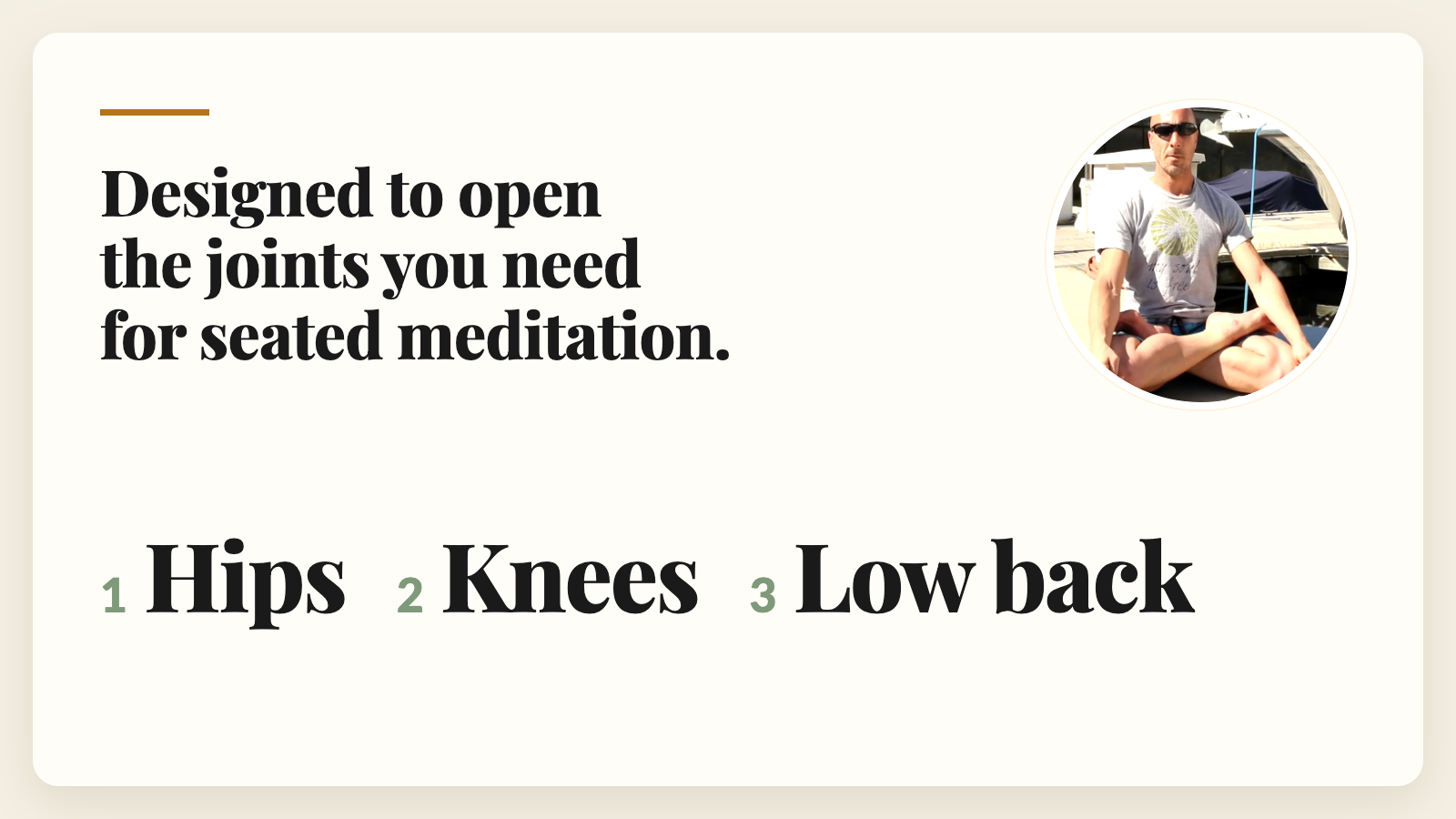
Yin yoga is first and foremost a practice designed to open the joints you need for seated meditation: the hips, the knees and the low back. It is a limited practice, on purpose. It isn’t meant to replace your practice. It’s a tool for it.
Its history points the same way. Paul Grilley, a yoga teacher in California, read that yoga is for sitting, sat down, and wasn’t comfortable. He went to Paulie Zink, a martial arts teacher, who didn’t use yoga words at all. He used Chinese ones. Everything is yin or yang, and all you do is yang. You punch, you kick, you do handstands in yoga class. Sitting is yin. You’ve never done yin, so of course you’re not comfortable.
Who gets the credit for yin is an argument people still have online. It matters less than the problem Grilley started from: a body that couldn’t sit.
So “it’s quiet” is a slightly wrong place to start. Quiet is what yin feels like. Sitting is what it’s for.
Why adult joints need a playground
Watch a child sleep. They end up in strange positions, moving their bones around all night. Children take their joints through all kinds of ranges, all day, by choice. Somewhere on the way to being adults we lose that.
What we do instead is hold one shape for hours. The chair, the car seat, the computer, the couch, the way we lie in bed. They work like braces we put on our bodies, and none of them is a brace that helps.
A yoga mat can be an adult playground. Even so, years of practice don’t guarantee comfort on the floor. When I gave this talk, I asked the room to sit first. For about half of us it wasn’t comfortable, and that included someone who had practised yoga for a long time, years of preparation and all.
How to sequence it: pick each pose by what it opens
This is the logic I use, and it needs very few poses.
- Open the hip to help the knee. That’s pigeon, which yin calls swan.
- Open the hip, then the back. That’s seal, which looks like cobra or up dog.
- Open the back, then the ankle and knee, so the student can sit again. That’s saddle, or half saddle.
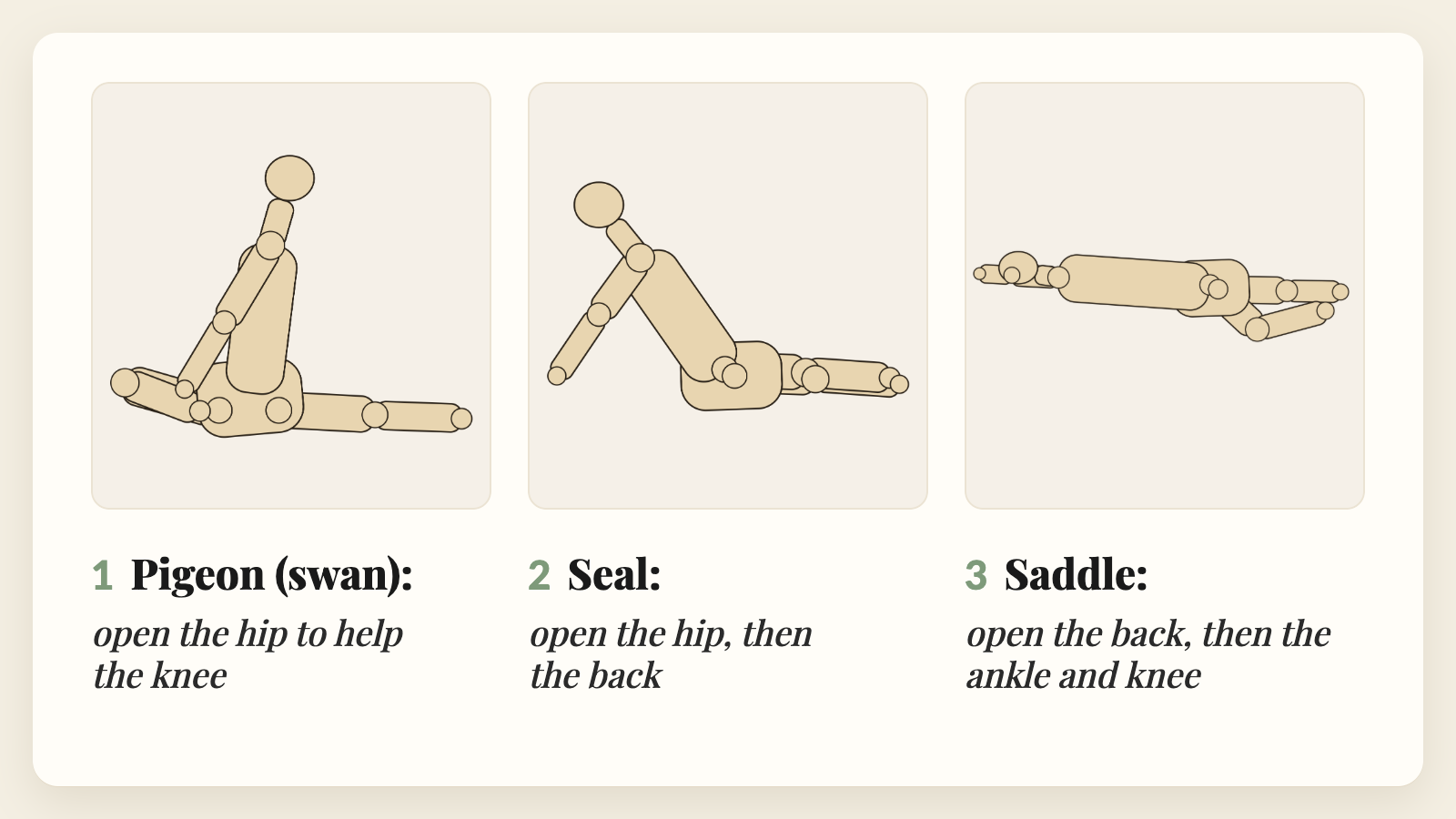
Each pose points somewhere. I could teach all eighteen-odd yin poses because it’s yin and it’s quiet. I’d rather know what each pose is for and use the few that point where the student needs to go.
If someone will only do one, I tell them pigeon, with the chest up so there’s a low back bend in it. Pigeon and seal are both poses you can do watching TV.
Leave the muscles out of it
When you sit in meditation, do you squeeze your muscles the way you do in warrior one? You don’t. So in a yin pose you don’t either. You come in and you stay.
If you like using your muscles, use them. You just can’t use them for five minutes.
Yin yoga and the yin principle
In my vocabulary these are two different things.
Yin yoga is the lower-body practice. There are about 18 to 20 poses, all for the hips, the knees and the low back, all in service of seated meditation. Open a yin yoga book and you’ll see it.
The yin principle is the instruction underneath: stay, and relax the muscle as much as you can. That works at any joint, so you can take it to the shoulders and the upper body. Some of my yin classes include upper-body poses and some don’t. That’s my call as the teacher. Now it’s yours too.
What this doesn’t cover
- Pain and injury. In the talk I get into knees, tendons and ligaments, and into athletes who repeat one motion all week. An article can’t assess your body. If you have an injury, a diagnosis or a medication in the picture, your own care team comes first.
- The spine as we age. I have more to say about the curves of the spine. It needs its own piece.
- One class is one story. What happened on my Sunday is my experience. Yours may go another way.
My first yin class was nice, and nice was never its problem. The problem is the student who walks out of a nice class with what they really needed still undone.
P.S. This comes from a live talk I gave, Yin Yoga: The Power of Sequencing. The Quiet Scribe team cut it into eleven short clips. You can watch me tell the Sunday story in Wellness & AI SKOOL: skool.com/wellness-and-ai/about