Name the Job, Not the Worker
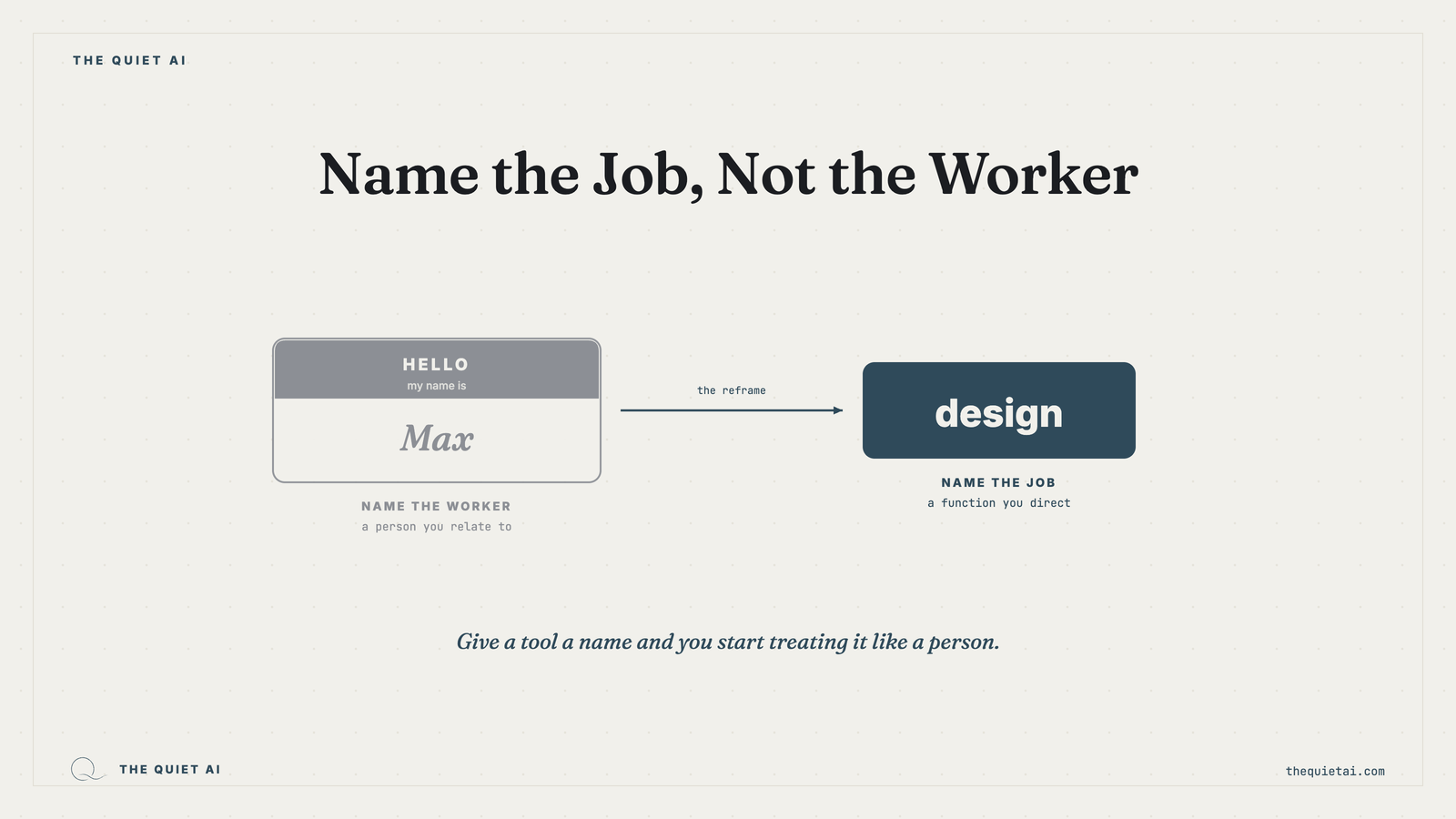
Give a tool a name and you start treating it like a person. Three things follow, and none of them is the team you were hoping for.
There’s a move going around right now, and I’ll say up front that it’s genuinely fun. You stand up an AI helper and you give it a name. Then another, and another, until you’ve got a little crew with faces and personalities. Max runs design. Ada handles research. Someone cheerful answers your email. People are gamifying their whole operation this way, building a cast, and I want to be generous about it before I disagree, because the generosity is the honest part: the people teaching this have done more to make ordinary, non-technical folks comfortable with AI than a decade of careful think-pieces ever did. They turned a cold tool into something you’d actually sit down and work with. That’s not nothing. That’s most of the battle.
So this isn’t a dunk. It’s a quarrel with one small instinct sitting underneath the whole thing.
The naming.
Because the moment you give a tool a name, you’ve quietly decided what it is. And I think the decision is wrong, in a way that costs you more the better it works.
Name a tool and you turn it into a person. That sounds harmless. Warm, even. But personify a tool and three things follow, in order, nearly every time.
The first is that you stop seeing the tool. “Max” isn’t a capability you can pick up, set down, copy, or swap anymore. He’s a guy. You’ve traded something you operate for someone you relate to, and a relationship is a heavier thing to carry than a hammer.
The second is the one that actually costs you, so let me slow down on it. Once it’s a person, you start needing it to take care of you. Watch your own desk. You ask the named one for something, it comes back slow or wrong, and you find yourself doing a strange thing: waiting on it. Giving it another chance. Softening how you’d put the correction, the way you would with a colleague who’s having a rough week. You thank it. You hesitate to hand its work to something else, because that now feels a little like firing someone. None of that is in the work. A folder never made you feel a single bit of it. You don’t give a folder another chance; you just open a different drawer. The personality you added didn’t make the tool better. It made you more dependent and a little more polite to a thing that has no idea you’re being kind.
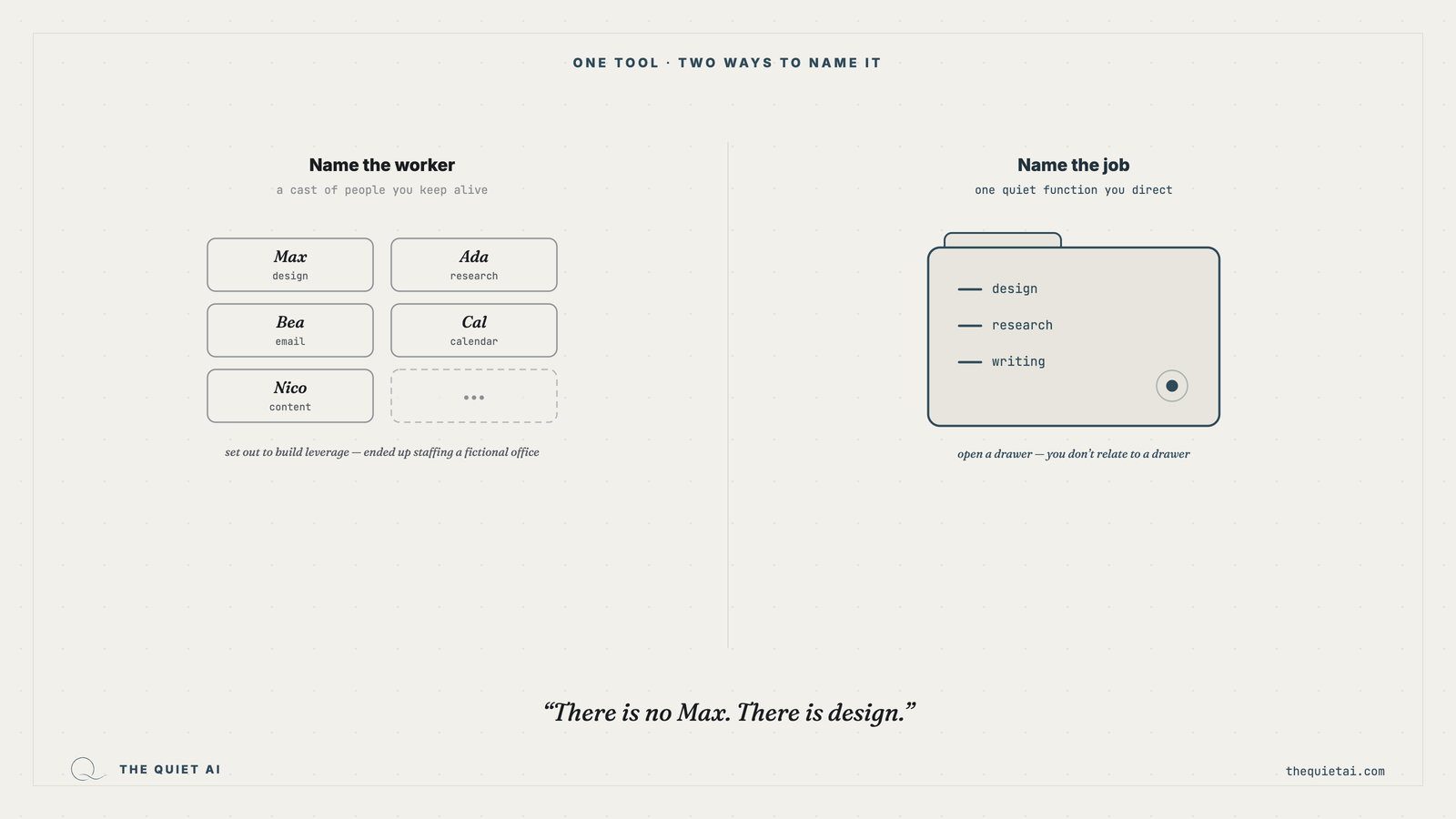
The third follows from the second. One person is lonely, so you make more. To have a team, you start inventing teammates, and now you’re maintaining a roster of little personas, each needing a voice and a backstory and a lane, most of the upkeep going into the characters rather than the work they were supposed to do. You set out to build leverage and ended up staffing a small fictional office.
Here’s the version I run instead, and it’s almost boringly plain.
The AI is the tool. The suite of them is the operation. And you name by the work, not by the worker.
There is no Max. There is design. There is no Ada. There is research. There’s the one that writes, the one that organizes, the one that goes and finds things out. When a thing is simply “the design worker,” your attention has nowhere to pool except where it belongs: on the output, and on whether the problem in front of you actually got solved. You’re not managing a feeling. You’re not wondering if it’s happy. You’re looking at the result and asking the only question that pays — is this good, and if not, what’s the correction. Naming by function keeps you the operator instead of slowly turning you into the office manager of a team that doesn’t exist.
And the function name carries something the personal name destroys: honesty about what the thing is. “The research worker” can’t quietly become a colleague you owe loyalty to. It stays a job, done by a system, that you direct.
Now the part that makes the whole persona project unnecessary in the first place.
A single worker, named for its job, is already a team.
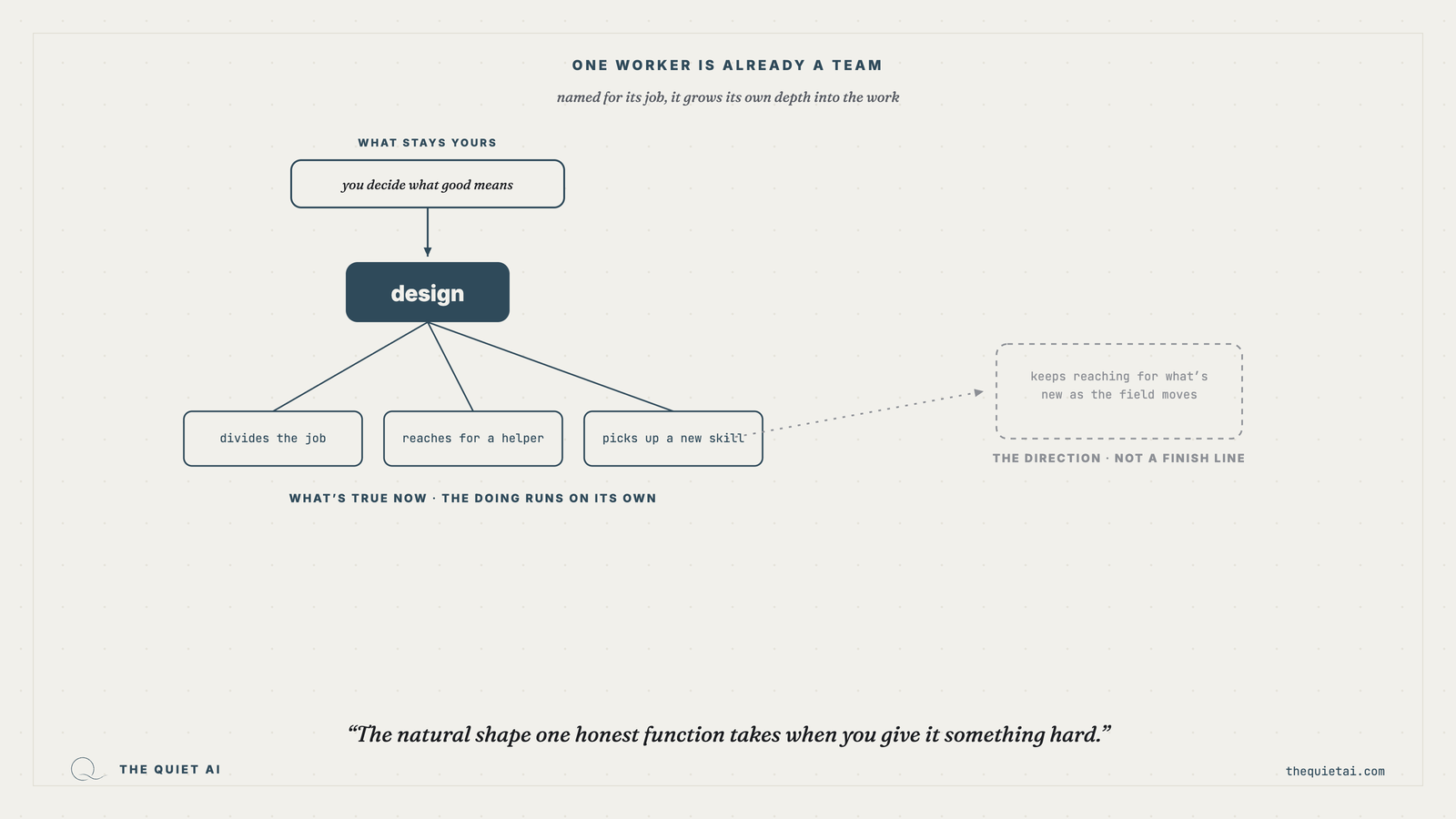
This is the piece people skip, and it’s the good one. When I stand up “the design worker” and hand it something real, it doesn’t stay one fixed thing. It divides the job. It reaches for a smaller helper to take a piece. It picks up an ability it didn’t have that morning and goes and uses it. I didn’t have to draw eight portraits first and assign them lanes. I stood up one function and let it grow its own depth into the work. The team isn’t a cast I manufactured. It’s the natural shape one honest function takes when you give it something hard and get out of its way.
Let me be exact here, because this is precisely where the hype lives and I’d rather hand you the real line than a shiny one. There’s a difference between how far that self-assembly runs today and where it’s built to head, and I won’t blur the two to sound more impressive. What’s true now: the doing can run on its own. The dividing of a job, the reaching for the next piece, the picking-up of a new skill. What stays mine, always, on purpose: deciding what good means. The worker brings me the call that matters before it matters; I don’t set it loose and walk off. And the direction we’re building toward, stated as a direction and not a finish line, is a system that keeps reaching for what’s new on its own as the field moves under us, the skill that didn’t exist last month, the better way to do a thing, without me redrawing the map each time. That’s the aim. I’m not going to dress it up as already arrived.
But even today, the principle holds: you don’t need to invent a roster of little people to have depth. You need one function pointed at real work, allowed to grow.
So here’s the whole thing in a line, the rule I’d actually hand you: humanize the package, never the parts.
There is a name I’m fond of for the whole. People reach for “Jarvis” when they mean the one calm thing that runs the shop, the single coherent operation you live alongside. I’m not selling you a Jarvis, and I’m not borrowing the costume; I’m pointing at the instinct behind the name. Naming the whole is earned, because the whole is something you genuinely have a relationship with. It holds your voice, your standards, your way of working, in one place that doesn’t forget. One resonant name for one resonant thing is fair.
The parts underneath it are not roommates. They’re systems.
The design worker isn’t a person having a bad day; it’s a function you can inspect, correct, and trust, exactly the way you’d trust a well-made tool and never a moody one. Humanize at the top, where a relationship is real and useful. Stay plain underneath, where a relationship is just a tax you pay on every correction.
That’s why The Quiet AI is built the way it is. The AI is kept quiet and named by its job. The operation, taken as one thing, is something you can stand next to and call your own. And the judgment, the deciding of what the work is even for, stays with the person. Set it up that way and you don’t get a team you have to manage feelings for. You get a system you can grow, set loose on the doing, and keep pointed at what matters while the field keeps changing under everyone.