Show Up Weekly, Even for Fake Clients
The reps you do before anyone’s watching — even for a client you made up — are the ones that make everything after them possible.
There’s a specific kind of quiet that comes after you publish something you know is thin.
You felt it while you were making it. You shipped it anyway, told yourself it was fine, that nobody would look that closely, and then you sat in the small silence afterward where you knew it wasn’t. Not a disaster. Just thin. The kind only you can see clearly, which somehow makes it sit worse.
I do this every week.
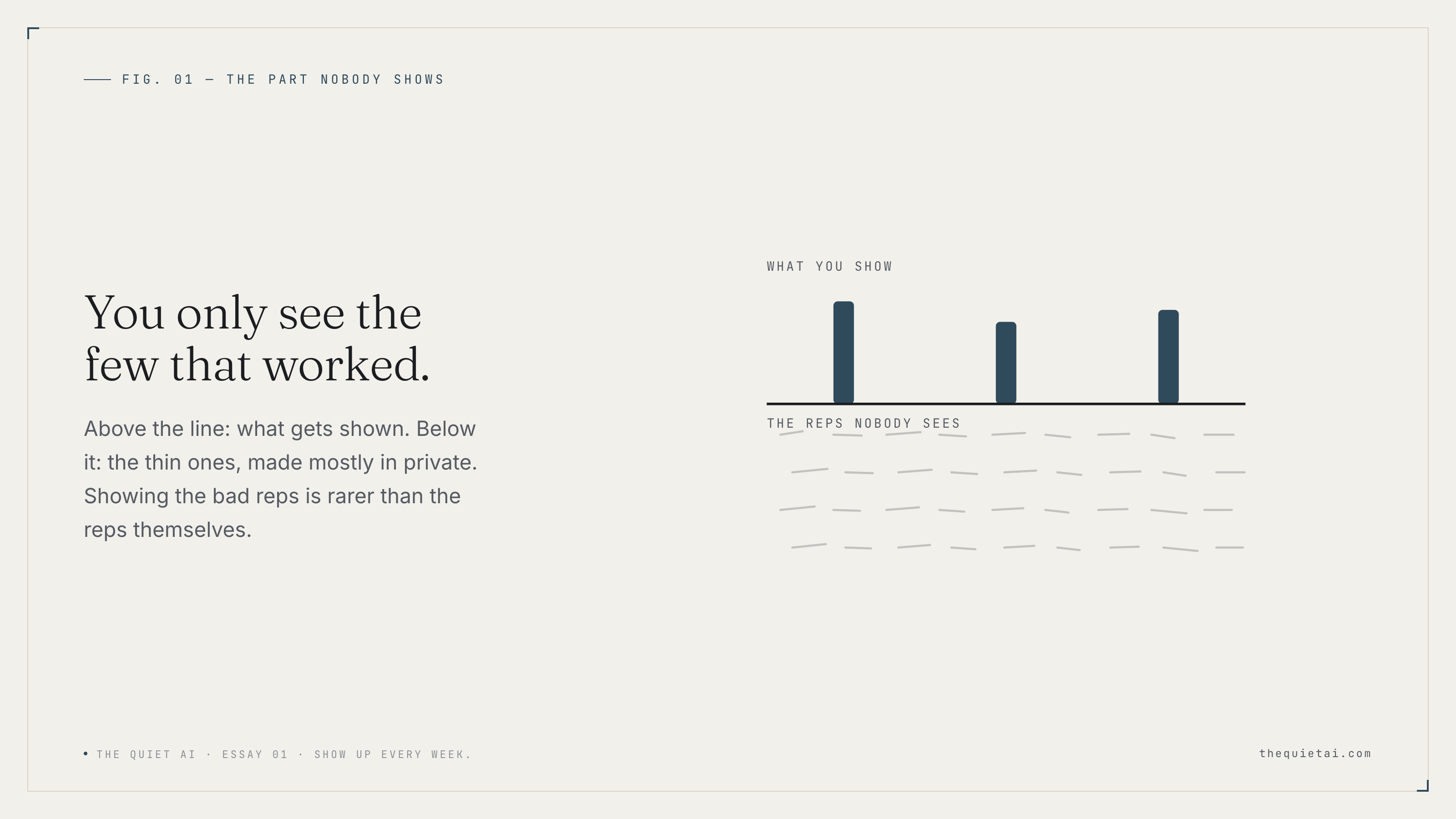
I’m telling you that first, before anything else, because the version of this you usually read skips it. You get the finished thing, the clean result, the “here’s what I made.” You almost never get the week it was thin and went out anyway. So you quietly assume the people who make things have stopped making bad ones. They haven’t. They’ve just stopped showing you that part.
This is the part nobody shows. I’m going to show it, because openly explaining the bad reps is rarer than the reps themselves, and it turns out to be the whole point.
Here is what I wish someone had said to me plainly, years earlier than anyone did: you are allowed to be bad at this for a long time, and you are allowed to keep going anyway.
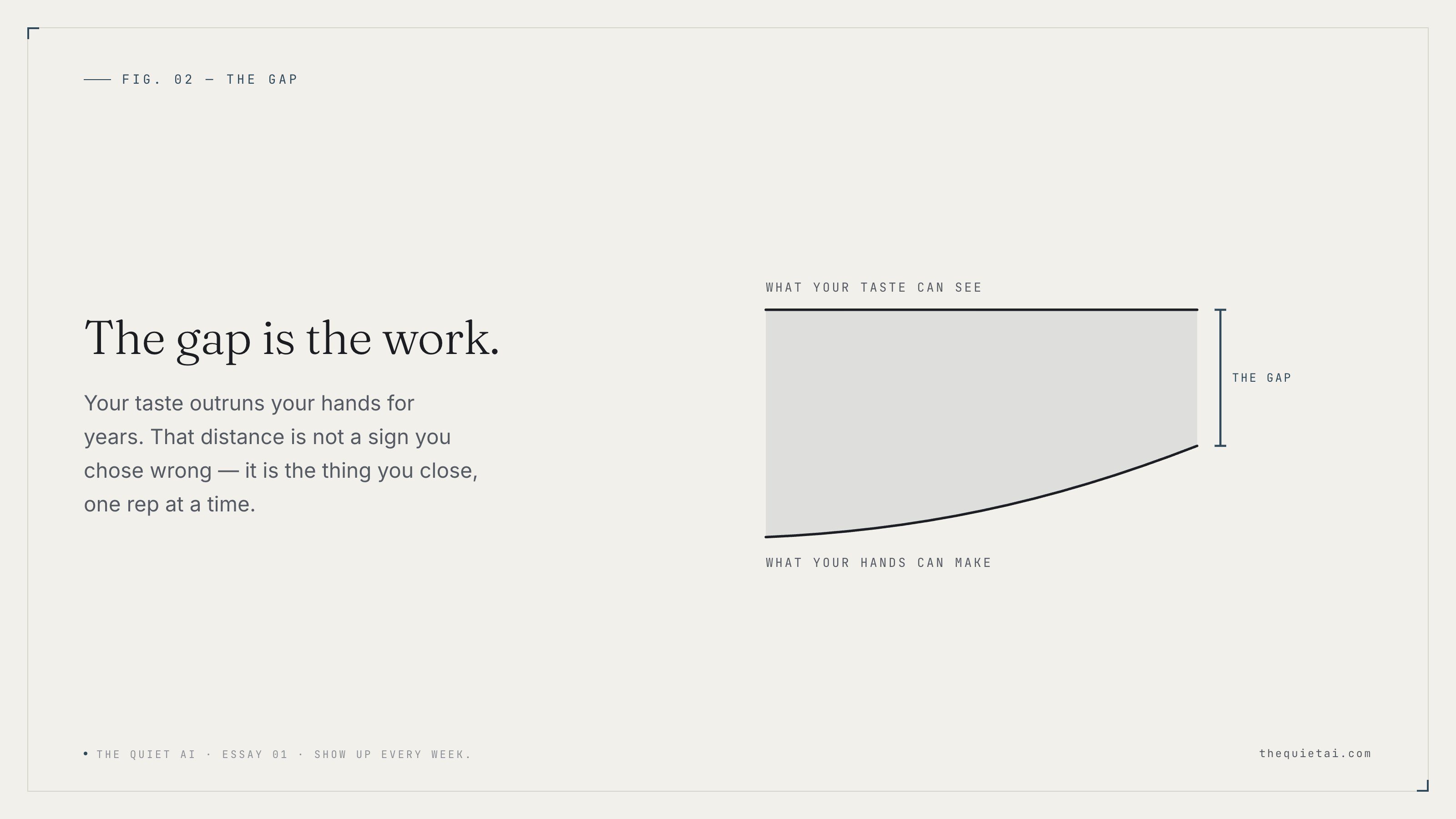
Most people don’t quit at the start. The start is exciting. They quit in the gap. The gap is the place where your taste has gotten good enough to see exactly how far your work falls short of it, and your hands haven’t caught up yet. That gap is not a sign you chose wrong. It’s the sign you’re actually in it. Everyone who is good now spent years there, making thin things, mostly in private.
The mistake is treating the gap as a waiting room. Somewhere you sit until you’re good enough to begin. It isn’t a waiting room. It is the work. You close it by repetition, and only by repetition, and the early repetitions are bad before they are good. There is no version where you skip the bad ones.
Which brings me to the fake clients.
The thing that keeps people out of the reps is waiting for a real one. You tell yourself you’ll do the real work when someone’s actually paying for it, when the stakes are real, when it counts. So you study, and you plan, and you never ship the first version, because the first version is going to be bad and you’d rather it be bad for no one.
So invent the someone.
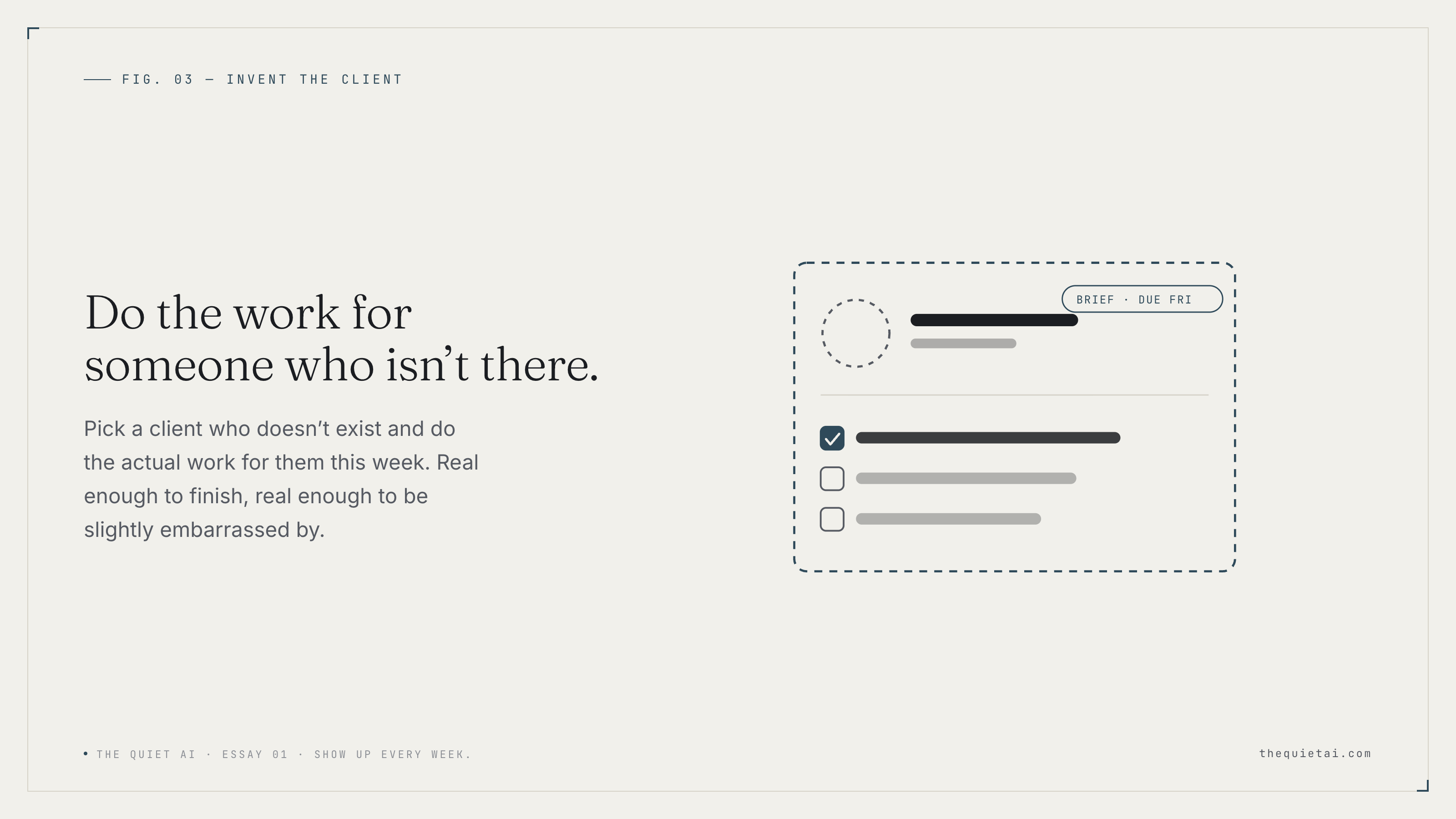
Pick a client who doesn’t exist and do the actual work for them this week. Not a plan for the work. The work itself. If you want to design, design the thing they didn’t ask for. If you want to write, write the piece they would have hired you to write. If you want to build, build the tool for the customer you don’t have yet. Make it real enough to finish, real enough to be slightly embarrassed by, and then next week make another one for the next client who doesn’t exist.
The fake client does one quiet, useful thing: it makes the rep real without making it expensive. You get the whole loop — decide, make, finish, look at it honestly — without a real person absorbing your worst version. That isn’t practice instead of the real thing. For a while, that is the real thing.
I still ship things I know are thin. That isn’t a confession; it’s the mechanism. The weeks I make nothing because nothing would be good enough are the weeks I quietly get worse. The weeks I make the thin thing and look at it honestly are the weeks the gap closes by a millimeter.
I want to be careful here, because this is the paragraph where these stories usually turn. This is where I’m supposed to tell you it paid off. That I kept showing up and then one day I was good, and now here’s the proof. That’s the version that performs well. It’s also the version that quietly tells you the showing-up was a phase you graduate out of. It isn’t. I’m still in it. The reps don’t end. You just earn the right to run them on better things. The promise of this is not that you’ll arrive. It’s that you’re allowed to keep going while you’re still bad, and that the keeping-going is not a holding pattern you endure. It is the entire skill.
So I’m not going to tell you it gets good. I’m going to tell you to do it again next week.
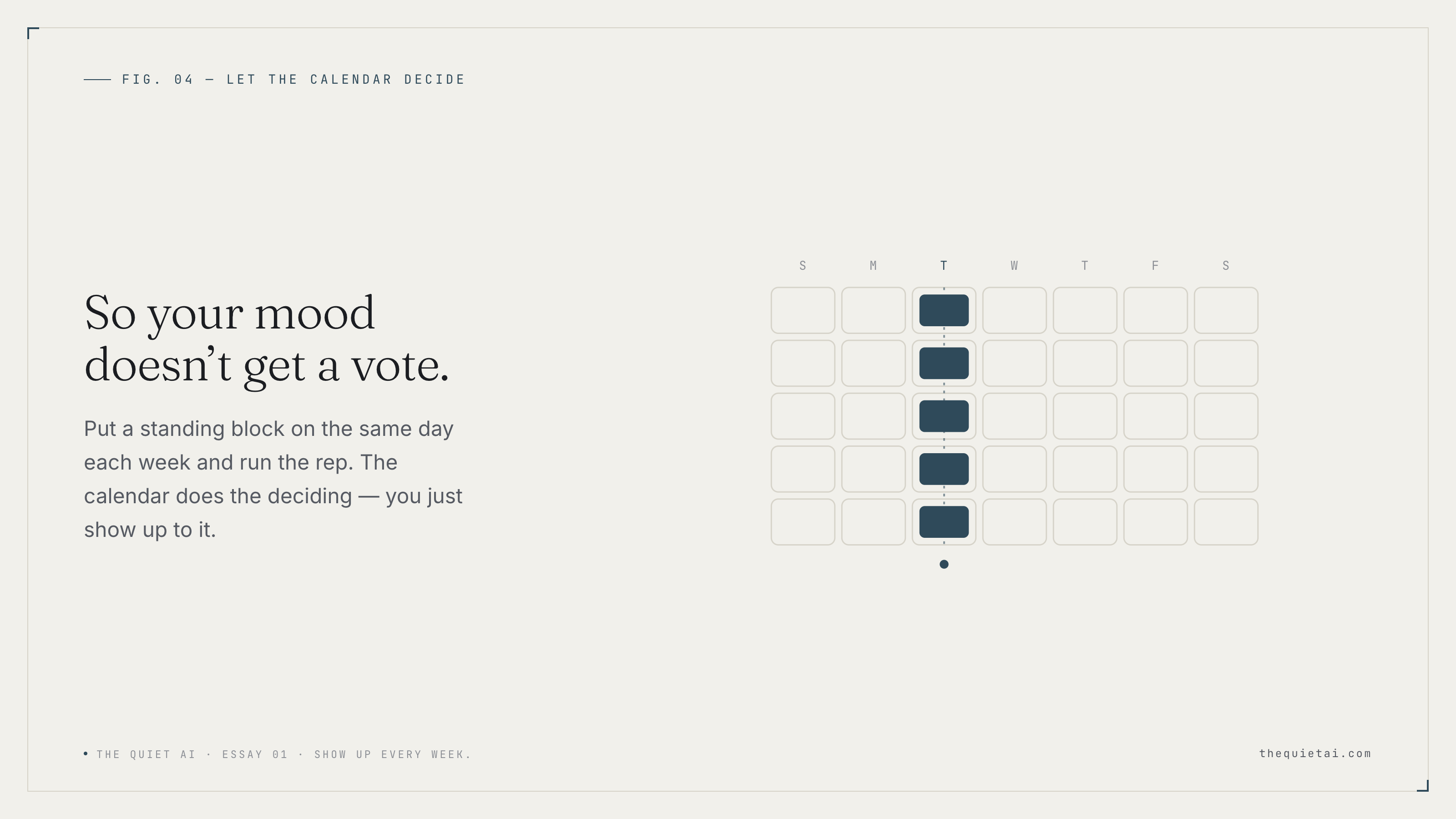
If you take one thing from this: before next week, invent one client and do one real piece of work for them. Finish it. Put it somewhere slightly uncomfortable — a post, a folder you’ll actually open again, a person whose opinion you respect. It will be thin. Do it anyway. Then put a standing block on your calendar for the same time next week and do it again. Let the calendar do the deciding, so your mood doesn’t get a vote.
That’s all of Part 1. The rest of this series is about what comes after the reps: encoding what you know so it scales, designing the system that runs it, the honesty that protects the whole thing, and what you turn into on the other side. None of it works without this part, which is why this part comes first.
If you want to see what the reps eventually build, not just the practice of doing them: The Operator’s Handbook walks through two finished ones, Nightwatch and Claimwise — both free, both forkable.