You Got Good at Prompting. That’s Not the Skill Anymore.
The habit that’s actually costing you time isn’t a bad prompt. It’s a good memory nobody wrote down.
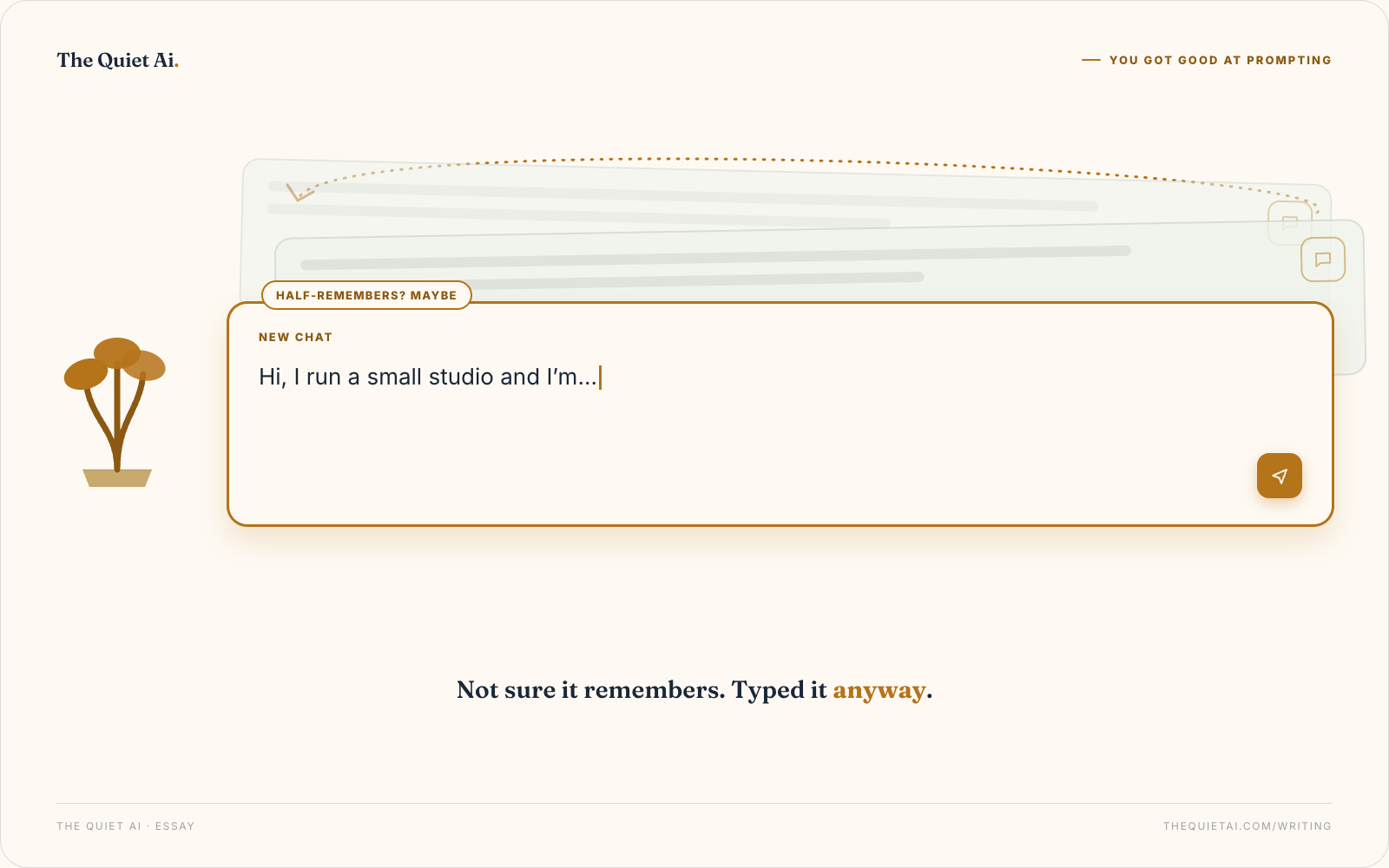
The AI tool you use most already remembers some things about you, on its own. That isn’t the fix. It might be worse than starting from zero, because at least zero was predictable.
I named this cost and stopped there, earlier this month. This time I don’t stop there.
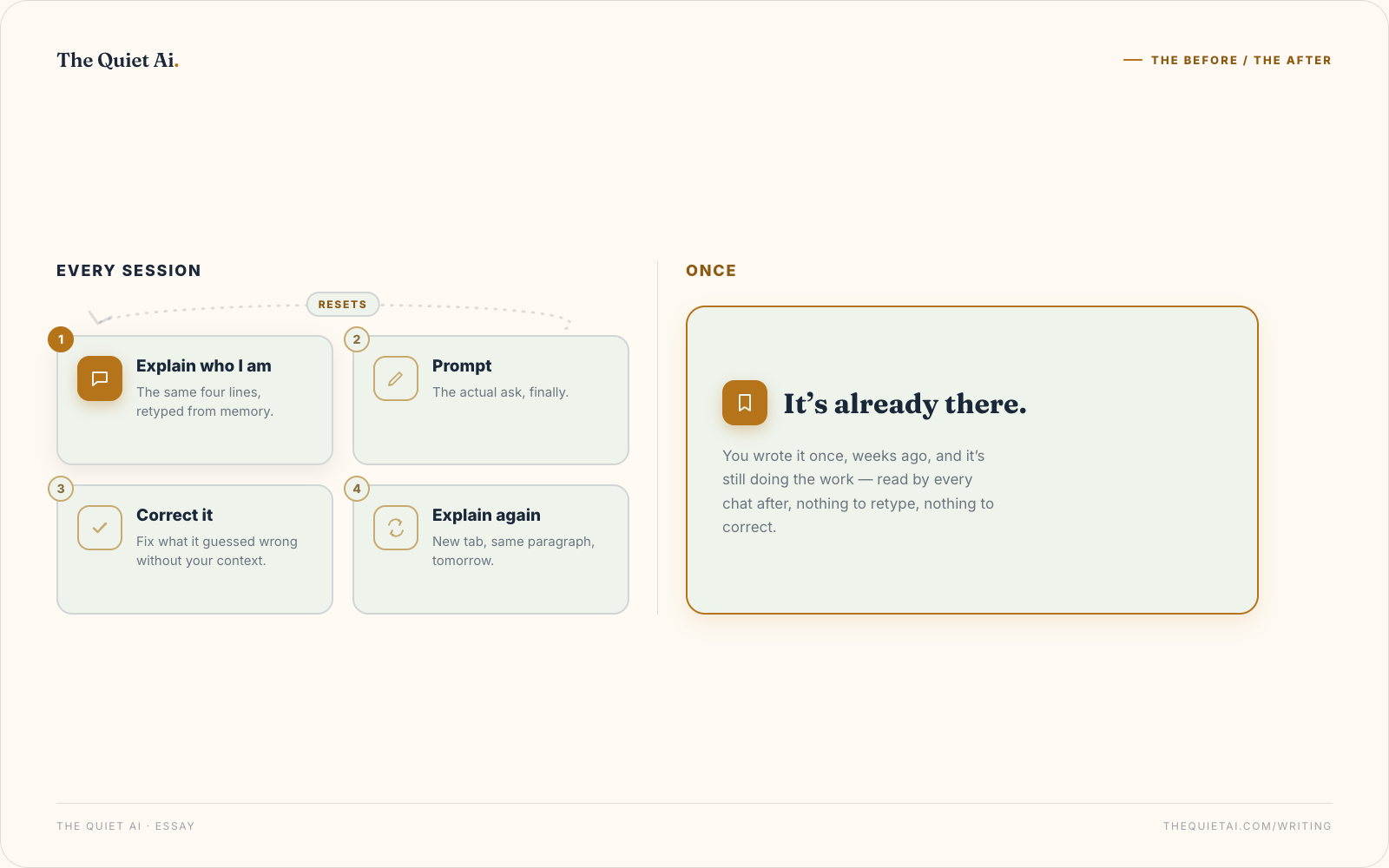
Say you run a small photography business. Every time you sit down to draft a client email, you open a new chat, and sometimes the draft already leans the right direction — a little like it half-remembers something from a conversation you had last week. More often it doesn’t, and you can’t tell which time you’re in until after you’ve read the reply. So you paste the same four lines anyway, just in case: what you shoot, who your clients are, how you like to sound in writing, which is casual, not corporate. You wait, and the draft that comes back is close but not quite you, so you rewrite the sign-off anyway and soften a line that reads too stiff. Call it ten minutes, gone, before you’ve written a single sentence you’ll actually send. You do this most days. You’ve started to think you’re just not very good at asking for what you want.
You are not bad at asking. You’ve been solving the wrong problem.
The tool isn’t guessing badly when it hands you something close-but-off. It’s carrying pieces of your last few conversations forward on its own terms, never telling you which pieces or whether this is the chat where they’ll actually matter. So you keep re-teaching it who you are anyway, just to be safe, and calling the reteaching “prompting.”
The problem was never your prompt. It’s that whatever the tool decides to carry forward was never yours to control.
Some memory is worse than none, because it’s inconsistent. What survives from one conversation to the next is the tool’s call, not yours — sometimes it’s the fragment that actually matters, sometimes it’s nothing useful, and you find out which only after you’ve already gotten an answer built on the wrong guess. Deliberate is a different thing entirely: you decide exactly what gets read, and it’s the same every time, not a maybe.
Most of the tools you already pay for have a second, deliberate place for that paragraph too — a project, a set of saved instructions, a memory setting, sitting in the interface right now, usually a tab or a settings menu you’ve scrolled straight past. Unlike the automatic kind, this one is entirely yours: you choose what goes in, and it reads the same way every time you open a new chat. Almost nobody turns it on, and it isn’t because it’s hidden. “Prompting better” is the skill everyone’s been told to practice, and “write it down once” doesn’t feel like a skill at all. It feels too small to be the fix.
It is the fix, and it’s exactly that small. Take the four lines you keep retyping — who you are, who you’re writing to, how you sound, the one thing you never want it to say — and put them somewhere the tool reads before you ask, once, instead of somewhere you retype every time you ask. Every new conversation you start from that place already knows the four lines. You’re not writing a better prompt. You’re not writing a prompt at all, for that part. You wrote it once, weeks ago, and it’s still doing the work. That’s the actual shift: the four lines stopped being part of the prompt and became part of the setup.
This doesn’t fix everything. The saved version doesn’t make every reply perfect: you’ll still catch a tone slip here and there, especially on a new kind of request the four lines never anticipated. It has a size limit, so it can’t become a dumping ground for your entire business; it needs editing the way any short document does, not one more thing you write once and never touch. And when something about your business actually changes — new offer, new voice, a client type you’ve stopped taking — the saved paragraph goes stale exactly like an out-of-date bio would, and nothing pings you to go fix it. This isn’t a switch you flip and never think about again. It’s closer to a bio you keep current, not a form you fill out once and forget.
What it does do is narrow what you’re correcting down to the genuinely new cases, instead of correcting the same tone slip on the same four facts, week after week, and mistaking that correction for the work.
You don’t need the tool to remember you. You need to be the one deciding what it’s allowed to use.
If you’ve been doing the weekly reps — showing up, making the thin thing, shipping it anyway — this is the one habit that makes each rep cost less than the last one: a five-minute setup, not a new discipline, that quietly un-taxes every rep after it.
So do this today, not next week: the next time you catch yourself typing something into a new chat that feels familiar, stop and ask two questions. Have you told it this before? Will you tell it again? If both answers are yes, that line doesn’t belong in the prompt anymore. Open the AI tool you already use most, find the project, the custom-instructions field, or the memory setting — it’s there, probably one click past where you’ve been stopping — and move it there instead. Write the four lines you keep retyping, paste them in once, and start every new conversation from inside that one place for the next seven days. Notice, specifically, how much less you’re correcting by Friday.
The models underneath these tools keep getting smarter every few months, and that was never the part costing you the ten minutes. The ten minutes was you, typing the same paragraph into a machine that was left to guess at what to carry forward. Decide where it lives instead of leaving that to chance, and the smarter model finally gets to work from the version you actually meant.
More of this, quietly, at thequietai.com.
Reading started this week with a seven-post prompting course, Wise Architects Corner, taught by a moderator going by Bas inside Jake Van Clief's Skool community. That’s an affiliate link — if you join through it, I get a small commission at no extra cost to you.
It didn’t shape this piece’s structure or its editing pass — a different set of essays did that, later the same day. What it did shape: the image format on this piece’s own visuals, and two small rules now built into how briefs and handoffs get checked in this operation, both in place before this article was even an idea.