I Thought I Was Automating YouTube. I Was Actually Removing Myself as the Handoff.
I wanted an AI worker to publish my YouTube videos. Three days into letting it run without me, I realized the interesting part wasn’t the upload. It was the moment after I said “approved.”
I started with what seemed like a small annoyance.
I make content.
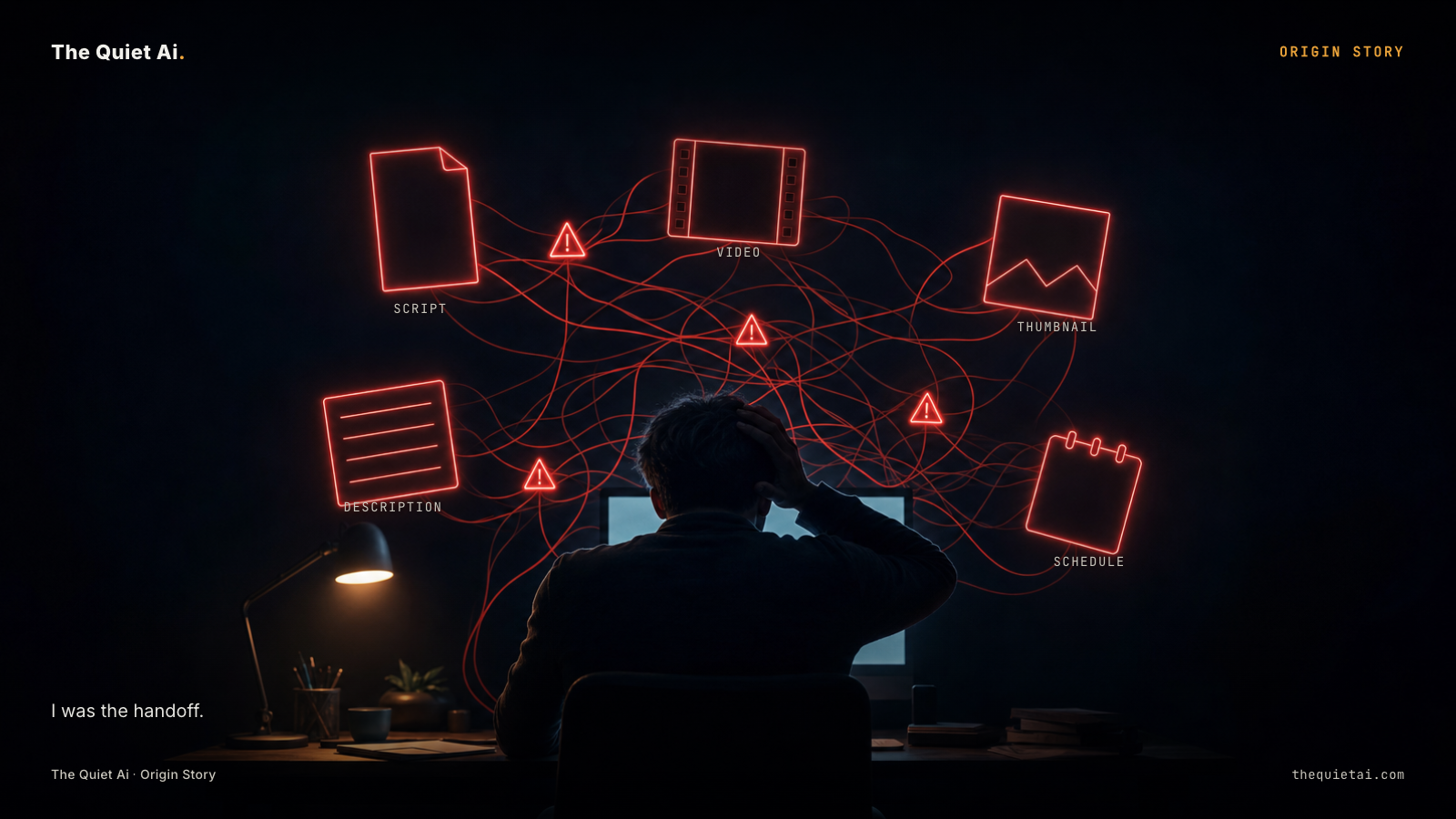
The script gets written. The video gets made. The thumbnail gets designed. The title and description get written.
And then somehow, after all of that automation and all of those tools have supposedly saved me time, I still have another job.
Go find the final video.
Find the right thumbnail.
Find the description.
Make sure I’m using the final title.
Open YouTube.
Upload.
Copy.
Paste.
Choose the playlist.
Set the publishing state.
Schedule it.
Come back later and make sure it actually happened.
None of this is particularly difficult.
That’s almost what makes it worse.
It’s just enough work to keep requiring me.
So I built something for that.
I call it Scribe Hands.
And I thought I was building a YouTube uploader.
I wasn’t.
Uploading turned out to be the easy part
Once you get through the backend setup — Google OAuth, permissions, YouTube API access, authentication, the correct channel and all the little details that have to be right — uploading a video programmatically isn’t particularly remarkable.
There are already tools that do it.
Some can upload a video, set the title and description, attach a thumbnail, schedule publishing and assign a playlist.
There are publishing platforms that will let you prepare a week’s worth of content and schedule the whole thing.
And there are even much more expensive systems claiming to operate large portions of a YouTube channel for you.
So at some point while I was building and researching all of this, I had to ask myself:
What exactly am I solving that isn’t already solved?
That’s when I noticed something.
Most of these systems begin with an assumption.
You bring them the stuff.
Bring the finished video.
Bring the thumbnail.
Bring the title.
Bring the description.
Tell it the playlist.
Tell it the publishing time.
Organize everything however that particular system expects it to be organized.
Then the automation takes over.
And that’s useful.
But I kept looking at that workflow thinking:
Wait. Why am I doing all of that?
I was still the integration layer
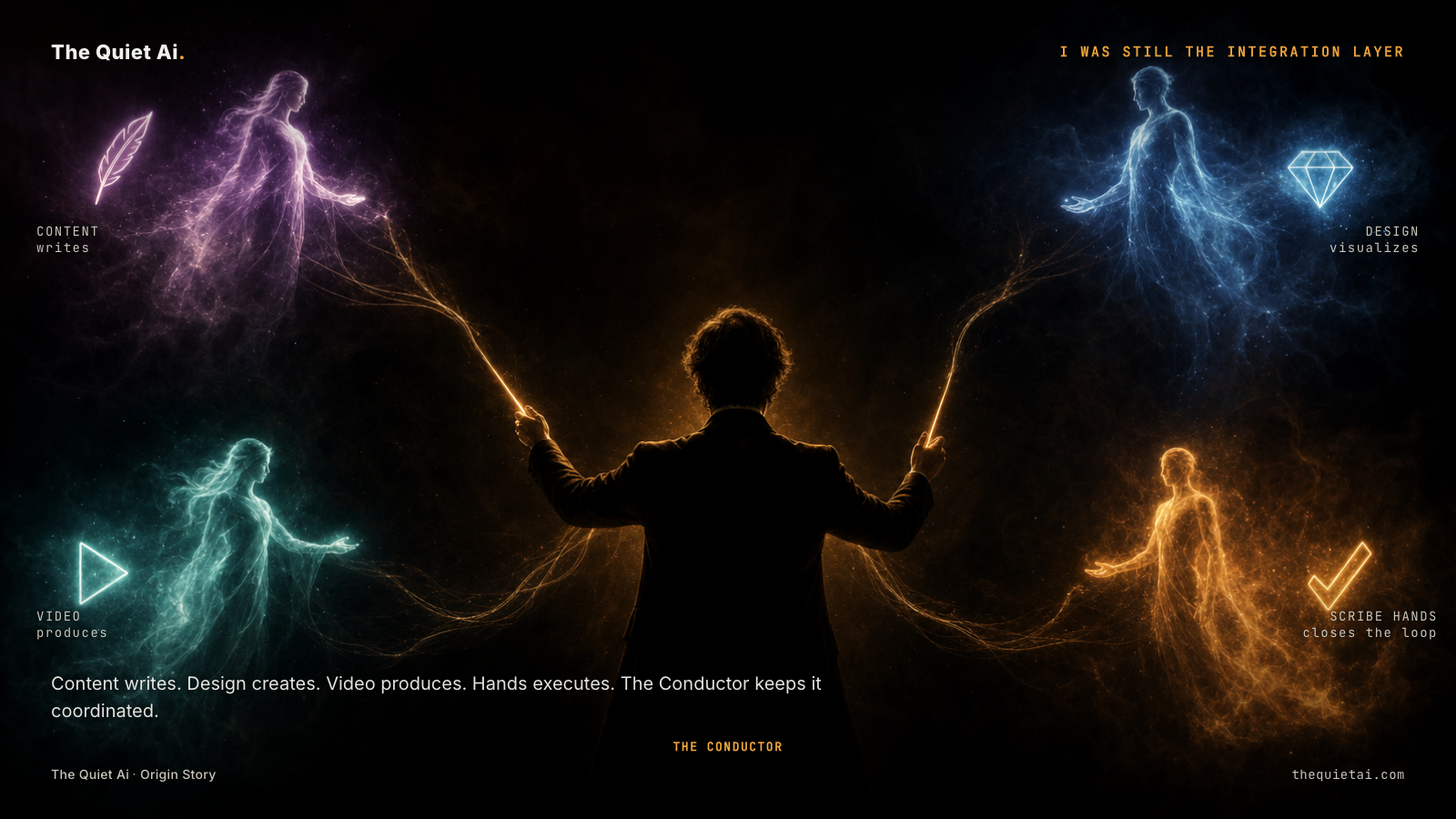
I’d already built a system for making this content. It already has a content worker.
It already has design.
It already has video.
It has a Conductor coordinating the work.
If we’re developing a video, the system already knows what that video is about.
The content worker was there when we developed the script.
Design was there when we worked through the storyboard and visual direction.
The video worker knows what it’s producing.
The Conductor knows how those pieces belong together.
So why would I finish all of that work inside one coordinated system...
...then pull everything back out...
...find the files...
...organize them...
...and explain the content all over again to another piece of software so that system can automate publishing it?
That’s when the problem became obvious.
I’d automated the click.
I hadn’t automated the handoff.
Worse than that:
I was the handoff.
The human was still acting as middleware between systems that were supposedly automating the work.
The user shouldn’t have to become the API between their own AI workers
That became the architectural question.
What happens if the context doesn’t stop moving?
If Content creates something, Design shouldn’t need me to re-explain what it is.
If Design creates the visual direction, Video shouldn’t need me to reconstruct it.
And when the finished work reaches Scribe Hands, Hands shouldn’t ask me to build a neat little publishing package containing everything the other workers already know.
It should inherit the work.
That’s a very different idea.
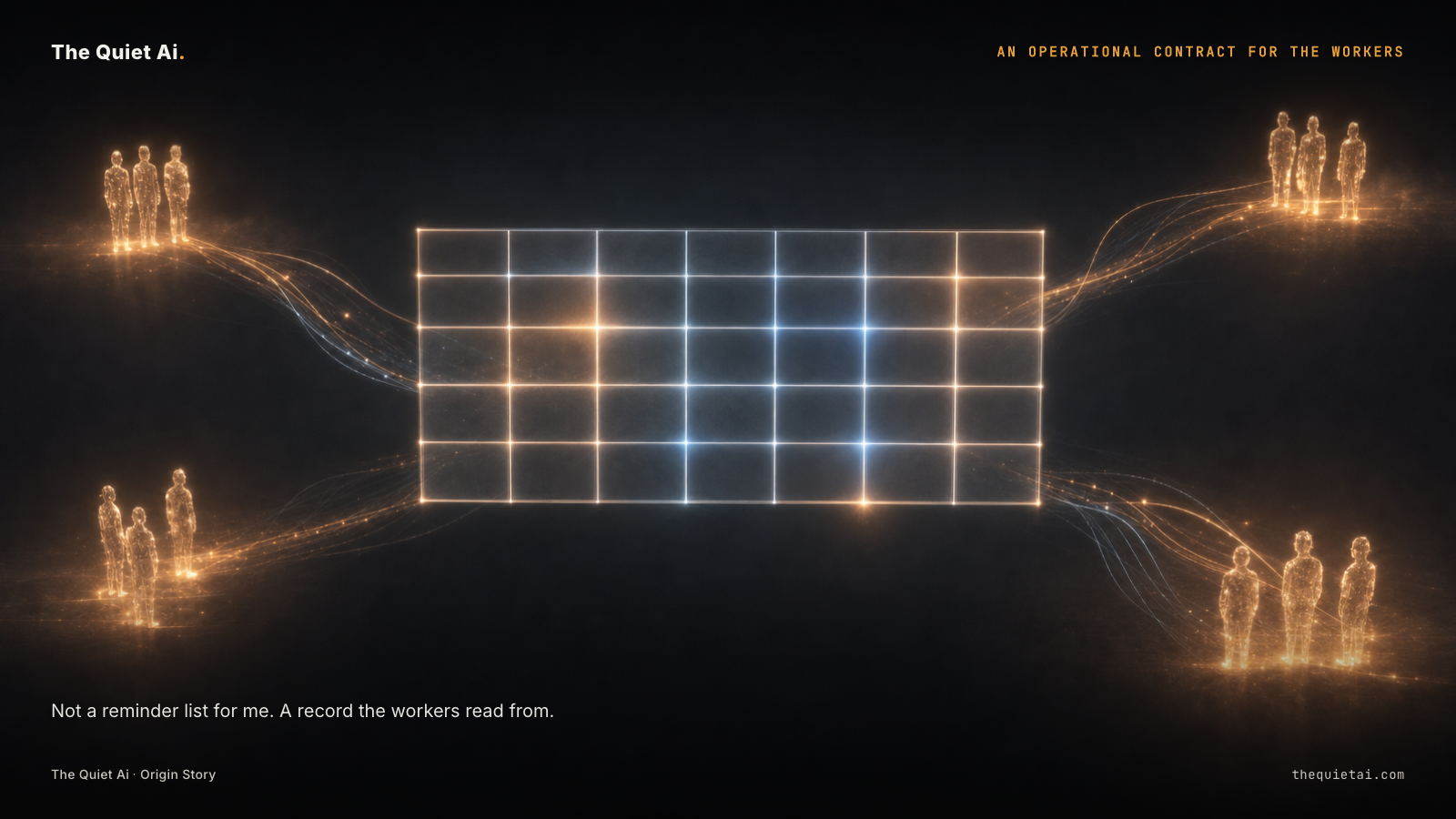
The calendar became part of that architecture.
It’s not just a list reminding me what I’m supposed to post.
It’s an operational contract for the workers.
The Conductor and the other workers establish what is being produced, what belongs together, when it should happen and what has been approved.
Scribe Hands can read that same organized information.
So Hands doesn’t need me to return on Wednesday and say:
“Okay, this is Wednesday’s video. Here’s Wednesday’s thumbnail. Here’s the description. This one goes into this playlist.”
The organization already knows.
Let it execute.
Then I realized something else: approval is different from assembly
This is the part I initially misunderstood about automation.
I don’t actually want to remove myself from the process.
There are decisions I want to make.
If we’re planning seven videos for the week, I want to see the scripts.
I want to see the storyboards.
Maybe I don’t like number four.
Maybe the hook on number six is wrong.
Maybe the thumbnail direction on number two isn’t what I had in mind.
Change it.
Show it to me again.
Good.
Approved.
That’s not a failure of automation.
That’s my job.
Think about a functioning company.
The writer writes.
The designer designs.
The video team produces.
Someone responsible for the direction reviews the work, changes what needs changing and approves it.
But after approving the campaign, the CEO doesn’t say:
“Great. Everyone send me your files so I can organize them into folders and personally upload them to YouTube every morning this week.”
The organization executes.
And that became the boundary I wanted for the whole workflow.
Human judgment before approval.
Machine execution after approval.
Not because the human is unnecessary.
Because the human shouldn’t be doing work that doesn’t require human judgment.
“Approved” should mean something
That changed how I thought about the whole workflow.
I can sit down and work through a week’s content.
Content develops the scripts.
Design lays out the storyboards.
I review them.
We change things.
We argue a little.
We make them better.
Eventually I reach:
Yes. These are the ones. Make them.
That should be the moment my operational responsibility ends.
The video worker can make the videos.
Design can create the thumbnails.
Content can finish the descriptions, titles and other written material.
The Conductor can keep the pieces coordinated.
The calendar can carry the publishing intent.
And Scribe Hands can take the work from there — upload it, apply the correct information, organize it into the appropriate playlist, handle the publishing state and verify that YouTube actually did what was requested.
I don’t need to collect those outputs afterward.
I don’t need to move them into another system.
I don’t need to remember which thumbnail belongs to which video.
I don’t need to become the project manager of the automation I built to stop project-managing.
I already approved it.
Let the workers work.
And this week, I stopped opening YouTube
This is where the experiment stopped being theoretical for me.
I’m writing this on Day 3 of the first real independent run.
The publishing calendar was prepared.
The information the worker needed had already been created upstream.
And then I stopped managing it.
For the last three days, Scribe Hands has been picking up the scheduled work, locating the information associated with it, pulling the descriptions and thumbnails, and handling the YouTube publishing without requiring me to return and assemble everything for it.
And perhaps the strangest measure of success is also the simplest:
I haven’t had to worry about YouTube.
I haven’t been thinking:
“Oh, I need to upload today’s video.”
The work was approved.
The organization had the information.
The worker did its job.
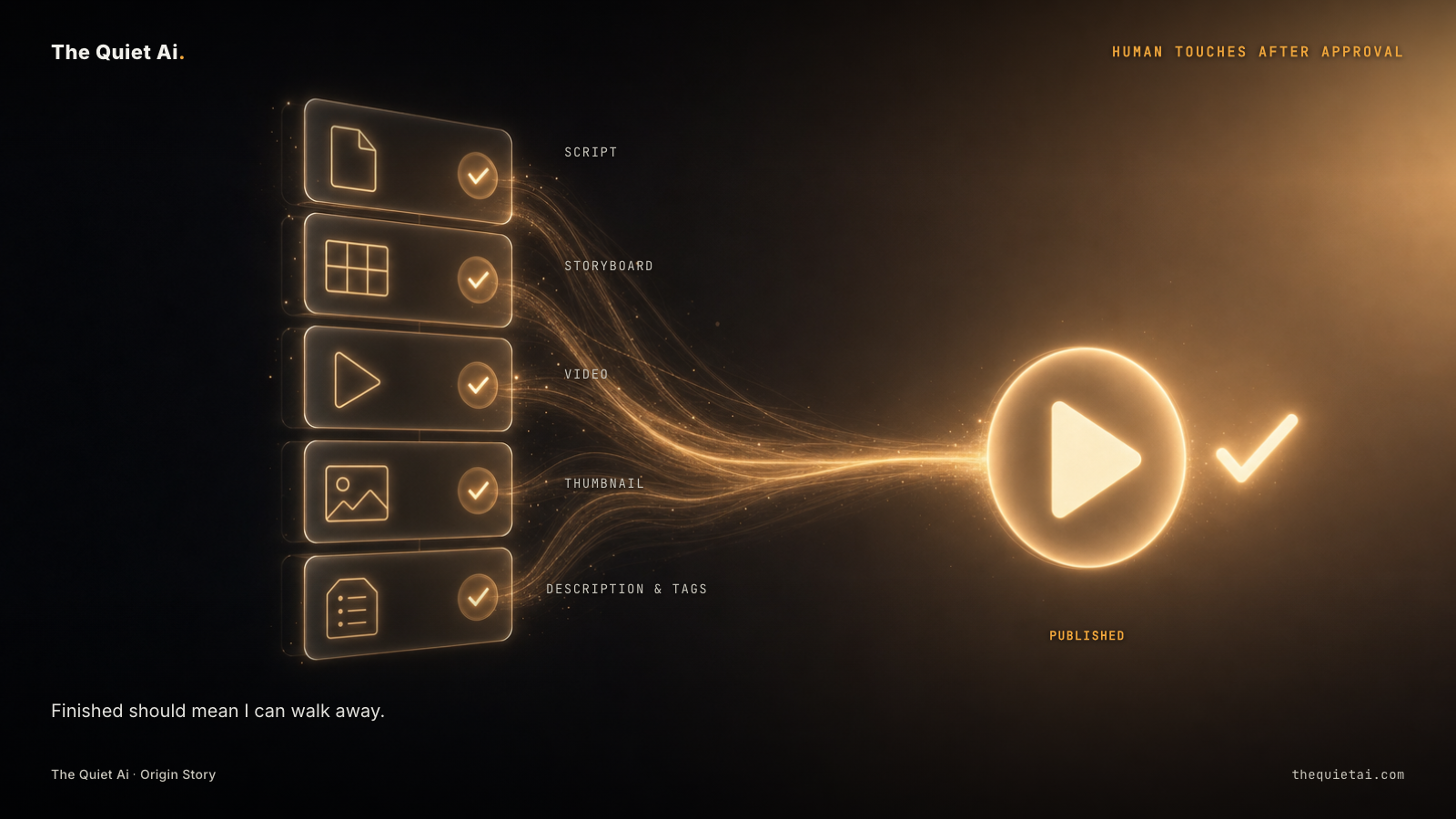
I’m still watching the experiment, obviously.
It’s only Day 3.
Something could break tomorrow.
In fact, eventually something will break, and I’m equally interested in what happens then.
Can the worker recognize the failure?
Can it recover?
Does it know when reality doesn’t match the instruction?
When does it need me?
Those questions matter more to me now than whether an API call can successfully upload an MP4.
Next week is the test I’m really waiting for
This week’s experiment is proving that Scribe Hands can take an already-organized publishing calendar and execute it independently.
Next week goes further.
This week, I’ve been working upstream.
I’ve been looking at the video ideas.
Content has been developing the scripts.
Content and Design have been laying out the storyboards.
I’ve been reviewing them.
Changing things.
Approving them.
And when that work is approved, I want to stop.
Not stop caring.
Not stop checking quality.
Stop operating.
The workers should now take those approvals and carry them forward.
Video gets produced.
Thumbnails get produced.
Descriptions and titles get finalized.
The calendar carries the instructions.
Hands publishes.
YouTube becomes the destination, not another workplace I have to visit.
If that works, then the experiment has moved considerably beyond:
Can AI upload my YouTube videos?
How far can approved intent travel through an organization before the human has to touch it again?
That’s a much more interesting question.
It doesn’t mean everything has to be planned
Real content doesn’t always begin neatly inside a weekly calendar.
Tomorrow I might pick up a camera because I suddenly have something I want to say.
Fine.
I record it.
Now that becomes the beginning of the workflow.
I can hand the video over.
Explain what I’m trying to communicate.
Let Video work on the edit.
Let Content develop the title and description.
Let Design create the thumbnail.
I can still review everything.
I can hate the thumbnail.
Change it.
I can dislike the edit.
Change it.
I can rewrite a sentence.
That’s the point.
I’m not trying to build a system where I’m forbidden from touching my own content.
I’m trying to build one where, when I finally look at the work and say:
Yes. That’s finished.
I am actually finished.
I shouldn’t then have to export everything, rename everything, find everything, match everything, upload everything and explain everything to the next tool.
The context already exists.
Use it.
For now, I’m watching the number that matters
Not uploads.
Not API calls.
Not how many AI workers I can put on a diagram.
I’m watching this:
Human touches after approval.
If I approve seven pieces of content and seven correctly produced, packaged, published and organized videos appear on YouTube...
...and the number of times I had to step back into the operational process was zero...
that tells me something.
If the number is three, that tells me something too.
Those three interventions become the next problems to solve.
Because I think I’ve finally found the boundary I’m actually interested in.
The human decides.
The human creates.
The human changes direction.
The human approves.
Then the organization executes.
The human shouldn’t have to become the API between their own AI workers.
And when I finally say finished, I want that word to mean something.
Finished should mean I can walk away.