The Myth of the Clean First Draft
Where the material actually comes from before it looks like anything.
I used to think a first draft, even a bad one, was supposed to look like writing. Rough sentences — sure. But sentences. Something you could hand someone and say, here, an early version.
My actual first draft didn’t look anything like that.
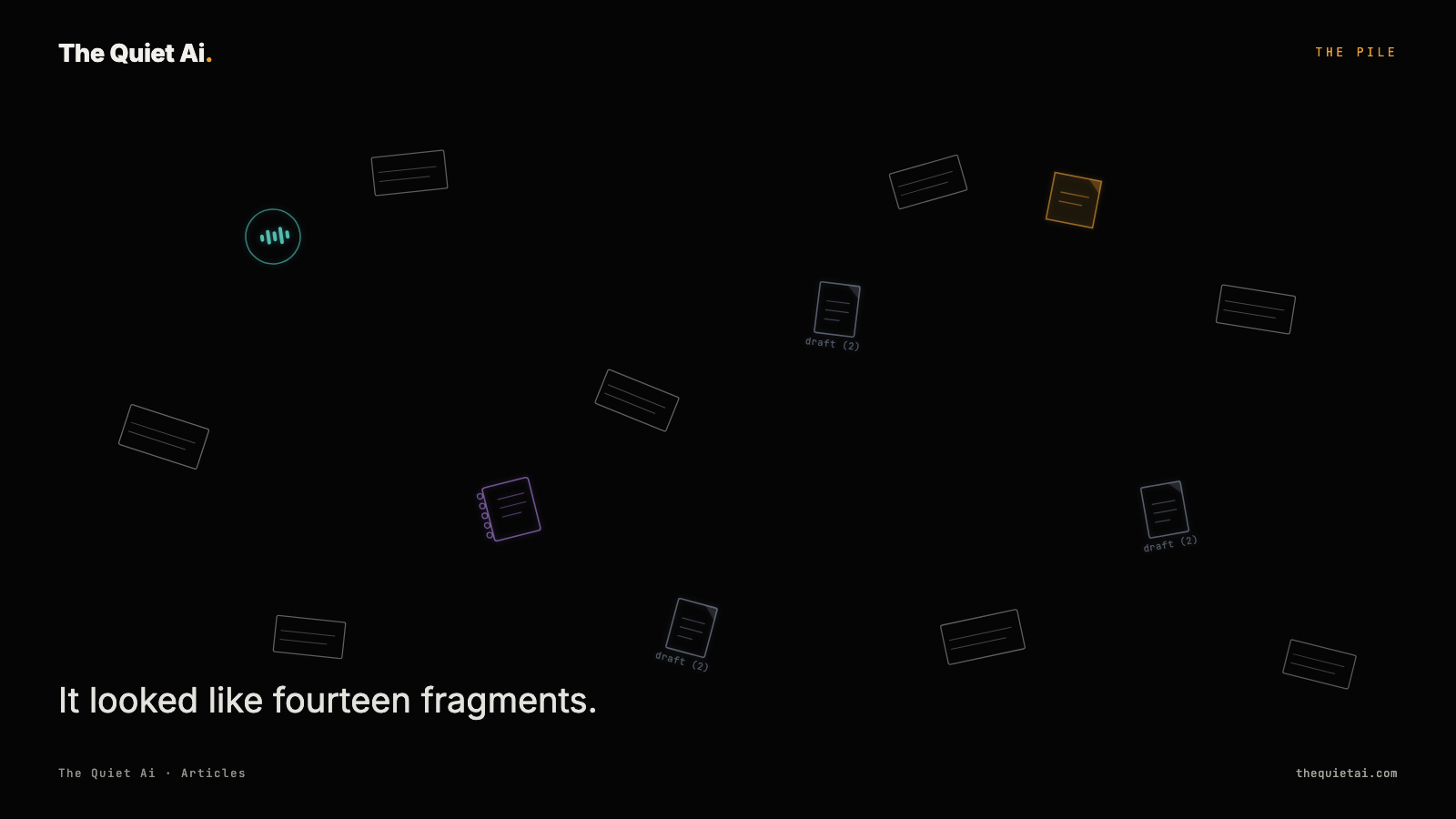
It looked like fourteen fragments scattered across whatever was closest when the thought showed up — a voice memo recorded walking somewhere, a sticky note, a notebook I can no longer find, three Google Docs all named “draft (2)” because I’d started over so many times I’d stopped bothering to rename them. Some of the fragments weren’t even sentences. One of them reads, in full: the right TOOL. it begins with. realizing it is possible. I couldn’t tell you today which thought that was supposed to finish.
Call it a pile before you’d ever call it an outline. It doesn’t even qualify as notes, really — a note implies somebody organized it on the way in. This was just whatever got left behind after thinking about the same problem on fourteen separate nights.
The part I had backwards
For a long time I told myself the reason none of it had become a real draft was a discipline problem. If I just sat down with fewer distractions, or picked a better hour, the fragments would sort themselves into something that read like a chapter.
They wouldn’t have. I’ve carried most of these thoughts for years — some of the fragments predate the book I’m supposedly writing with them. What’s actually been missing, late at night with a laptop open and a notes app full of half-sentences, isn’t willpower. It’s the mental room to untangle fourteen loose scraps into any order at all, on top of everything else that hour is already asking of me.
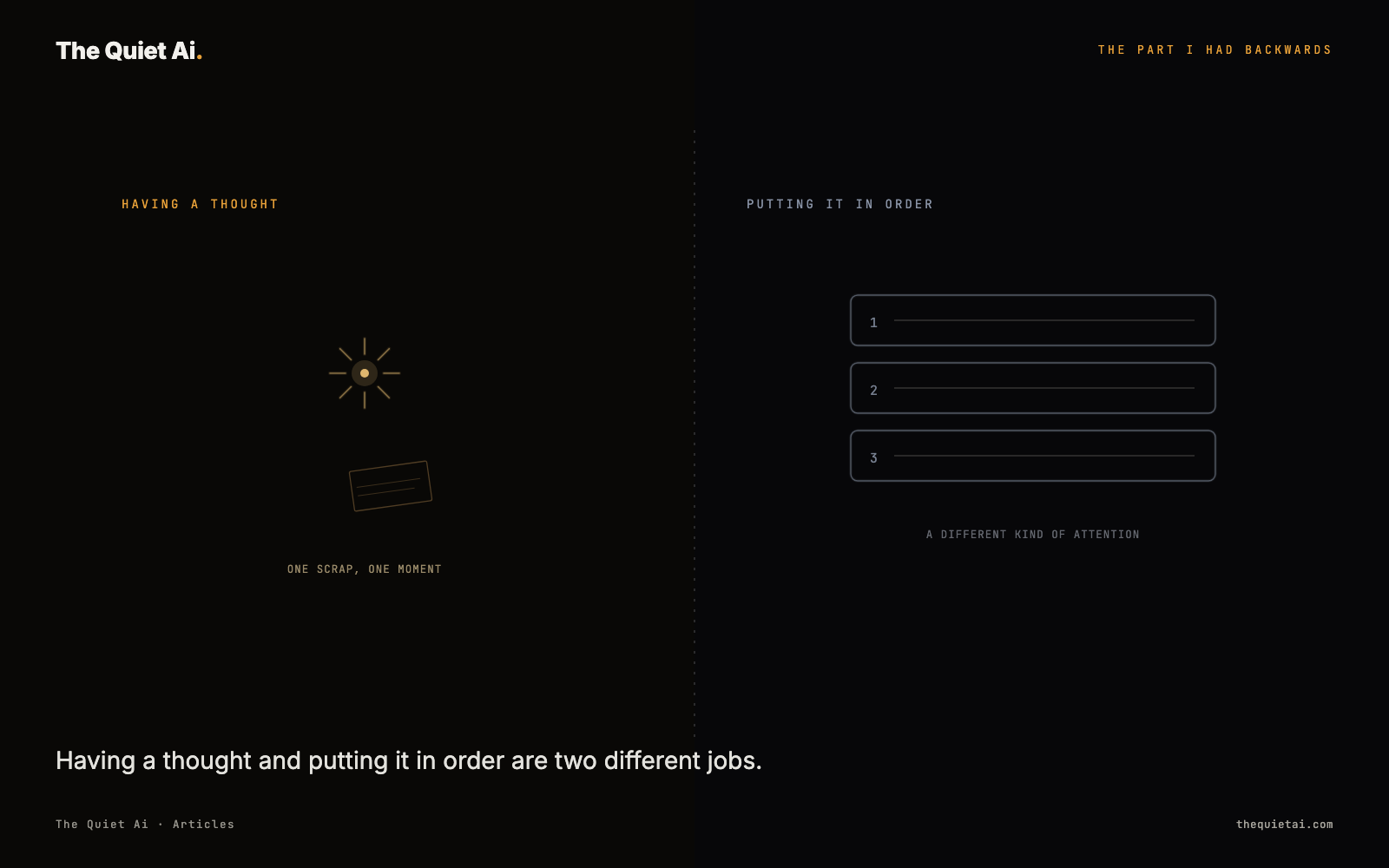
That’s the part I had backwards. Having a thought and putting it in order are two different jobs, done at two different times, and I kept scheduling both for the same sitting — which meant I usually did neither. I’d open the pile, feel the size of it, and close the laptop instead. Not because I didn’t have a book. Because sorting a pile and writing a page take a completely different kind of attention, and I was always trying to do both at once, at the worst possible hour for either.
What actually happened
What changed wasn’t that the fragments got better. They didn’t. The fourteen scraps I eventually looked at again were the exact fourteen scraps I’d typed in the first place, several of them still barely parsing as sentences.
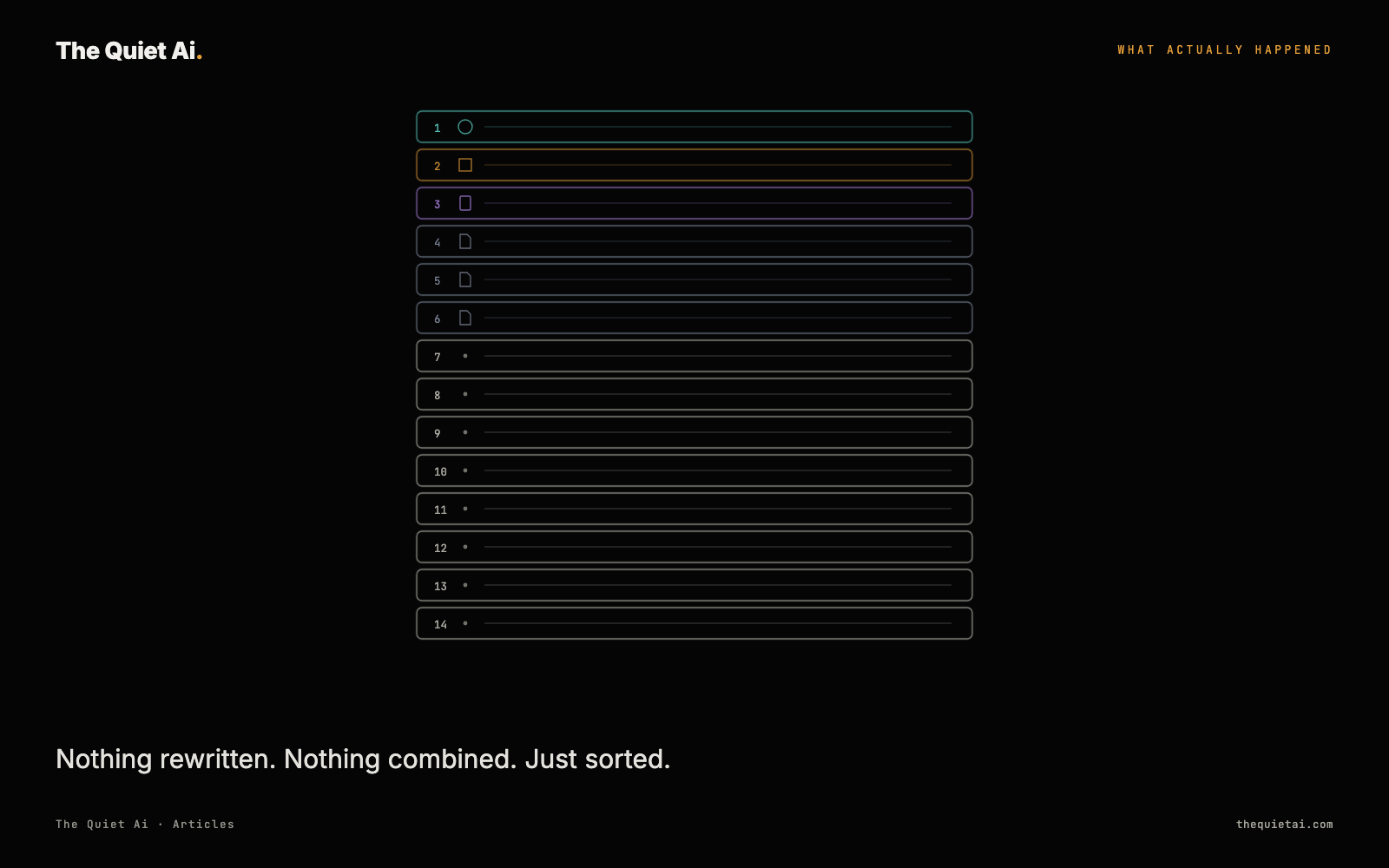
What changed was that they stopped being a pile and became a list — the same fourteen fragments, same words, now sitting in the order I’d have put them in myself if I’d ever had the patience to sit down and do it by hand. Nothing got rewritten to get there. Nothing got combined, and nothing got quietly improved into something that sounded more like a finished book. A stray line about designing the cover first ended up sitting near a different, older line about needing the right tool to even begin — two fragments from two separate nights, months apart, that I’d never once noticed were circling the same problem until they were finally next to each other.
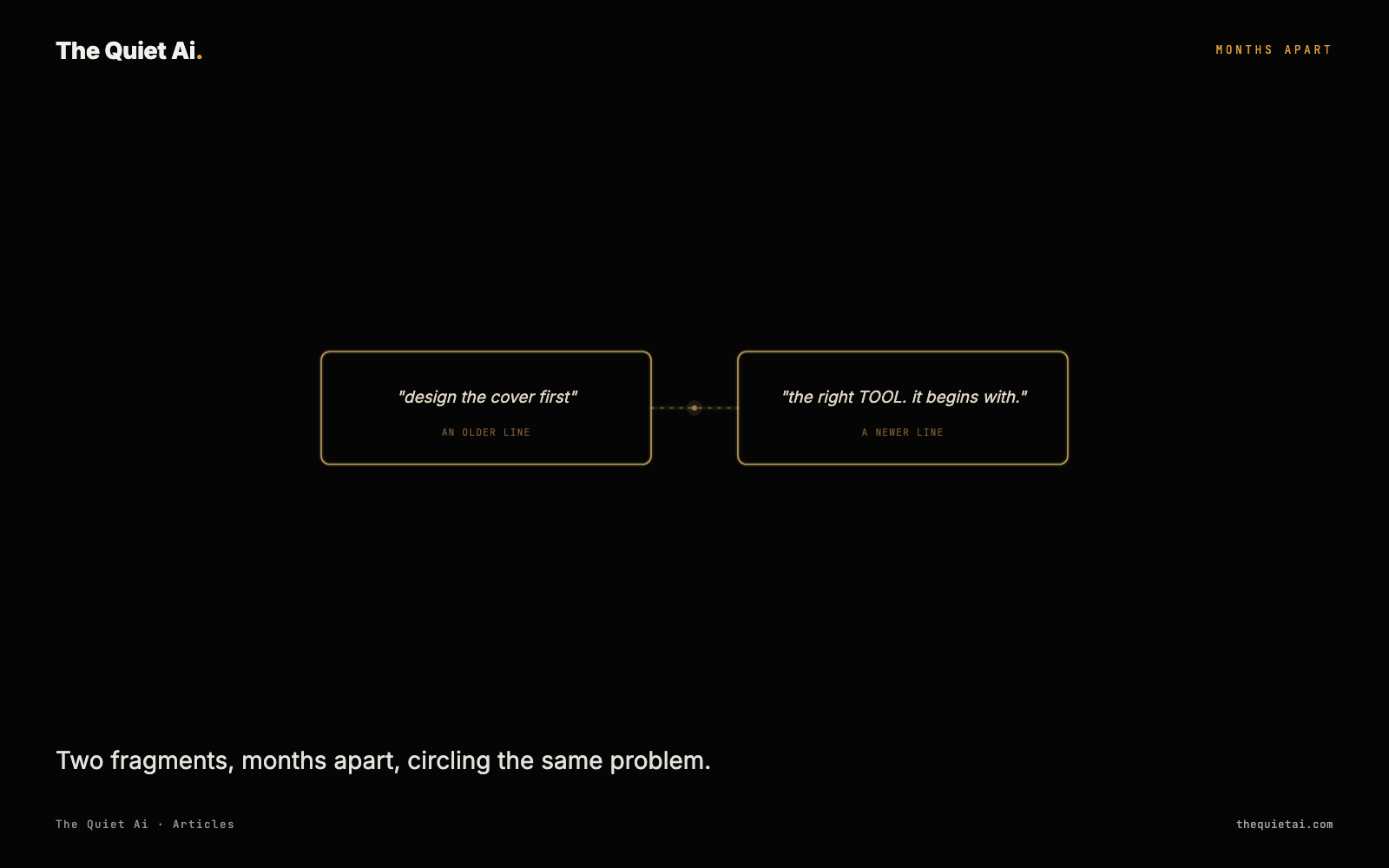
That’s a far more modest thing to say happened than “it wrote my draft.” Nobody decided what the chapter was about, or noticed that two of the fragments quietly disagreed with each other, or cut the one that didn’t belong. I still had to do every one of those myself, the same as always. What changed is that I could finally see the fourteen pieces clearly enough to start.
The myth, stated plainly
Here’s what I think the “clean first draft” idea actually does to people: it puts the ordering step before the having-thoughts step, as if real material is supposed to arrive already knowing what it’s for. Then when your own notes show up looking like fourteen unrelated scraps instead, it feels like evidence you did something wrong — like a real writer’s material would already resemble a book, and yours doesn’t because you’re not one yet.
It doesn’t work that way for anyone, at the stage mine were at. The mess isn’t a sign the material is bad. It’s what real material looks like before anybody — including the person who wrote it — has had a chance to see it as more than one scrap at a time.
What’s still true
I want to be honest about the part this doesn’t solve. Sorting fourteen fragments into a line didn’t write a chapter. It didn’t decide which fragment survives the next pass and which one gets cut — some of the fourteen still might not make it. What it did was remove the one thing that was actually stopping me, and it wasn’t the writing. It was the size of an unsorted pile at eleven at night, and the fact that sorting it and writing it were never the same job to begin with.
The draft that came out the other side isn’t clean. It’s ordered, which turns out to be the thing I actually needed, and the thing I’d been quietly asking a blank page to hand me instead.
More of what I’m building, slowly and honestly, at thequietai.com.