The Week the Method Checked Itself
Nine captions were retelling their own storyboards. The fix, and the test it led to, both went out the same week — on the record, whichever way the test landed.
The week of September 7, before the next batch went out, someone on the team opened the captions that had actually shipped — not just the brief that had ordered them — and found something worth stopping the line for. Nine short-form captions were retelling the same beats their own storyboards already showed. One of them described a hand re-typing, a quick cut, a line said under someone’s breath — everything a person watching the video could already see — then added one reflective sentence and called it finished. Someone who watched the clip learned nothing new by reading on. Someone who couldn’t watch it, muted in a feed, got a recap instead of a reason to stop scrolling.
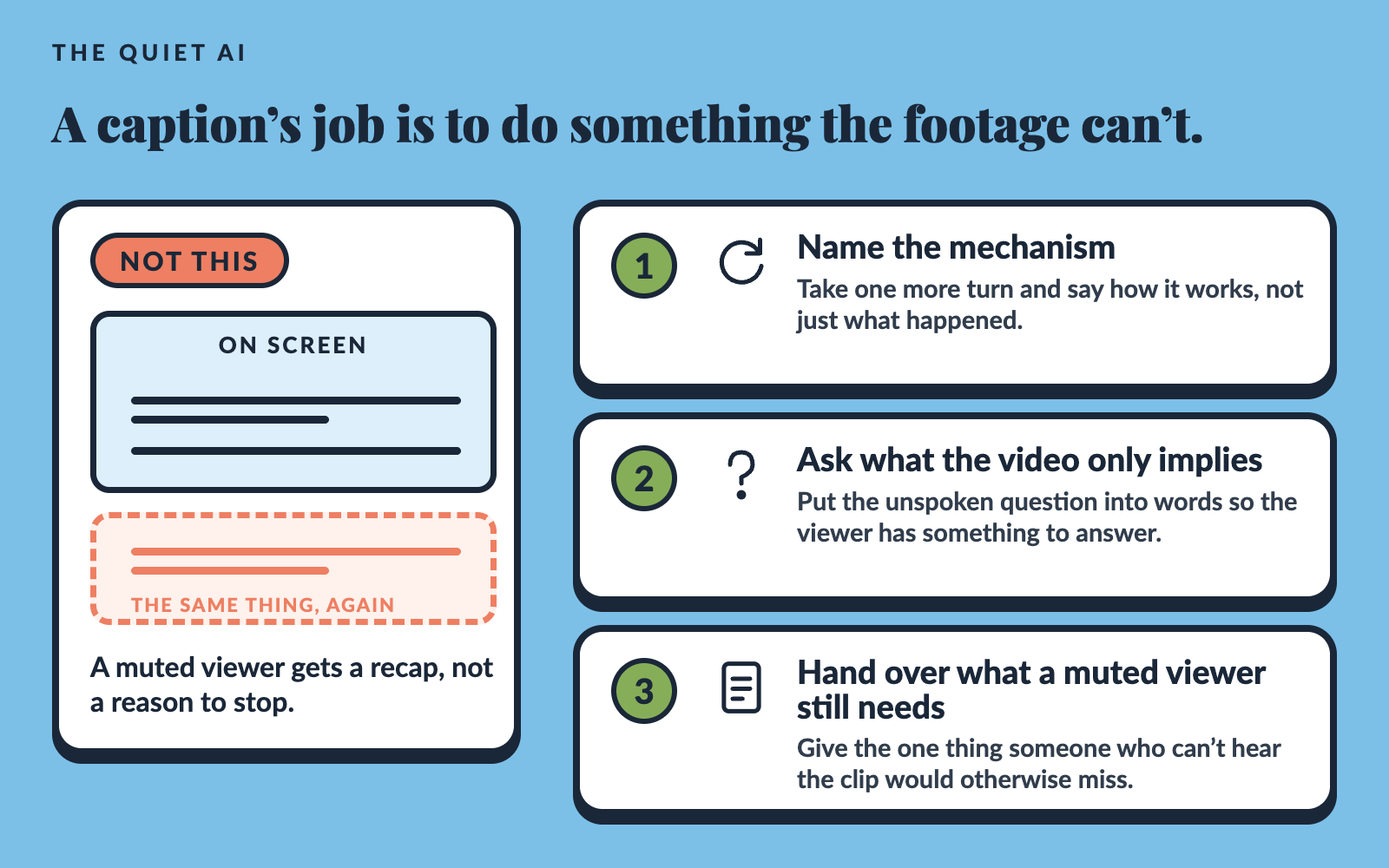
The fix got named the same day: a caption’s job isn’t to describe what’s already on screen. It’s to do something the footage can’t — name the mechanism in one more turn, ask what the video only implies, hand over the one thing a viewer who can’t watch still needs. Then the correction got tested against the hardest case immediately, not eased in. A full batch went out under it — sixteen short-form pieces (nine shorts, two carousels, three tips, two insights) plus one longer piece, each built to open and close on its own shape instead of one scaffold with new words dropped in. One short states a count and lets it resolve into its own finished sentence, no trailing question. Another opens on a claim about “fresh” and closes on an image of wear instead. A recap closes by holding a quote and adding nothing after it. Six different closing shapes across those sixteen — because the same mistake had already shown up once, on the visual side, a few days earlier: one fixed template, new words, mistaken for variety. Nobody wanted to repeat it in prose.
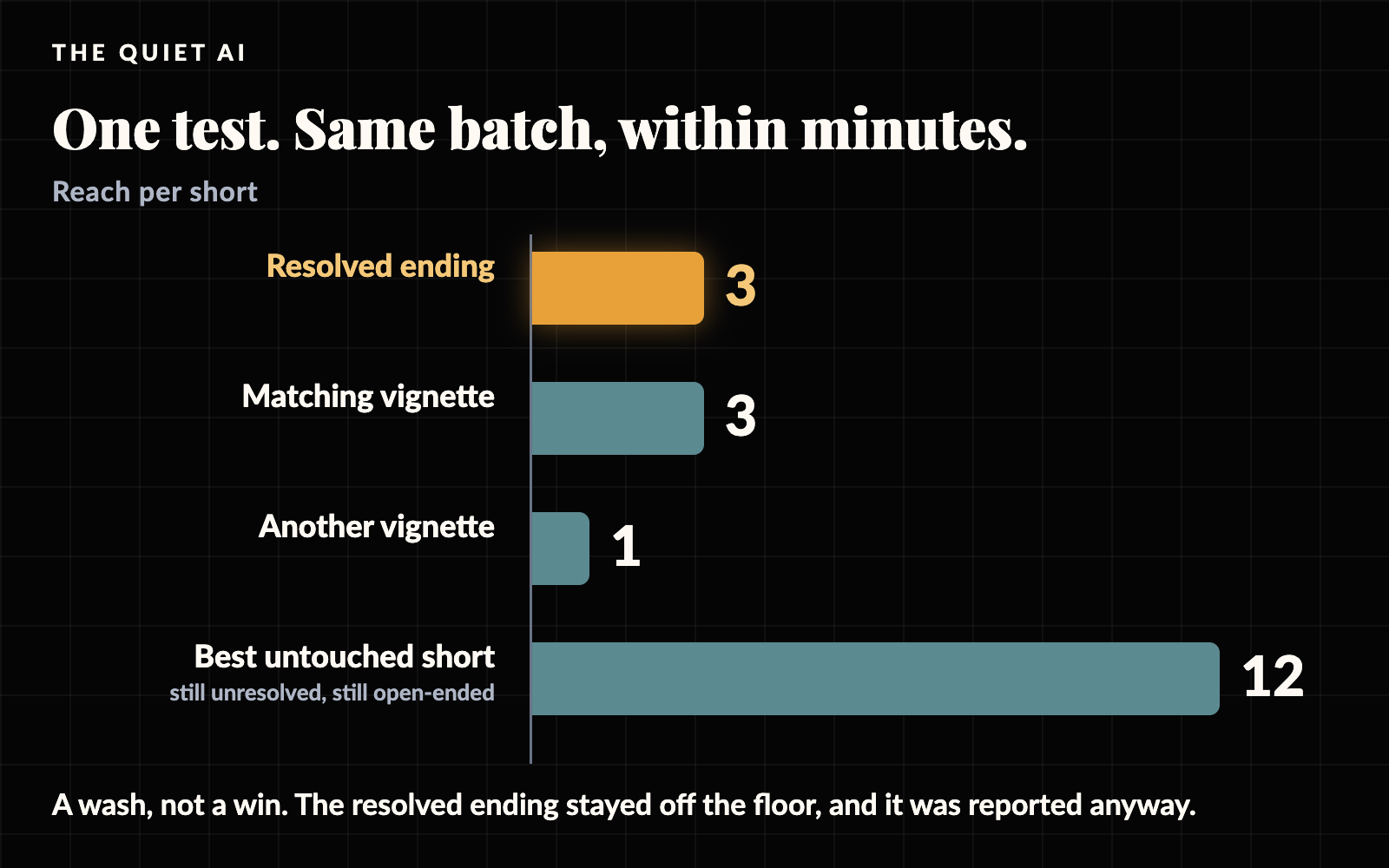
One of the sixteen carries its own experiment. Every short that week resolved nothing on purpose — an open scene, tension left standing, is the account’s actual register. One short breaks that on purpose: it opens on a declared count of tabs, narrows them on screen as each one repeats or contradicts the last, and closes on the one that’s left standing — no trailing question, unlike everything around it. The hypothesis behind that swap came from two real places: a reach analysis of this same account, showing one format had never once dropped to zero reach, and a teardown of an unrelated channel that found completion — watching a stated task actually close, not just imply it will — doing real work in what got pushed. The other eight shorts around the test stayed exactly as unresolved as they’d have been anyway, on purpose, because the comparison means nothing if the baseline gets touched to make the test look better. The post went up — Six Tabs, One Real Answer — and the honest read of the result is a wash, not a win. It pulled six views and a reach of three, posted in the same few minutes as three of that batch’s untouched vignette shorts: one matched it at a reach of three, one came in lower at one, and the best-performing short in that same run — still unresolved, still ending on an open question — pulled a reach of twelve, four times the resolved version’s number. The floor held; it didn’t drop to zero, which is the one part of the hypothesis this single post could actually confirm. It didn’t show the lift the completion hypothesis was testing for. At six total views, that isn’t a large enough sample to call a winner either way, and saying otherwise would be exactly the kind of spin this piece is arguing against. One test, one wash — a process that only ever reports the wins wouldn’t be the one this piece is describing.
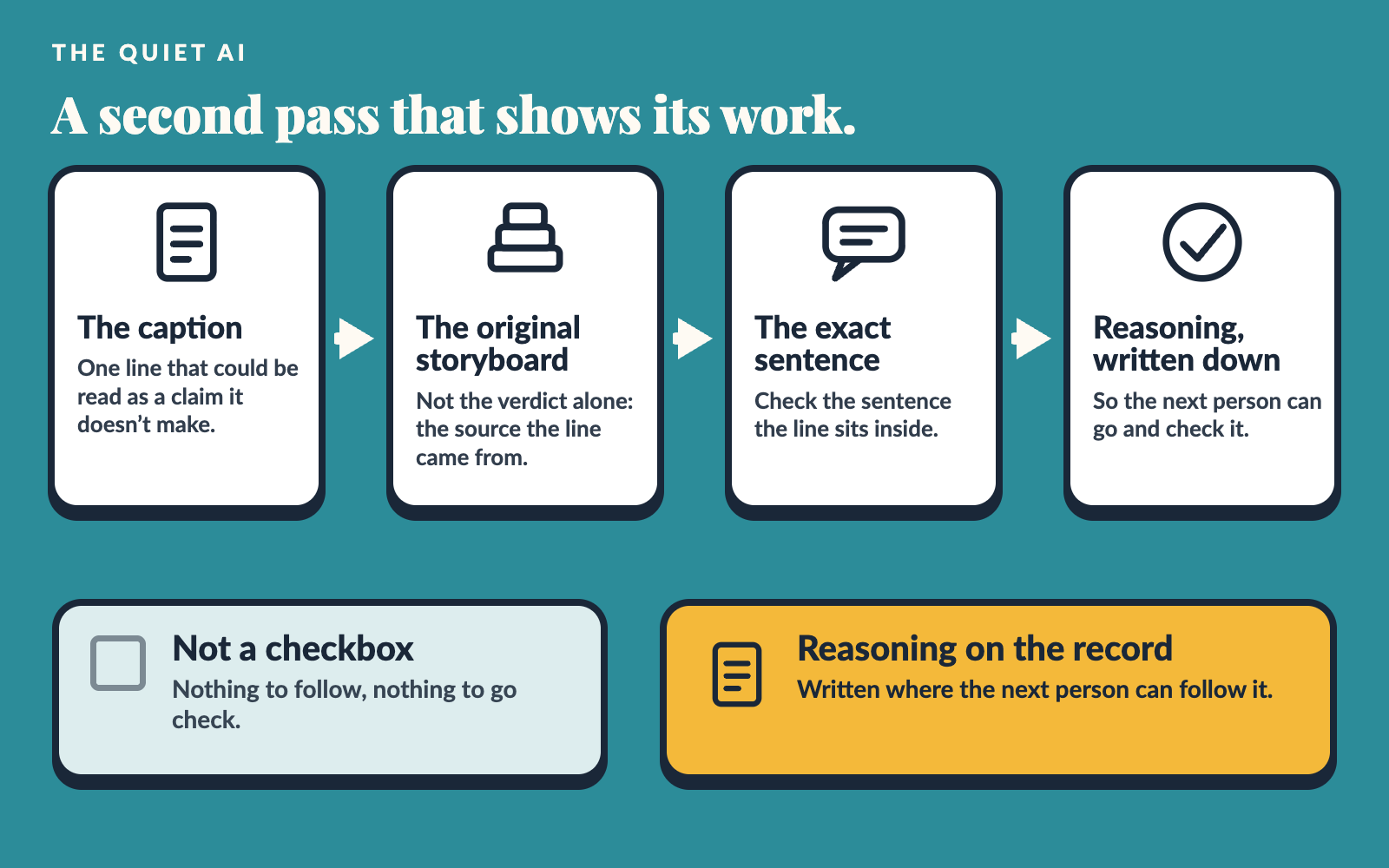
Every piece that week also went through a second pass before anything ships, and it isn’t a rubber stamp. One caption used a detail that wasn’t in its own storyboard — the client’s own unawareness, not just the founder’s side of the exchange. Read on its own, one line in it could misread as a claim about a tool that updates itself automatically. The pass didn’t wave that through on a bare verdict. It went back to the original storyboard, checked the exact sentence the line sits inside — “getting re-briefed before he can even open the message” — and reasoned out that the labor being described is manual and blocking, the same cost the rest of the week’s pain beats describe, not a benefit wearing a disguise. It passed, with the reasoning written down where the next person can go check it, not just a checkbox next to it.
None of that is a claim anyone has to take on trust. Pulled off each platform’s own numbers on September 19 rather than a log of what got scheduled: forty-seven videos live on the channel, nineteen hundred and thirty views across those forty-seven videos; a hundred and eighty posts on the account, forty-two hundred and forty-two views, thirty-five hundred and fifty-three reach, forty-nine likes, thirty-two comments. Those are the account’s running totals, not the week’s alone. Monday’s first short from the week of September 7 is still up — He’s Explaining Himself. Again. — and so is Tuesday’s follow-up, the one about finishing instead of starting. Anyone can open either link and check the caption against the actual video it was written for.
What’s actually being demonstrated is narrower than “look how good this content is” — that’s a taste claim, and nobody needs to believe it on my say-so. It’s this: the same team-of-digital-workers method runs our own channel, catches its own drift in the middle of a real week, and leaves the correction and the reasoning both on the record instead of quietly fixing it and moving on. That’s not a statement about the output. It’s a statement about whether the process holds up when nobody’s watching it but the people running it. That week, on this account, it did. The links are right there — go check them.
More of this, honestly, at thequietai.com.