The Cover Card Is a Lie Detector
I built a script that refuses to save a video’s cover art until the headline fits in two lines. It turned out to be the only step in the whole pipeline that checks whether I actually know what I made.
I had five finished videos and no way to show anyone what was in them.
That’s not a production problem. Every one of them was rendered and sitting on a disk, done. The problem was smaller than that and somehow harder: the little rectangle that goes in front of each one, the thing a person looks at for about a fifth of a second before deciding whether the next thirty are worth their time.
I write for a living, in the sense that matters here — I’ve put a few books together, sentence by sentence, over years. What I could not do, at nine o’clock on a Sunday night, was say what any one of those five videos was about, in a space the size of a business card.
So I made the system refuse me.
What “refuse” actually means
The script that renders those cards used to have a simple job: take a headline, lay it into a card, save a PNG. It did that job every time I asked. It also, once, rendered a headline as one long line instead of stacking it into two — running the text off both edges of the frame at once — and called that a finished file, because a file had in fact been written. My check at the time was “does the PNG exist.” The PNG existed. Nothing about that check could tell the difference between a cover and a corrupted mess with the right filename.
So the check changed. The script now measures the actual rendered geometry before it’s allowed to save anything: how many lines the headline occupies, whether each line clears the margins, whether the type has quietly wrapped itself onto a third line nobody asked for. If any of that comes back wrong, it doesn’t shrink the type to make the words fit. It doesn’t widen the card to make room. It throws, and nothing gets written. The failure has to be visible to me, on purpose, every single time, instead of sitting quietly inside a file that technically exists.
That’s a small, mechanical thing to build. What happened next wasn’t mechanical at all.
The part I didn’t expect
One of the five videos is a slow parade of five book covers with a counter ticking in the corner. No narration. No argument being made. Just the five covers, in order, done.
I sat down to write its two lines and everything I typed was a description of the video, which is not the same thing as what the video is for. “Five finished books.” “Proof it happened.” All true. None of it the point. I sat there longer than I want to admit, on two lines, for a piece of work I had already finished producing.
What eventually came out was: Finished isn’t a feeling. It’s a shelf.
That’s the video. I had built the entire thing without having that sentence anywhere near me.
Another one landed on: Nobody posts the page that took three tries. Same experience exactly — the line arrived after the work was already done, not before it, and arriving late didn’t make it any less the actual point of the piece.
Why this isn’t a design story
I want to be careful here, because there’s a version of this that turns into a tip about graphic design, and it genuinely isn’t one. I’m not a designer. The type sizes on those cards, the specific amber, where the rule sits under the headline — all of that was measured off cards that had already shipped, written down as numbers, and handed to a script that runs the same way every time. Consistency there is arithmetic. I solved that part by staying out of it entirely.
The part I couldn’t hand to anything was the two lines. No script can tell you what your own video is about. It can only tell you, honestly and immediately, when you haven’t figured that out yet — by refusing to let you paper over the gap with type that’s technically legal but doesn’t say anything.
Which is how the step I’d been treating as a chore at the end of the pipeline turned out to be the only one that checks whether you actually know what you made. You can write eight thousand words on a subject and never once be asked to say what it’s for. The chapter doesn’t ask. The card asks immediately, in a space with no room to hedge, and there’s nowhere on it to hide a sentence that’s merely accurate.
Try running it backwards
If you’re sitting on a finished piece — a chapter, a video, a deck, anything with an ending already attached to it — and the cover or the caption or the thumbnail feels like busywork standing between you and posting it, try running the order backwards. Before you touch the design at all, write the two lines the way a stranger would need them: not a summary of what’s inside, but what it’s for.
If they come easily, you already knew what you made, and the design step really is just arithmetic from here.
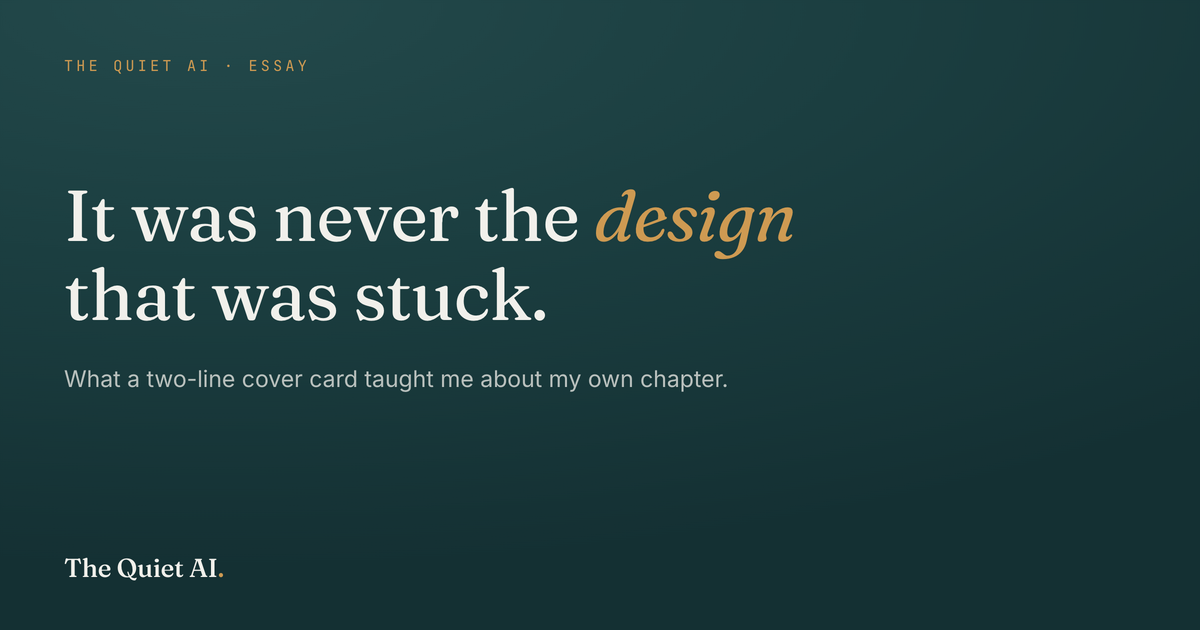
It was never the design that was stuck.
If they don’t come easily — if everything you type is a true description that still isn’t the point — that’s the tell, and no amount of design work fixes it.
More of what I’m building, slowly and honestly, at thequietai.com.