
Two Roads to the Same Machine
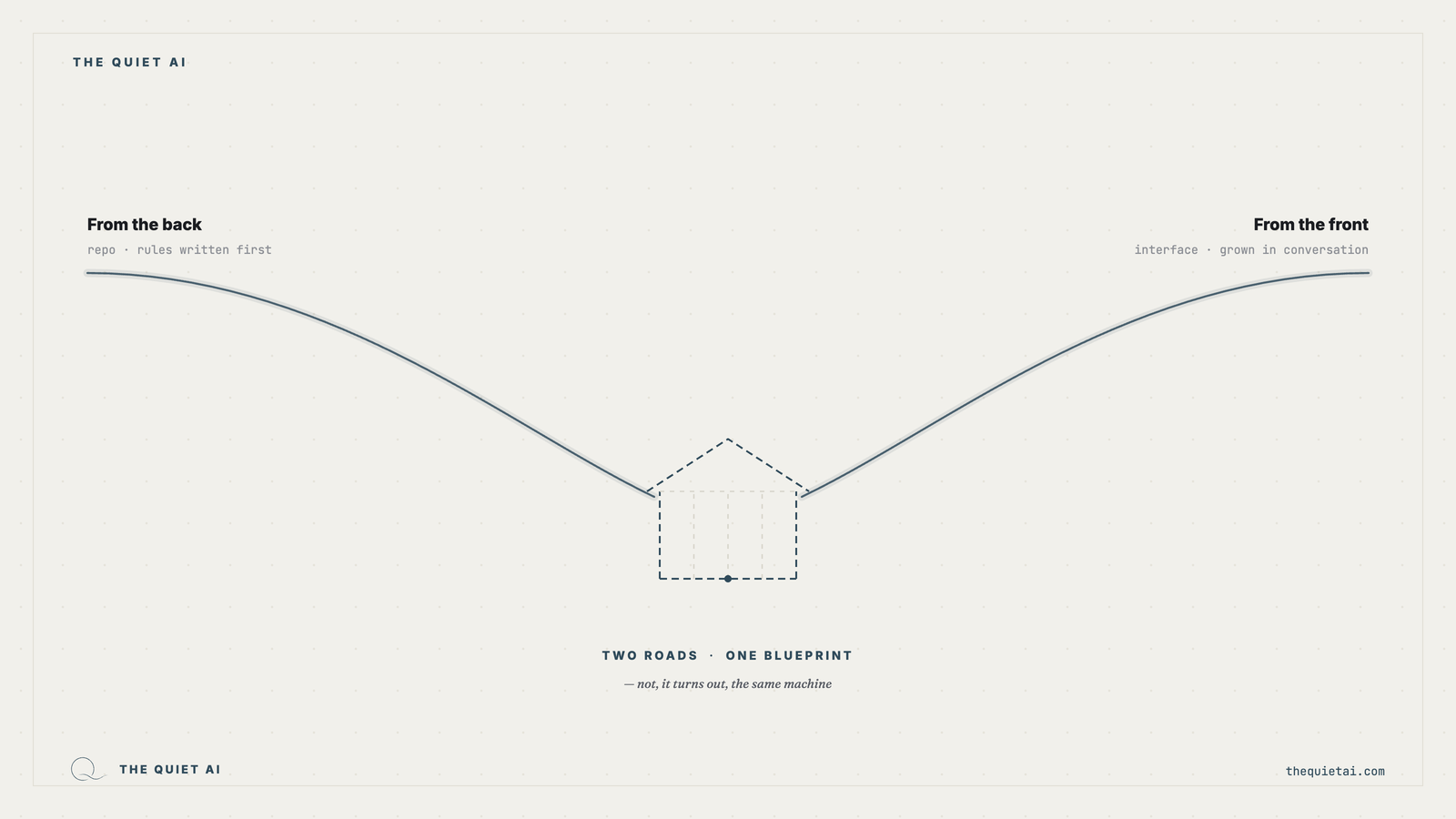
Two roads. One blueprint. Not, it turns out, the same machine.
I have a friend I’ve known a long time — the kind of friendship where each of us always half-knew what the other was up to without keeping close track. He was the one who built things and wrote code. I was the one making courses and websites and running marketing for a few small businesses. Different lanes, mutual respect, the occasional comment on each other’s work.
A while back he built a small tool to help him read a book in another language. I left a comment, and somewhere in the exchange I sent him the Quiet AI site. He didn’t just glance at the homepage. He went and read the repos — the actual code, sitting open — and came back impressed. We got to talking, and I shared the handful of principles I’ve come to build by. They aren’t originally mine — they come from a paper by Jake Van Clief: the discipline of building the system that runs your tools, rather than just collecting more of them. What it points at is the thing this whole story turns on. It was a good conversation. We both enjoyed it.
Then this morning he posted his own build, and I sat there smiling, because I recognized every inch of it.
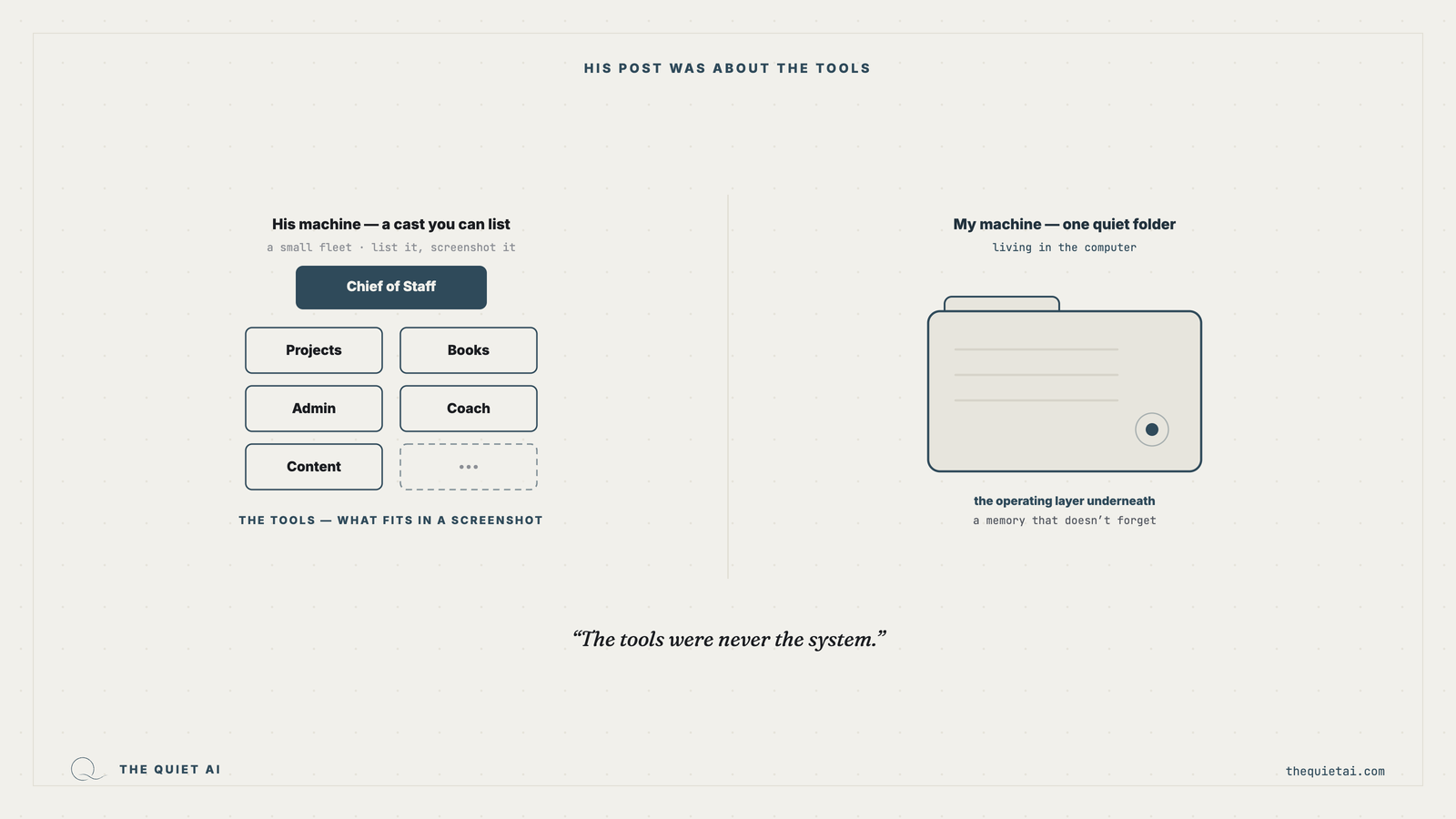
A small fleet of them, running on his home computer on a single monthly subscription. He’d given them roles like a small office — one to run the projects, one on the books, one for the admin nobody wants, one to coach, a personal assistant, one to make the content, a language tutor. And above them all, a chief of staff: the one who knows the others, runs them, and can stand up a new one or rewrite an existing one without being asked twice.
What he wrote about, though, wasn’t the org chart. It was the unglamorous heart of any real task — digging up which files, which steps, in which order, from where, before you can even begin. His monthly close used to cost him hours of exactly that. Now the bookkeeper runs it in about half an hour, because the steps don’t live in his head anymore. They live in the system. He doesn’t remember the process; the system does.
And then the morning’s punchline, which is the part I want you to catch. He wanted a new capability on the team — someone to handle the technical, development side. The old way to get one would be to open the source folder, define a new worker by hand, wire up its skills and its tools one at a time. He didn’t do that. He asked his chief of staff to hire one. Not build — hire. The lead already knows the shop, so it sets the new teammate up itself: gives it a place for its memory, the right skills, the working knowledge of what the team has done before. The new developer didn’t exist yet, as he put it — but already had a place waiting.
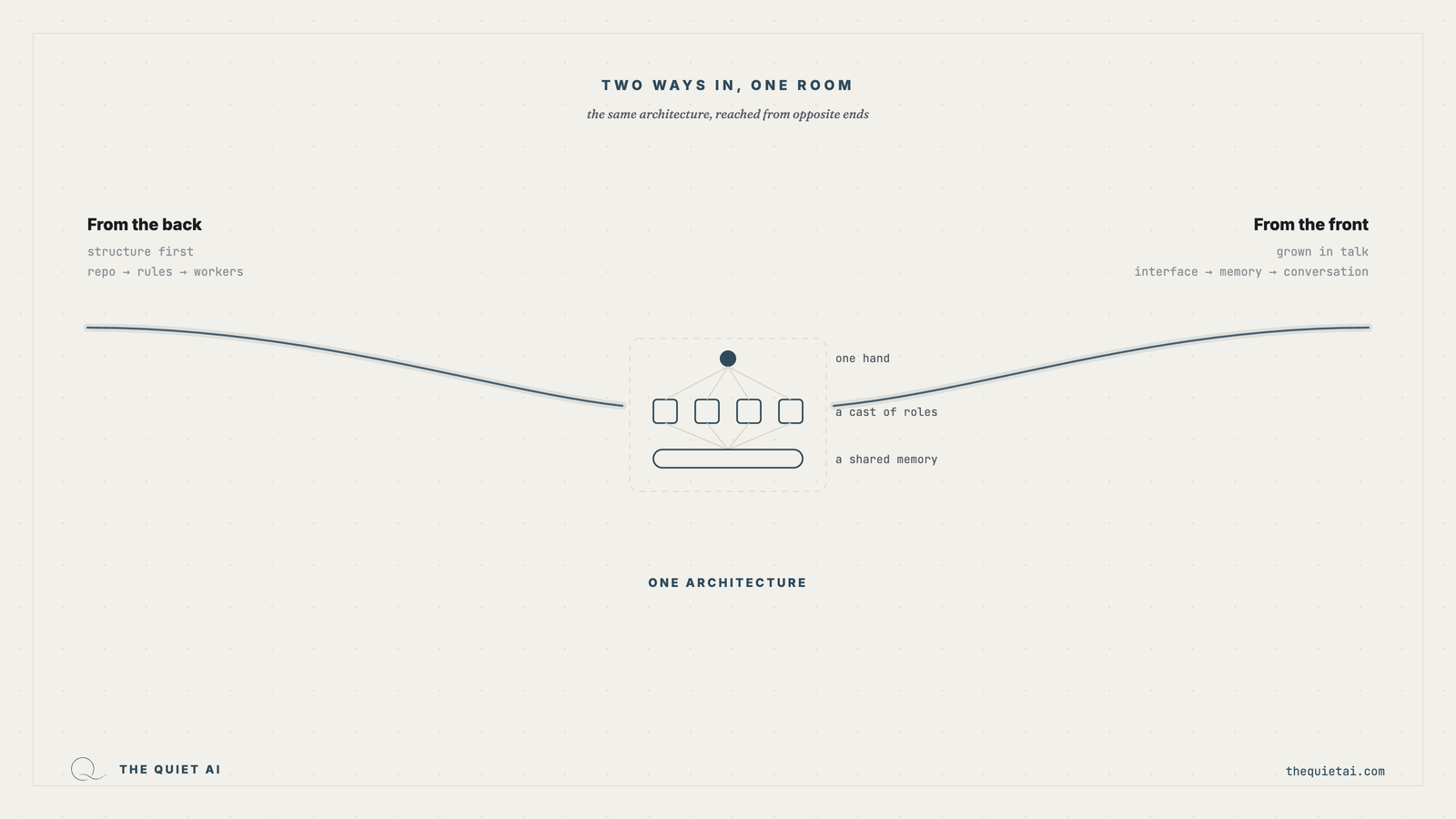
I recognized all of it, because it’s the architecture I live in. A cast of roles. One hand running them. A shared memory that doesn’t forget. And that same instinct: when you need a new capability, you hire a worker for it, you don’t engineer one from scratch.
He’d arrived there from the opposite direction than I had. He came at it from the front — the interface first, the memory kept in a notes app he already lived in, the whole thing grown by talking to it. I’d come from the back, from the repo and the rules written down first. From the front end, by feel, he’d found the same shape it took me a stack of mistakes to find. I want to say plainly how exciting that is, because the reflex in this space is to get territorial and the reflex is wrong. He stands up a whole robotic office on his kitchen computer and it runs. That is not a threat. That is the thing working.
So here is where the easy version of this story wants to end. Two roads, one machine. Put a screenshot of his build next to a screenshot of mine and you’d call them the same thing. Same kind of roster. Same conductor at the top. Same memory underneath. For a second, reading his post, I almost called it that too.
It’s a tidy story. It’s also not true, and the reason it isn’t true is the only part worth writing down.
A screenshot shows you the architecture. It cannot show you how far down the road that architecture has been walked. Same blueprint is not the same building. One can be freshly framed and the other lived in for a long time — the plumbing tested, the roof proven through a season of rain, the doors hung so they no longer stick. From across the street, on a bright day, the two photograph identically. You only learn the difference by moving in.
His post, like most posts right now and plenty of mine, was about the tools. The workers, the connections out to their apps, the memory folder. And the tools are extraordinary right now. They are also about to be everywhere. A year from now, everyone reading this will have a small team like that and a memory it can reach. The tools stop being an advantage the moment everyone has them. The tools were never the system. That’s the whole of it: AI is the tools; the system is the operating layer that runs them. Information doesn’t scale. Systems do.
And notice: his system already works. The bookkeeper really does save him those hours. That’s not nothing — that’s real, and I’d never call it anything less. Which is exactly why the next question is the one almost nobody is asking yet. Standing one of these up is the easy part now. A weekend, a few good prompts, and you’ve got a team answering you. The real question is the one that starts the morning after: does it mature?
Does it grow up? Does it go from saving you an afternoon to running things you’ve half-forgotten are running — handing you work that’s actually finished, the kind you’d send to a client without you in the loop re-explaining and re-improvising every session? Or does it stay a brilliant thing that only performs while you’re standing next to it?
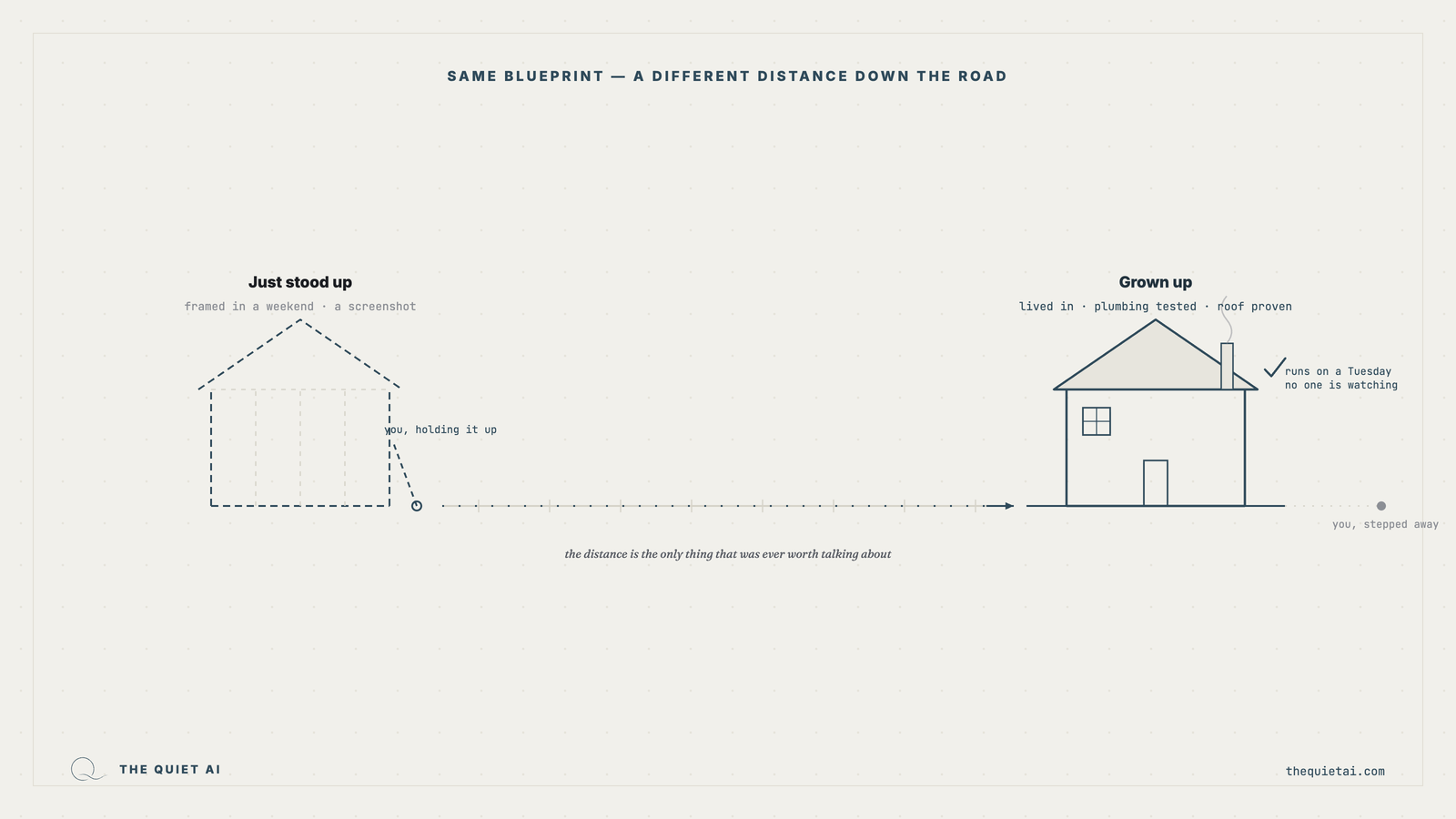
That gap — between standing up and growing up — is the only thing The Quiet AI is about. And because the brand is built on not making claims I can’t show, let me show it instead of describe it.
The matured version doesn’t live in a chat window I keep reopening and re-explaining. It lives in a repo. The rules, the standards, the voice each worker writes in, the way one hands its work to the next — written down, version-controlled, so the system runs the same on a day I’m sick as on a day I’m sharp. The boring discipline is the product. It’s what turns a cast of capable workers into one operation instead of a row of tabs I’m babysitting.
It produces work that goes out the door and gets used. Not screenshots — finished things, in businesses that have nothing to do with each other, that I built and still run today. A movement-teaching company in one world. A travel business in another. The books behind the method. The same quiet operating layer underneath all of them, shipping real work in worlds that share nothing except the system running them.
And none of it is a claim you have to take from me. The builds run live. The code sits open on GitHub, where you can read exactly how it’s wired — the actual thing, not a polished diagram. There’s a small, free tool called ClearMind you can open in a browser right now and watch run. No inflated screenshots in between.
That is what down-the-road looks like. It isn’t louder than his build. It’s quieter. It’s just the part that arrives after the thrill of standing up wears off, when the only thing left is whether the machine still works on a Tuesday when no one is watching.
I’m not telling you his won’t get there. It might — it’s already further than most. The road is open, which is the whole reason I build in the open instead of guarding it. It’s the same road I’m still on; some weeks my own work is thinner than I’d like, and the walk from stood-up to grown-up never quite ends. The difference between his build and mine was never talent, and it was never the blueprint. He found the shape from the front end faster than I found it from the back. What separates the two screenshots is distance — how many ordinary, unglamorous miles have actually been walked. That’s the part you can’t fake, can’t hire around, and can’t shortcut with a better prompt.
Two roads. One blueprint. Not, it turns out, the same machine.
And the distance between them is the only thing that was ever worth talking about.
See the live builds and the open code at thequietai.com. And if you want the folder shape itself rather than the story: it’s written up in The Operator’s Handbook, with two working ones — Nightwatch and Claimwise — free and forkable.