
Two Schedulers, Each Sure It Was the Only One
A duplicate post taught me the platform won’t let you delete your way out of a mistake — and that the real gap wasn’t the bug, it was how long it sat there before anyone saw it.
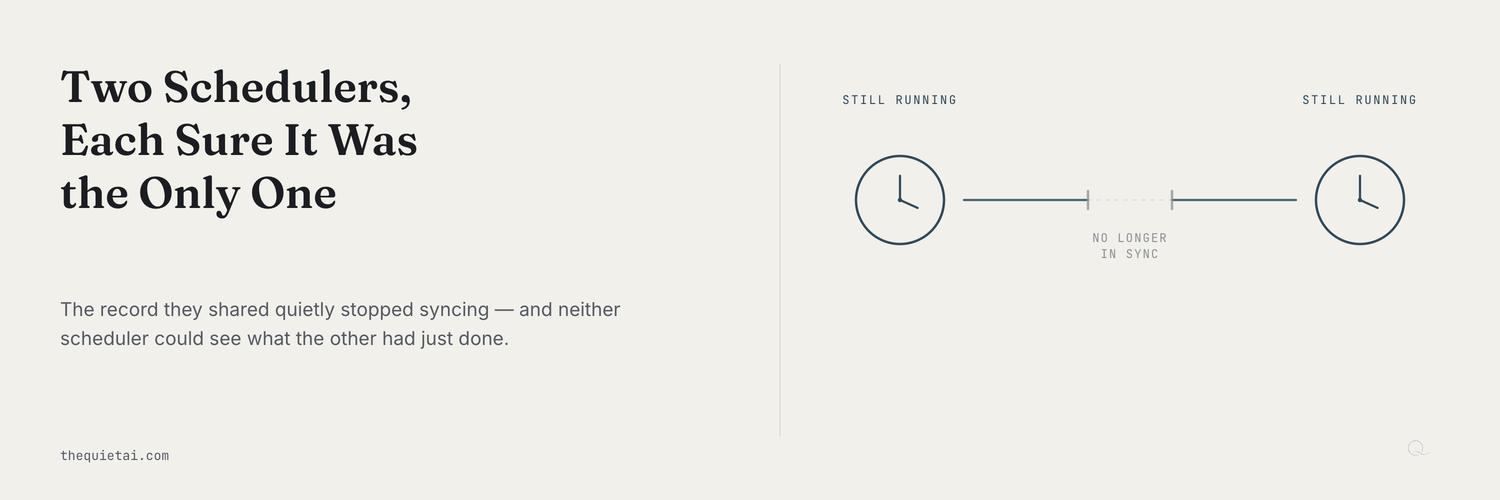
I’d already written once about moving my Instagram scheduler off my laptop and onto its own always-on service, so it wouldn’t care whether my laptop was open, closed, or on a plane. I said the local, laptop-based version would stay on as a backup while I worked out a real fix for the cloud version. I meant it as an honest “still open,” not a loose end I expected to get hit.
It got hit.
My laptop was closed for a few hours one afternoon while I was traveling. When I checked back at the end of the day, the scheduler itself had done its job — its own catch-up logic correctly noticed the one post it had missed during the closed lid and fired it once things came back. That part worked exactly as designed.
What I found instead was two actual duplicate posts, live on the real account. Not a display glitch. Two separate captions, each published twice.
What actually happened
The cloud scheduler and the laptop backup share their sense of “what’s already posted” through one common record. That record had quietly stopped syncing cleanly between the two sometime around midday — a routine step that keeps both copies in agreement had started failing without making any noise about it. From that point on, each scheduler was working from its own, slightly different idea of what had already gone out, with no way to see what the other had just done.
One post fired from the cloud side at 12:52. The laptop backup, unaware, fired the identical post again at 15:17. A second post fired from the laptop at 15:17, and the cloud side, equally unaware, fired that one again at 18:12.
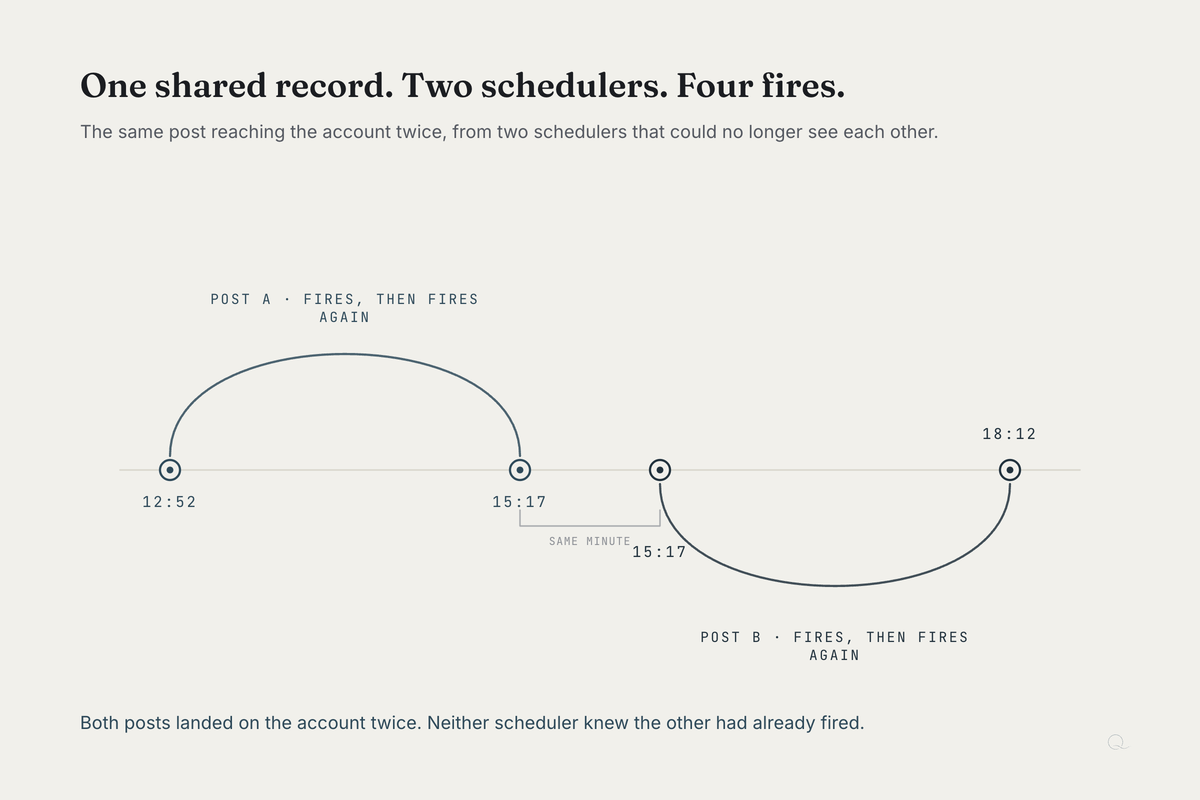
I didn’t find this from my own logs, either — I found it by checking the account directly. The written record actually under-reported what had happened: one scheduler’s own confirmation step had reported itself as failed, even though the post had gone out correctly, so its half of the story never made it into the shared bookkeeping at all. The lesson I keep re-learning in different shapes: the log is not the same thing as the account’s real state. When something looks off, check the account, not the file that’s supposed to describe it.
The fix, and the thing I tried that didn’t work
The immediate fix was mechanical: reconcile the two divergent records back into one, and turn off one of the two schedulers so exactly one is ever allowed to fire, until there’s a sturdier design that doesn’t depend on two systems quietly agreeing with each other.
Cleaning up the two duplicate posts themselves was a different problem. I reached for the obvious tool — the same script that publishes also has a delete function — and pointed it at one of them.
The platform sent back a flat rejection: deleting a published post through that interface isn’t supported. Not a permissions issue, not a bug on my end. The interface simply doesn’t do that, full stop.
That mattered more than it sounds like it should, because a note I’d written earlier had claimed the opposite — that this exact delete path had been “proven live and working.” It hadn’t. Nobody had actually called it against a real post; the earlier note recorded an assumption as if it were a tested fact. I corrected it out loud rather than let it quietly stand, because the whole point of writing any of this down is that it’s supposed to be checkable, and a false “proven working” note is worse than no note at all.
What I built instead
Since I can’t delete a duplicate automatically, I built something to catch one and tell me, fast. A check now runs on its own, watching the account’s real, live posts rather than any log file, grouping today’s posts by matching caption text. If it ever finds more than one copy of the same post, it still tries the delete first — cheap to attempt, and the platform’s own behavior here could change — but it now treats that failure as the expected outcome, logs it plainly, and sends an alert naming the exact duplicate so a person can remove it by hand, in the app, which is the only path that actually works.
The gap that actually mattered
Both of those duplicates sat live on the account for about three hours before I saw them and deleted them myself. That gap, not the missing auto-delete, was the real failure. The only alert that existed was a notification on a laptop that was closed the entire time. A perfect detection system that only speaks to a screen nobody’s looking at isn’t much of a system.
So I added a real alert that reaches a phone, not just a laptop — wired into the duplicate check, into the scheduler’s catch-up notice, and into a failed publish attempt, which used to fail completely silently outside the log. I tested it against the real service and confirmed it arrives. I still need to finish subscribing my own phone to it before I can call the loop actually closed — the code is proven; whether it reaches me every time isn’t confirmed yet, and I’d rather say that plainly than round it up to done.
More of this, honestly, at thequietai.com.