
The Village and the City
Everyone is building a city as fast as they can. You can build something quieter, and live in it.
It is early, and the work is already running.
I made coffee. The first task of the day finished while the kettle was on, and it finished about the way I would have done it myself, which is the only reason I let it run without me. Nothing is on fire. Nothing is waiting for me to rescue it. There is a particular quiet in the room this morning, and I want to write from inside it, because almost nobody writes about this work from here.
Most of what you read about building with AI is written from the other place. It is written at two in the morning, from inside a fire, with a clock running somewhere in the corner of the screen. The story always has the same shape. Everything was breaking, then a tool saved it, and now you should go buy the tool. I understand why those stories get written. Fear travels faster than calm. But I have come to think the fear is the actual product being sold, and I would rather not sell it to you. So let me try writing from the quiet, and we will see whether the quiet survives being described.
Here is what I see when I look at where all of this is heading.
We are building a city. Not on purpose, exactly, but the way cities actually get built, which is quickly and in every direction at once, by everyone, because the materials are lying around and it is possible. Every week there are new tools, and the tools breed more tools, and people wire them together into something larger than anyone planned. A great deal of it gets built simply because it can be, not because a single person sat down one day and needed it. The whole thing grows denser and louder, more connected than any one person can hold in their head, and from across the valley it looks like progress. Some of it is.
But you know the feeling of a city you do not live in. You cannot find anything. You are never sure which street is safe after dark. You are holding a map that went out of date this morning, because they finished a new road while you slept. You keep a dozen tabs open because each one does a thin slice of the job and none of them speak to each other, and the tool that worked last week quietly stopped working and did not think to tell you. That is the city most people are now living inside. They call the exhaustion of it keeping up.
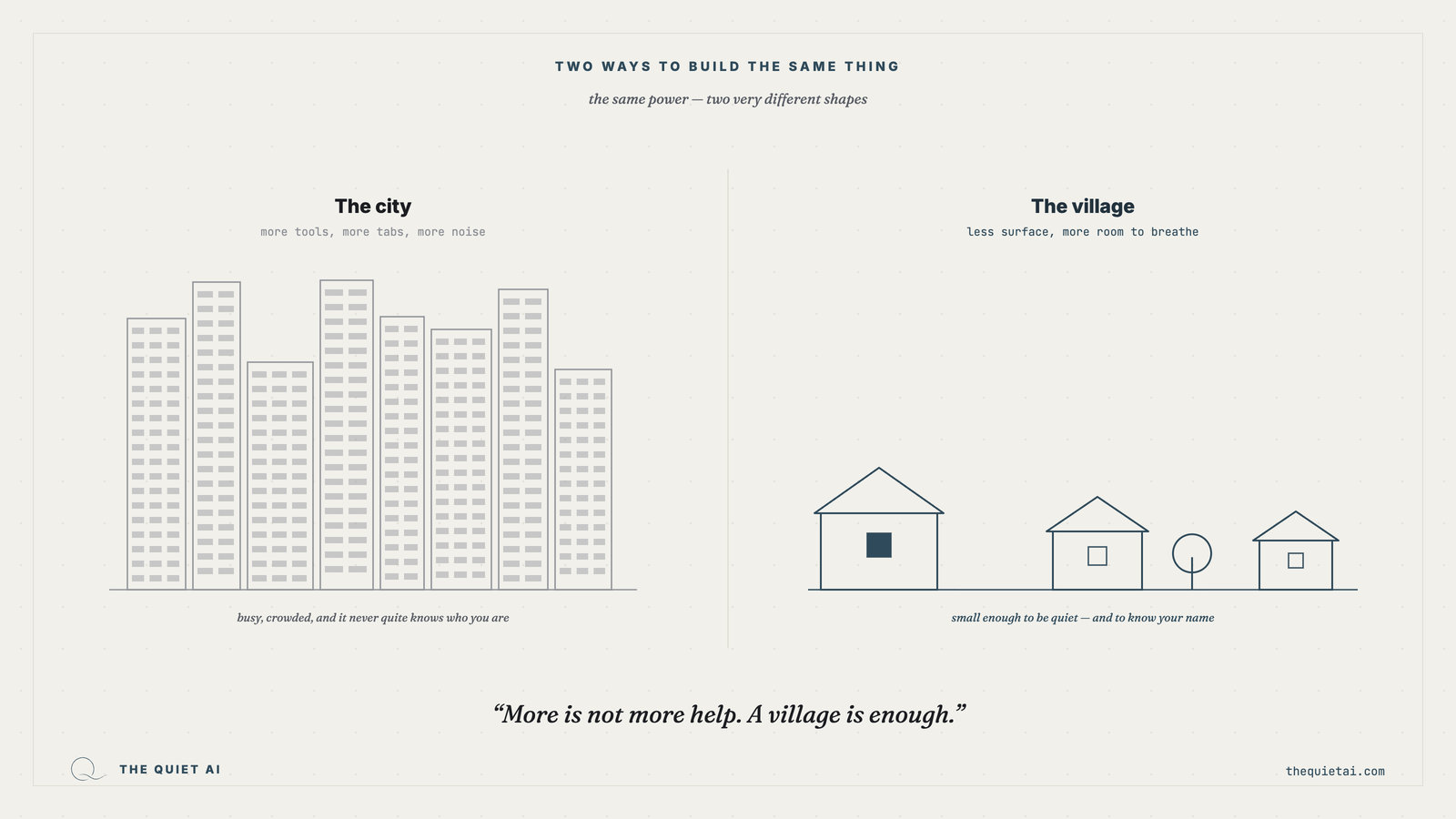
There is another thing you can build. I think of it as a village.
A village is smaller on purpose. It is quiet on purpose. The thing that makes it a village instead of a thinned-out city is not its size. It is that the people who live there understand how it works and can fix it themselves. The water runs because someone nearby knows where the pipes go. When something breaks, nobody files a ticket into the void and waits a week. They walk over and fix it, because the whole place was built to be understood by the people who depend on it.
That is the idea, carried into the way I build. A small operation, where every part of it is something I, or the person beside me, can actually see into and repair. Not a sprawl of services I rent and pray over. A handful of well-understood pieces, each one doing a job I could explain to you over the coffee, each one running somewhere I can reach.
The foundation under this is not mine. It comes from a recently published framework called ICM, written by a builder named Jake Van Clief, who teaches it through his community. (That is my referral link and I get a little if you join through it, but I would point you to him either way.) His paper is the careful, rigorous version: the discipline of building the system that runs your tools instead of forever collecting more tools. What I have done is less original and probably more useful to you. I took those principles and wore them down into something a one-person business or a five-person team can actually run on an ordinary Tuesday. The paper was not written for the solo operator or the corner shop. I am carrying it to them, because they are the ones the city is hardest on.
There is a proportion I work to inside all of this, a rough balance I try to keep in anything I build. I will leave the exact shape of it for another day. What matters here is the smaller, plainer point underneath it: a village is built to a measure. It is not thrown up as fast as the hands can move. Something is always held back on purpose. That restraint, the part that looks like slowness from the outside, is most of what makes the place calm to live in later.
Let me tell you what that actually feels like, because the abstractions are cheap and the felt thing is the whole point.
The first thing you notice is that the tools stop surprising you. In the city, a tool does something strange on a Tuesday and you find out about it when a client does. In the village, the work runs inside boundaries you set, so the strange output gets caught on the inside, before it reaches anyone. I have watched my own system stop a bad piece of work at the door, quietly, the way a good editor catches a sentence you would have regretted, and hand it back to be done again. Nobody outside ever knew there had been a near miss. That is not a small thing. Most of what damages a small business is not the disaster you see coming. It is the medium-sized mistake that walks out the door with your name on it.
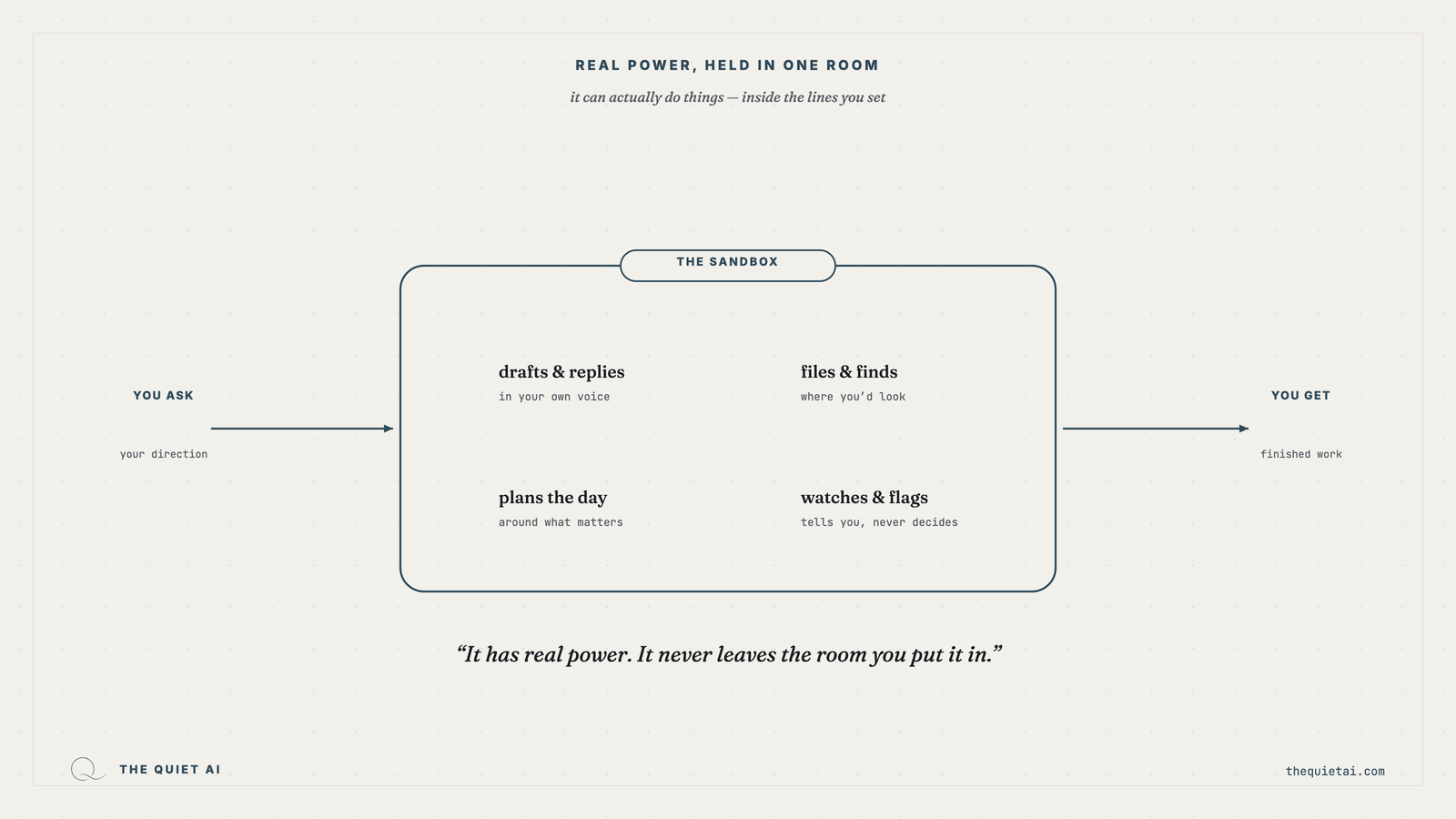
The second thing is that the people get their hands back. This one surprised me. You would think handing work to a machine would make everyone around you more passive, more like they are watching a screen do their job. The opposite happened, but only because of how it was built. Each person owns a small, clearly drawn piece of the operation. A sandbox that is genuinely theirs, where they have real power to change how things run. Not a button that says regenerate. Actual authority over a bounded space they understand all the way to the edges. Give someone a small kingdom they fully grasp and they stand up straighter than you would expect. They stop being a babysitter for a machine they do not trust, and start being something closer to an operator: someone who runs a thing, knows it, and can make it better next week.
The third thing is quieter and shows up on a longer clock. You spend less. Not because you went hunting for savings, but because the expensive mistakes mostly stop happening. The re-dos, the cleanups, the work that gets thrown out and paid for twice, the slow leak of renting eleven tools to do the job of three. None of it announces itself. You simply look up one quarter and notice the money that used to burn is not burning. It is the kind of money larger companies pay over and over, relearning the same lesson at scale, and you get to mostly skip the tuition. I am not going to put a number on that, because anyone who puts a number on that is guessing, and I would rather be trusted than impressive.
Underneath all of it is the reason I actually build this way, which has nothing to do with speed.
Simon Sinek built a whole framework on a small, easy-to-miss observation: we forget our why. We stay fluent in what we are doing and how we are doing it, and somewhere along the way the reason quietly drops out the bottom. So let me say mine plainly, before it can. I do not build the village because it is faster. Plenty of weeks it isn’t, and it doesn’t win either. I build it because of what the noise does to a person. As the city gets louder, the rarest thing in the room becomes your own judgment: whether you can stay yourself inside all of it, and keep deciding things, rather than quietly hand your thinking to a machine because it is quick and it sounds certain.
That is the cost the city charges that nobody prints on the ticket. You can live in it for a year and slowly notice you have stopped deciding. The system sounds confident, so you stop checking it. It is fast, so you stop thinking at the speed that real thinking actually takes. The village is built the other way around. It is built so that you stay the one who decides and the machine stays the thing that carries it out. It handles the tangle so that your attention is freed for the part that was always yours to begin with. You keep your hands on the wheel, because the driving was the part you did not want to lose.
The more city they build, the wider the door opens for the village.
Every new tool laid down is another rail a solo operator or a small team cannot climb onto, another layer of noise, another thing to keep up with. The sprawl does not crowd the village out. It makes the village rarer, and calmer by comparison, and quietly more valuable to the few who find their way to it. Discernment becomes the scarce resource. Knowing what not to build becomes worth more than the ability to build anything at all. That is an opening, and it widens a little every week, paid for by everyone racing in the other direction.
I did not choose to build small because it was strategic. I chose it because of how I want to live. I wanted work that runs without me standing over it, that I can step away from, that does not ask me to be available to a fire at two in the morning. I have built a few small businesses this way and still run them, in worlds that have nothing to do with each other, on the same quiet operation underneath. It turned out that the thing I built for the sake of my own life is also, as far as I can tell, the more honest way to build. The city has a way of teaching everyone to keep up. I only ever wanted to stay a person while I worked, and building small is the one way I have found to do it.
If you have started asking a slightly different question lately, less how do I build more and more how do I build something I can actually live inside, then that is the whole of what I work on. The builds run in the open, and you can see them at thequietai.com. No countdown, no fire. Just a quieter way to build, and a door that stays open whenever you feel like walking through it.
If you want the village shape you can actually step inside, not just picture: two working operators, Nightwatch and Claimwise, are free to fork — The Operator’s Handbook walks through both.