We Already Live Here
Where a 44-folder system and a much smaller one seem to fail in the same way.
I read Kieran Klaassen’s “The Folder Is the Agent” and stopped at his list of what goes wrong. He runs 44 of these folders-as-agents across multiple projects, and he names three failures. I recognized two of them.
We run something much smaller than his. Recognizing the list felt less like flattery than relief. I hadn’t been overbuilding against a problem that doesn’t exist.
What he ran into
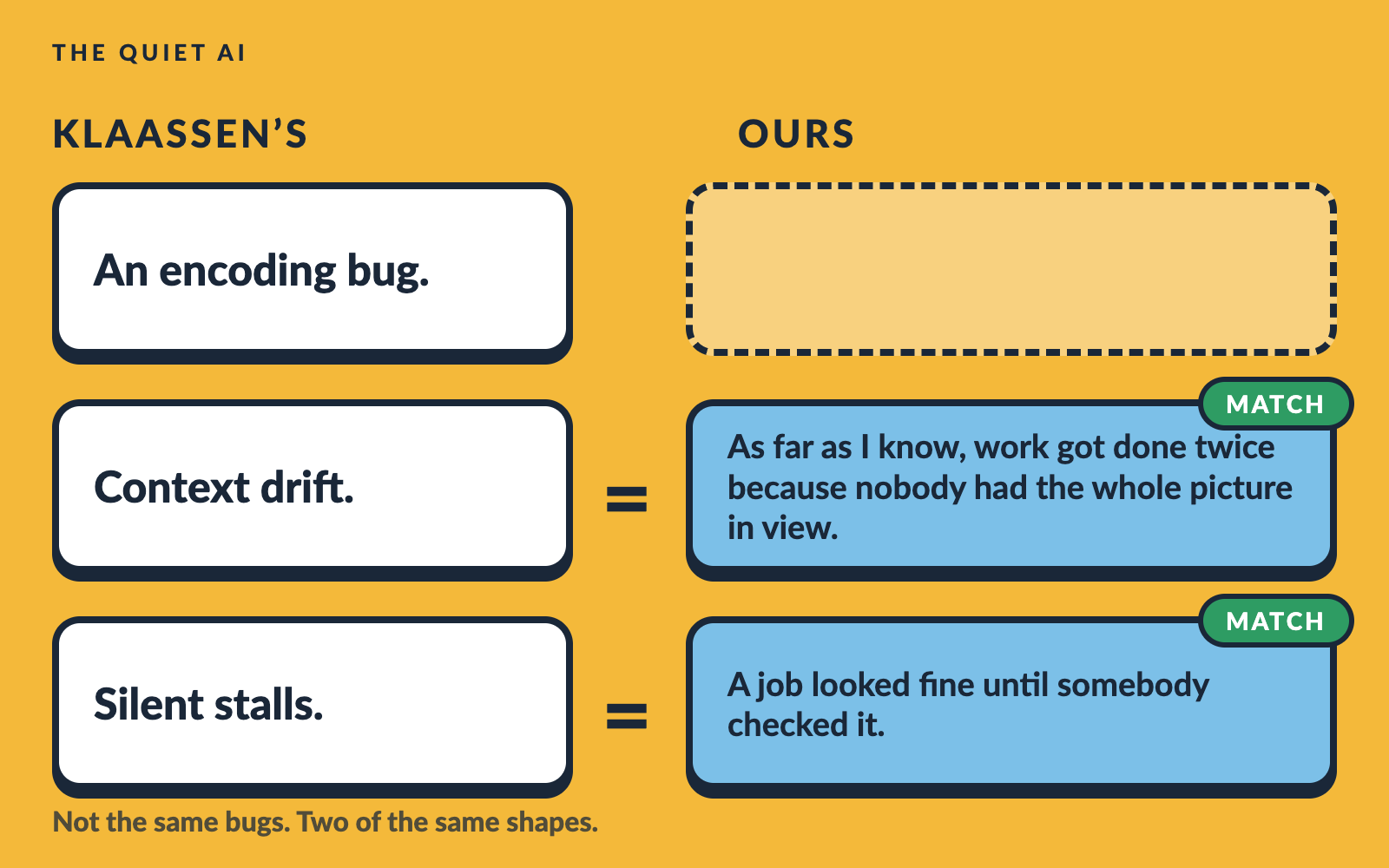
An encoding bug. He writes that the culprit “turned out to be em dashes and curly quotes—characters from text I’d copy-pasted into prompts.” Text that looked fine to a person broke something that had no way of saying why.
Context drift. “With dozens of agents, some end up running stale versions of tasks or duplicating work that another agent already finished.”
Silent stalls. “An agent makes too many API calls too fast or gets stuck waiting for input, and its status stays on 'working' indefinitely.”
His conclusion, in his words: “You can’t vibe orchestrate.”
What we’d already run into
Not the same bugs. Two of the same shapes.
As far as I know, work got done twice because nobody had the whole picture in view. Whoever ran each pass did the sensible thing with the information they had.
A job looked fine until somebody checked it. The record said it was fine, but the record only described whether the job had started.
The fixes were less exotic than the failures: a shared record everyone checks, a review step before anything ships, and dated entries in place of something always running that nobody was watching.
It isn’t a scale problem
The obvious reading of Klaassen’s list is that 44 is a lot, so of course it breaks. But two of the same shapes showed up in a system a small fraction of that size.
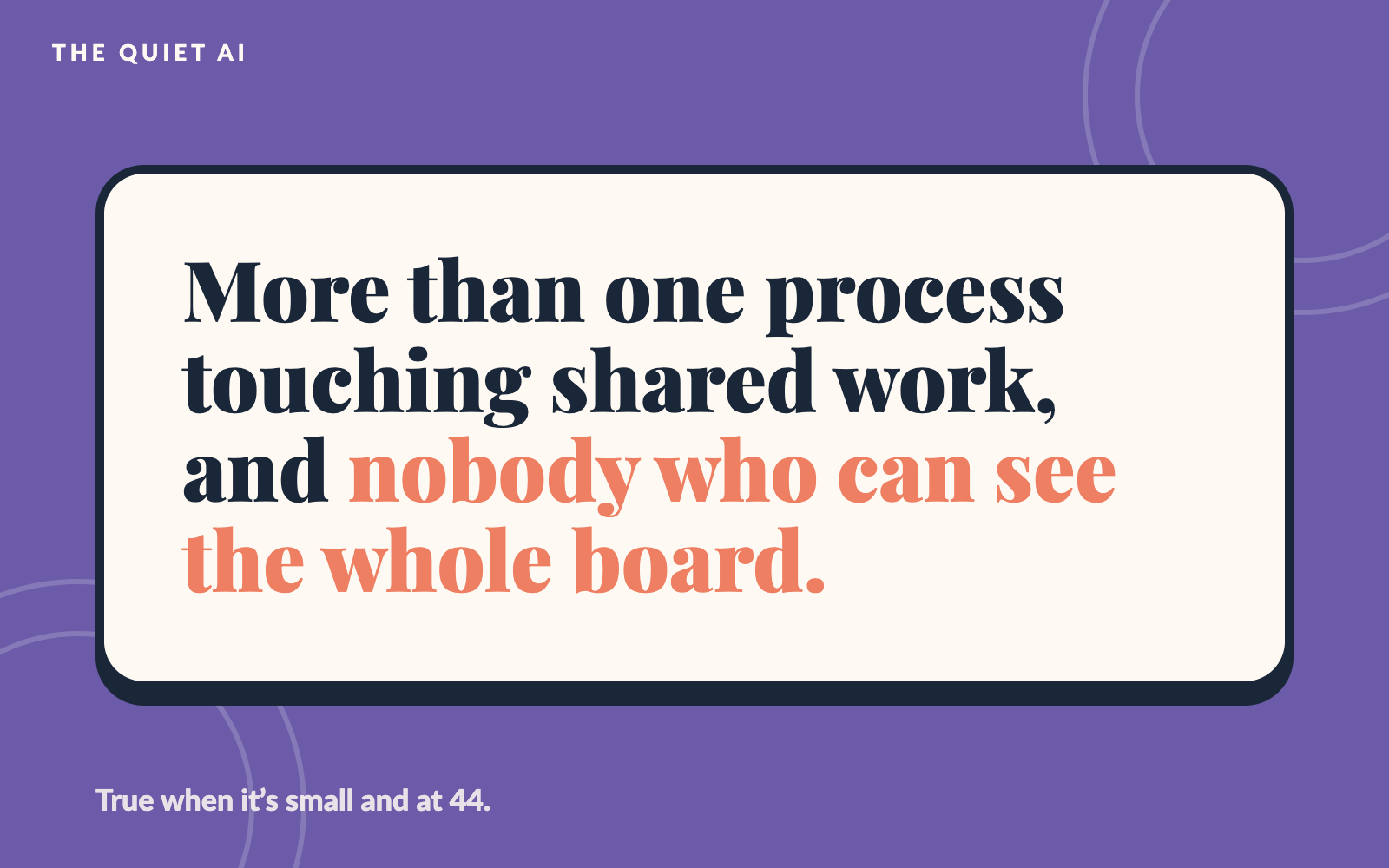
As far as I can tell, what they share isn’t the count. It’s that more than one process touched shared work and nobody could see the whole board at once. That’s true when it’s small and true at 44.
Why two systems agreeing matters
One system hitting a failure could be an accident of how it was built. Two systems, as far as I know built separately, at very different sizes, landing on two of the same shapes is stronger evidence than either alone. Two overlaps are a small sample, but these probably aren’t quirks. They look like what shared work does to whoever is doing it.
So if you’re building something small and worrying it’s too careful for its size, look at his list. The care wasn’t overbuilding. It was early.