What Feeds You Besides Food
Nutrition advice starts at the plate. The idea I trained in starts somewhere else, and it gives you four places to look.
Two people sit down to the same meal. One gets up lifted. The other, flat.
Nothing is wrong with either of them.

Most food advice starts at the plate and stays there. What to eat, what to cut, how much. That is a fair place to start, and it is the only place a lot of advice ever looks.
I trained at the Institute for Integrative Nutrition (IIN), and one idea from there changed where I look. Its founder, Joshua Rosenthal, calls the food on your plate secondary food. Primary food is what feeds you without ever touching your mouth. IIN has no part in this class or this article. The idea is theirs; the words here are mine.
The four I teach

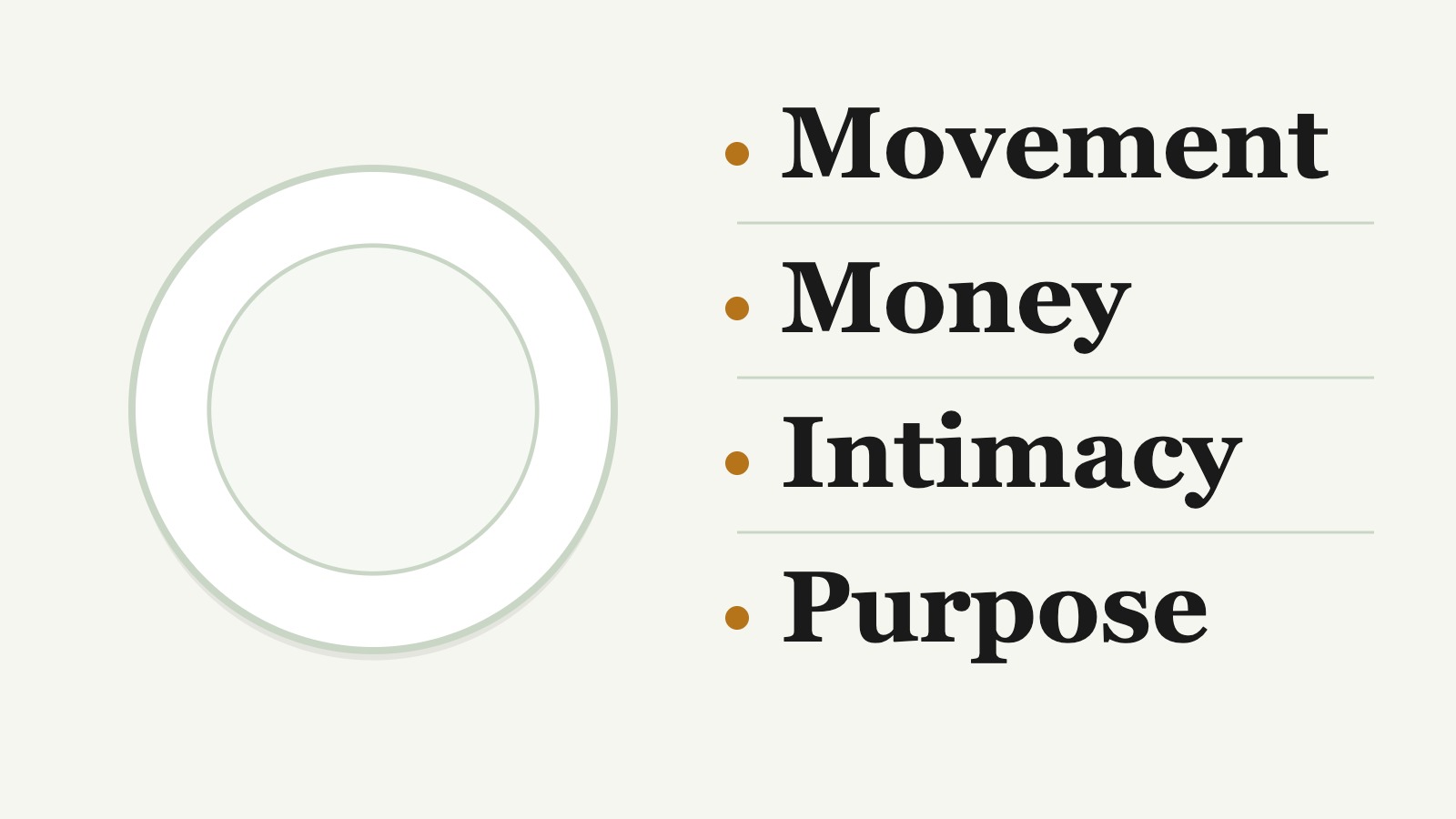
IIN’s list is longer. The four I teach come from it: exercise, career, relationship and higher purpose. In my own classes I use four plainer words:
- Movement (exercise)
- Money (career, though it is really about the work)
- Intimacy (relationship)
- Purpose (higher purpose)
The match to IIN’s list is loose, and I say so. My words decide the labels, not theirs.
Why bother with the idea
It changes where you look. If a craving keeps winning, or you keep eating past full, the plate is not always the place to start. Sometimes another part of your day is thin. Seen that way, you can be a little less hard on yourself.
I’ll give you two small examples from my own life, and you decide what they mean for you.
I once managed a restaurant. The owners were hard to work for, and I left. It made a huge difference. I’m not telling you to quit anything. I’m telling you what happened to me. I believe that when we dislike our work and have nobody to talk about it with, it shows up in how we feel. That is my belief. I’m not quoting a study.
From 2003 to 2005 I was the assistant yoga and meditation manager at Miraval, a resort in Tucson, Arizona. Part of my work was alongside couples in a program for them. What I saw was how much intimacy was missing, and how little anyone talked about it. That is my takeaway, and it is only mine.
A ten-minute check

Before you pick one to work on, look at all four. Take a pen. For each, write a number from 1 to 10 for how fed you feel by it right now. 1 is thin. 10 is full.
Movement: __ / 10
Money (your work): __ / 10
Intimacy (closeness): __ / 10
Purpose: __ / 10
There are no right numbers and nobody scores you. It is a way of noticing, not a test of your health. Look at the lowest one and finish this sentence: “What I notice is ______.”
Where the AI comes in

Here is how the class uses an AI for this, and the rules it gives the AI.
Leave out names and anything you would not want kept. Then give the AI your four numbers and ask for three questions about the lowest one. Tell it not to diagnose, not to advise you about your health, and not to say what you should change. Tell it that if it doesn’t know something about you, it should write “unknown” and not invent.
You tell it to ask, not answer. You answer.
That is the whole method, and it is why I put the two ideas in one room.
The same idea, at book length
I wrote a book that circles this question from the plate side. It’s called Are You Actually Hungry?. It comes out of years of detoxing myself, and I wrote it with the help of the Quiet Scribe Suite, the same AI workers that help me make much of what is in the SKOOL. What I found is that detox was not mainly about toxins. It was about removing enough noise to hear yourself again.
The book comes back to the idea in this article. My teacher used to say that what’s on your plate is only the secondary food, and the primary food is everything else: the people, the work, the movement, the meaning. So the truest reason to quiet the body for a few days may not be to scrub something away. It may be to make room. Some people shouldn’t fast, and the book says so; your care team comes first. If a craving keeps winning and you’re not sure what you’re actually hungry for, the book starts there.
Are You Actually Hungry? is available at areyouactuallyhungry.com.
Where to take it
The Primary Foods class is in Wellness & AI SKOOL. It has a page for each of the four. Each page starts with something true from my own life, gives you one small thing to try on your own, and ends in a check-in post where I reply within 24 hours. You can start with the self-check and take the page for your thinnest food.
Join us at skool.com/wellness-and-ai/about.
Not medical advice. If something here touches an injury, a diagnosis or a medication, your own care team comes first.
Two people, one meal. Maybe the meal was never the whole story.
thequietai.com