
Why I Built a Priced Product to Give Away Email Addresses
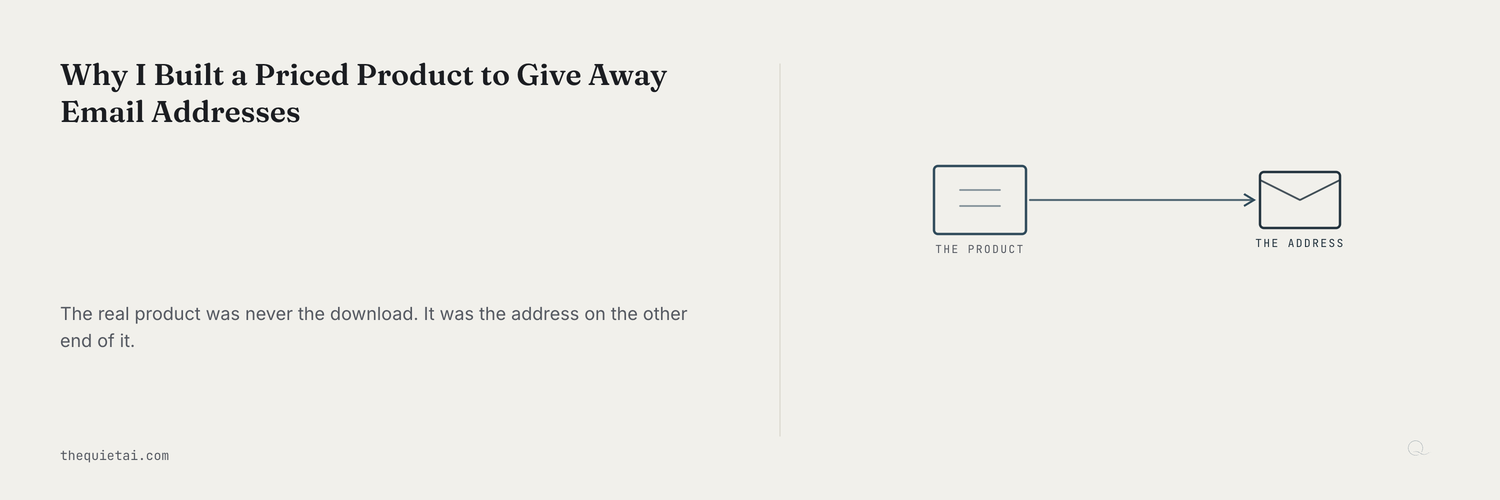
The real product was never the download. It was the address on the other end of it.
I built a product. I put a real price on it: a few hundred dollars, once, with a month to change your mind.
It’s a folder of tools, on your own machine, built to take years of notes and lived expertise and turn them into an actual finished book, in your own voice. That part is real — a real thing that exists, not a mockup.
But if I’m being straight about why I built it and priced it the way I did, the sale was never the main event.
The main event is the email address
Here’s the plain version of something I’ve said to the people building this with me, and I don’t think I’ve ever said it publicly: the point of pricing it the way I did, for a business like mine, was never mostly to sell as many copies as possible. It exists to have something to talk about, lead toward a niche market, and gain the emails.
That’s the whole strategy, said out loud, not dressed up.
I think most people selling something at a real price would bristle at admitting that. It sounds like it cheapens the product — like I’m telling you the thing you’d pay for isn’t really the point. It’s the opposite. The product has to be genuinely good precisely because it’s not the main transaction. A lead magnet that disappoints costs you the relationship it was supposed to start. A real, working, priced product that happens to also start a relationship is a much harder thing to build, and a much more honest one to sell.
What changes once you actually believe that
A product priced like this can survive some friction. Someone who already paid real money is more likely to push through a clunky setup step, because they’ve already decided this matters to them.
A tool built to start relationships can’t afford that same friction, because the cost of losing someone isn’t a refund request. It’s the actual point of building the thing at all.
Right now, mine has real friction in it — a genuine setup step, not a one-click checkout. Someone who gets partway through that and gives up isn’t a lost sale in the way a normal purchase drop-off is a lost sale. They’re a lost email. And worse than that, they’re a person walking away carrying a specific story about me: I tried it, and it didn’t work.
That’s a heavier cost than a missed sale, and pricing the friction as if it were only the smaller number would be a mistake I’d be making with my eyes open.
Why I’m saying this instead of just letting the page speak
I could let the pricing page do the talking and never explain the reasoning behind it. Most businesses do exactly that — the lead magnet and the real product live in two clearly separate places, and nobody has to explain how they relate.
Mine blur together on purpose, and I think that’s worth naming rather than leaving implicit. The priced product is a real thing you can own, use, and be disappointed by if it doesn’t deliver. It’s also, honestly, a door. What actually pays for the time I spend on this business isn’t that one download. It’s the deeper, one-on-one work that starts after someone raises their hand and says this is a problem worth solving properly — work that’s priced in conversation, not on a page, because it has to fit the actual size of what someone needs.
The part I’m not going to pretend
I don’t have a number to give you for how well this is working. I’m not going to invent one to make this piece land better. What I can tell you is the logic I’m actually building against: every friction point in that setup step is worth fixing not because it costs a sale, but because it costs the thing the sale was never really about.
A real, working product buys the thing on the label. What I actually built it to buy was a chance to be useful to someone before they’ve decided to trust me with anything bigger.
More of this, honestly, at thequietai.com.