
Every Business Needs a Content Team. Most Businesses Can’t Afford One.
Making the content got easier. Staying alive as the person who has to keep making it — across every platform, every single day — didn’t. This is what changed when I stopped collecting more tools and started building a team.
I used to think the hard part was the idea.
Write the caption. Design the image. Cut the video. Post it. Done — and it felt like nothing, because it basically was nothing.
Then do it again tomorrow.
And the day after that.
Add a second platform. Add a third. Add the version of the same idea reshaped for each one — the caption that’s too long here and too short there, the video that needs a different crop, a different opening beat, a different everything except the idea underneath it.
Somewhere in that repetition, “making content” quietly stops being the job. Running the operation that keeps making it becomes the job.
The part nobody shows you
Watch how the people who never seem to miss a day actually operate, and the trick isn’t discipline. It’s staffing.
Somewhere behind the account, a script is getting written. A graphic is getting built. Footage is getting cut down to the right length. And one more person’s entire job that day is confirming the post actually landed where it was supposed to, on time, with the right file attached to it. None of that runs through the one set of hands you actually see on screen — it can’t. There isn’t enough of one person to go around a full production schedule alone.
That’s not a trick, and it’s barely even a secret. It’s just never shown. What matters is that most of us are expected to run the whole operation solo, on the hours meant for one job, not four.
I’ve spent most of my working life teaching — movement, bodywork, breath. I never set out to become someone whose evenings belonged to a screen instead of the work itself. I wanted to teach, and let the teaching be the thing people found on their own. Instead I kept losing an hour to rewriting the same caption four ways and hunting for a file I’d already finished — work that asked nothing of my actual judgment and took the hour anyway.
More capability did not mean less to manage
I assumed AI would fix that, the way I think most people assumed it would. It fixed something, to be fair — writing got faster, images got easier to make, a rough video cut stopped eating a whole evening. Every individual piece of content got cheaper to produce.
What it didn’t do was make the operation around that content any lighter. If anything it got heavier, because now there were more finished pieces to move, and I was still the one moving every one of them by hand — digging a file back out of a folder, retyping a caption because the last app stripped its formatting, picking a crop, hitting publish, then circling back an hour later just to confirm it actually went live.
I had more capability sitting around than I’d ever had, and somehow more to keep track of.
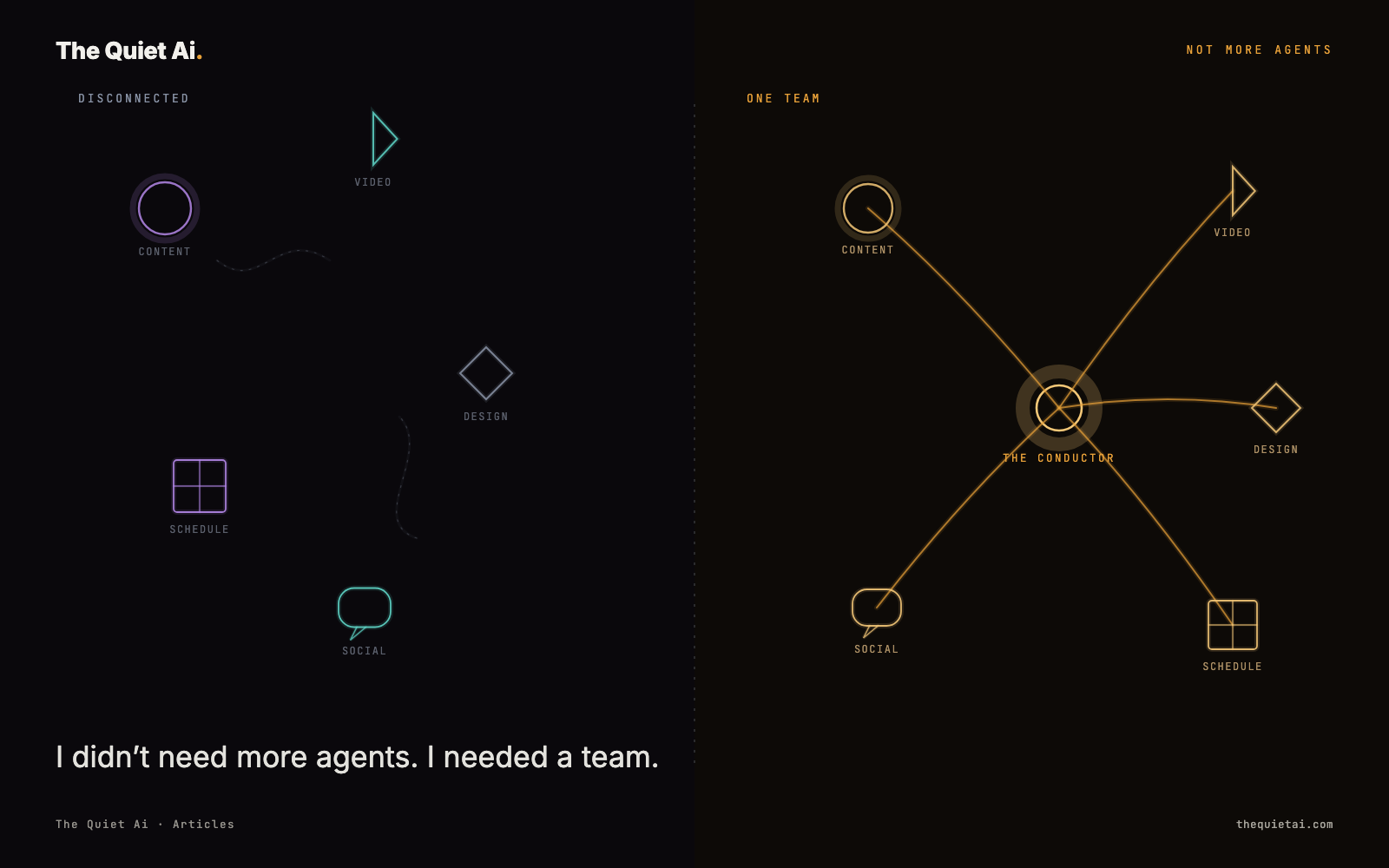
It took me longer than it should have to name what was actually wrong. I kept reaching for another tool — one for this, one for that — and each one solved its own narrow piece and handed me a new seam to manage between it and everything else. I was collecting capabilities the way you’d collect keys: useful on their own, and useless as a set unless something already knows which door each one opens.
What I didn’t need was another key.
What I actually wanted was a team
Think about how a real content team works, on the days it’s working well.
A finished piece of writing doesn’t need someone to hand-deliver it to the designer and reconstruct the brief from memory on arrival. A finished cut of video doesn’t need someone tracked down after the fact and walked through where it’s supposed to publish and why. The designer already knows what the writer was building toward, because they were in the same brief from the start. Nothing has to be reconstructed at the handoff. It was never actually handed off — it just kept moving.
That was the piece I’d actually been missing — not more capability, but people (or, in my case, workers) who already know what the others are doing, so I stop being the one who personally carries the context from desk to desk. So I built toward that instead: writing, design, and video pulling from the same material rather than three separate conversations I had to keep synchronized in my own head.
Sunday decides. Monday doesn’t ask again.
Once the pieces actually knew what each other were doing, the shape of my week changed in a way I hadn’t expected.
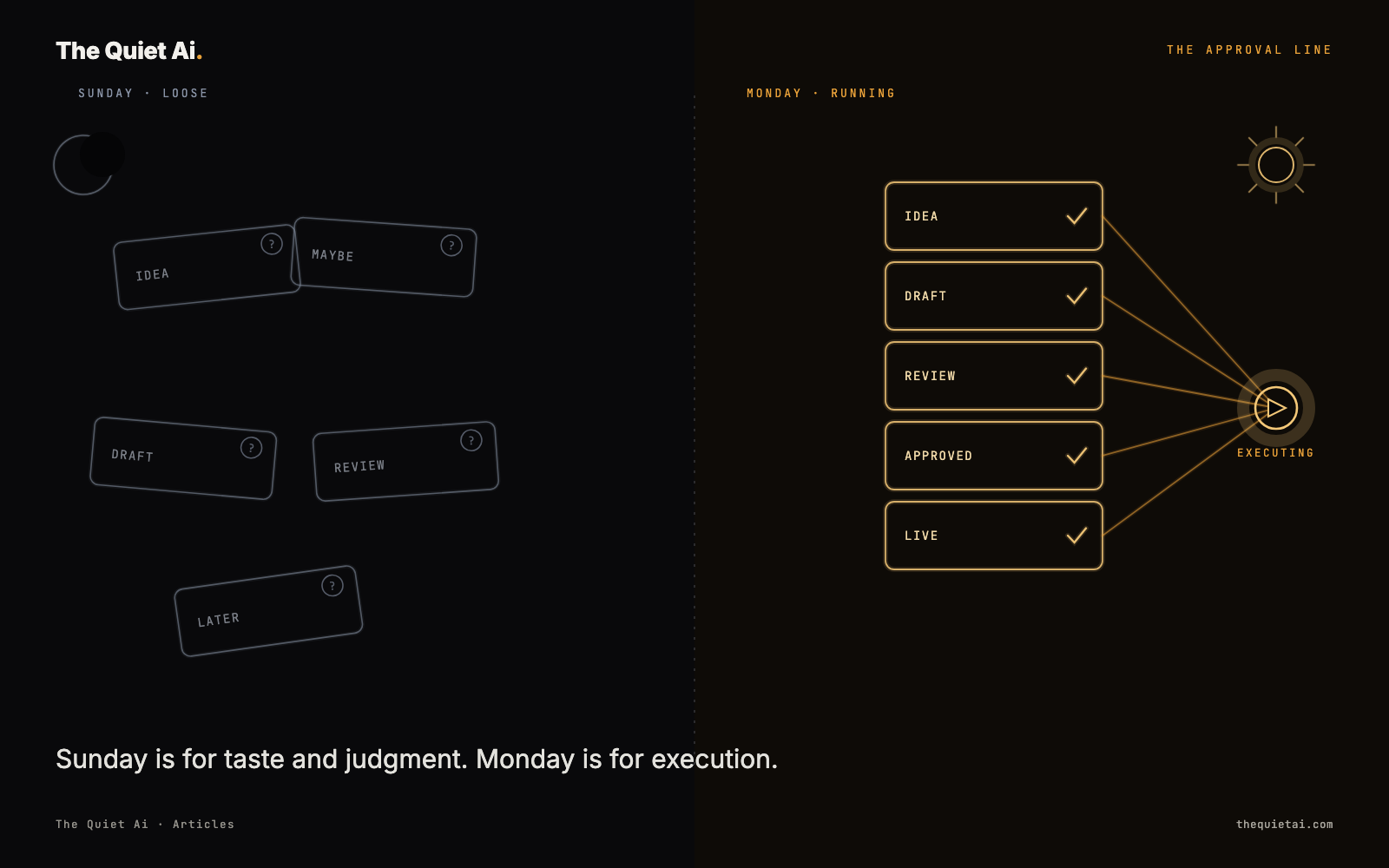
Now Sunday is for the decisions that need me. I look at the week ahead — the scripts, the storyboards, the ideas worth turning into something real. I fix what’s wrong. I approve what’s right.
And Monday, the work starts without asking me again.
That boundary is the whole thing, and it took me a while to actually see it: judgment belongs before the approval. Everything after the approval is execution, not another round of the same decision. A functioning team doesn’t make its director re-approve one call five separate times across five platforms — and once I stopped requiring that of my own operation, most of what used to eat my week simply stopped happening to me.
Giving the team hands
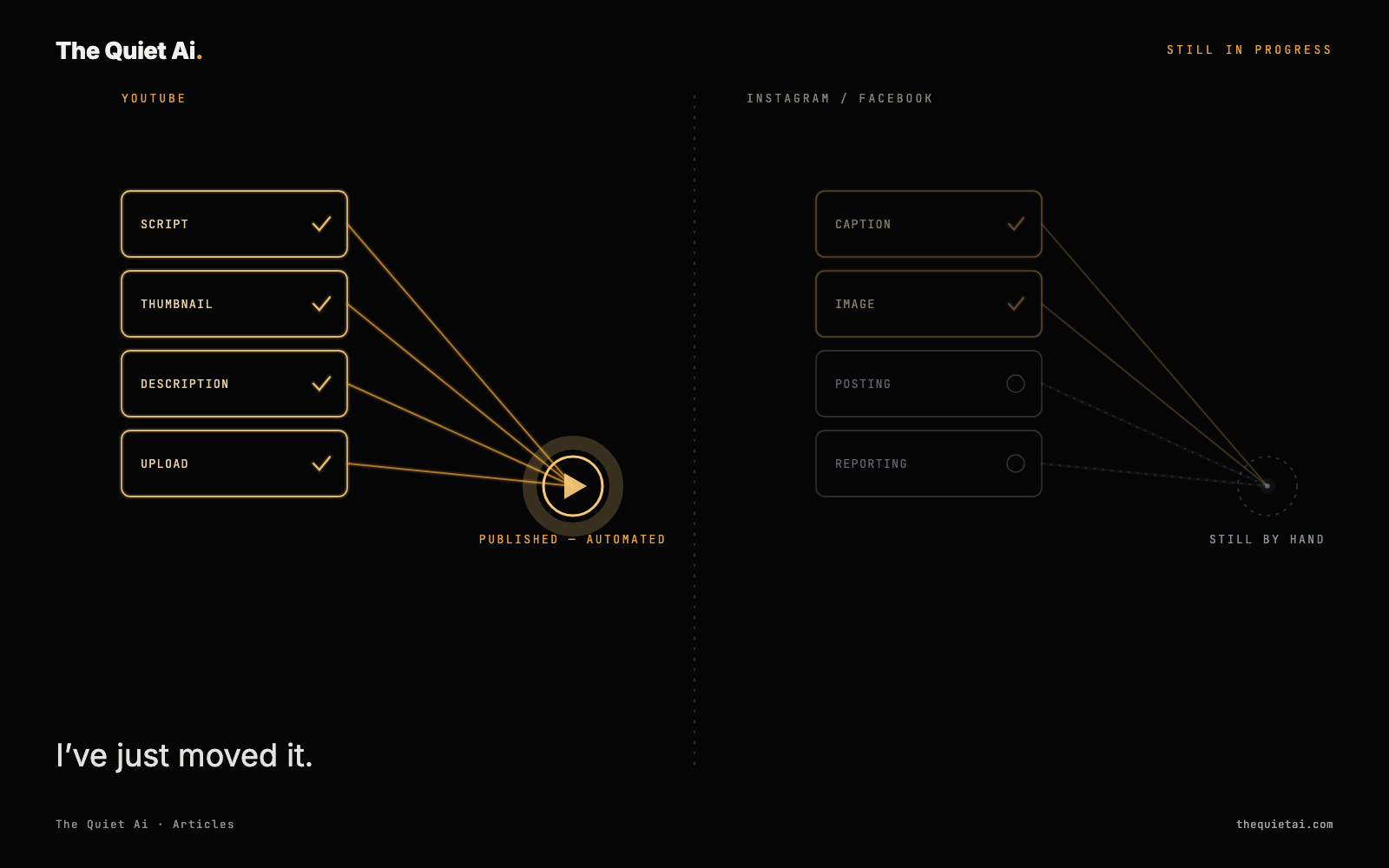
For a long time, all of this stayed inside production. The material got written, designed, and cut — and then I still had to personally carry it out into the world myself. Open YouTube. Upload. Set the thumbnail. Choose the playlist. Come back later to make sure it actually posted.
That last stretch turned out to be its own real problem, worth solving on its own terms. I wrote about giving that part hands — literally testing whether a finished video could get from my computer onto the right channel, correctly, without me sitting there clicking it through — in more detail here. Short version: it worked. YouTube stopped being something I had to personally do every time.
Instagram and Facebook are a different, harder story, and I want to be honest about exactly where that stands: not solved. The way those platforms expect to receive finished media doesn’t match how a person drags a file into an app, and untangling that is a real rabbit hole I’m still in the middle of — not a feature I’m quietly about to announce. I’d rather say that plainly than let the YouTube piece imply more than it’s actually proven.
The point was never more content
Here’s the part that took me the longest to actually believe about myself: none of this was ever really about producing more.
If volume were the goal, none of this would even matter much — a machine can already make more content than anyone should want. What I was actually chasing was quieter than that: fewer things still pulling at my attention after a decision was already made, so there was some of me left over for whatever showed up on its own.
If I’m somewhere and something happens that I want to talk about right now, I want to be able to film it and hand it off — not push it to the back of a queue because Tuesday’s carousel still isn’t finished. If the planned work is actually handled, the unplanned idea gets somewhere to land. That was the trade I was after the entire time, and I didn’t fully understand that until the operational part finally stopped needing me.
Not more content.
Room to be the person who has something worth saying in the first place.
More of what I’m building, slowly and honestly, at thequietai.com.