
The “It Won’t” List Is the Moat
A generalist tool answers everything, and the user has to guess whether the answer is good. A specialist refuses some questions — and the refusal is the credential.
A specialist’s value lives in what it refuses to do. The five jobs Realtor Copilot v2 ships are not what makes it a copilot instead of a chatbot. The published refusal list is.
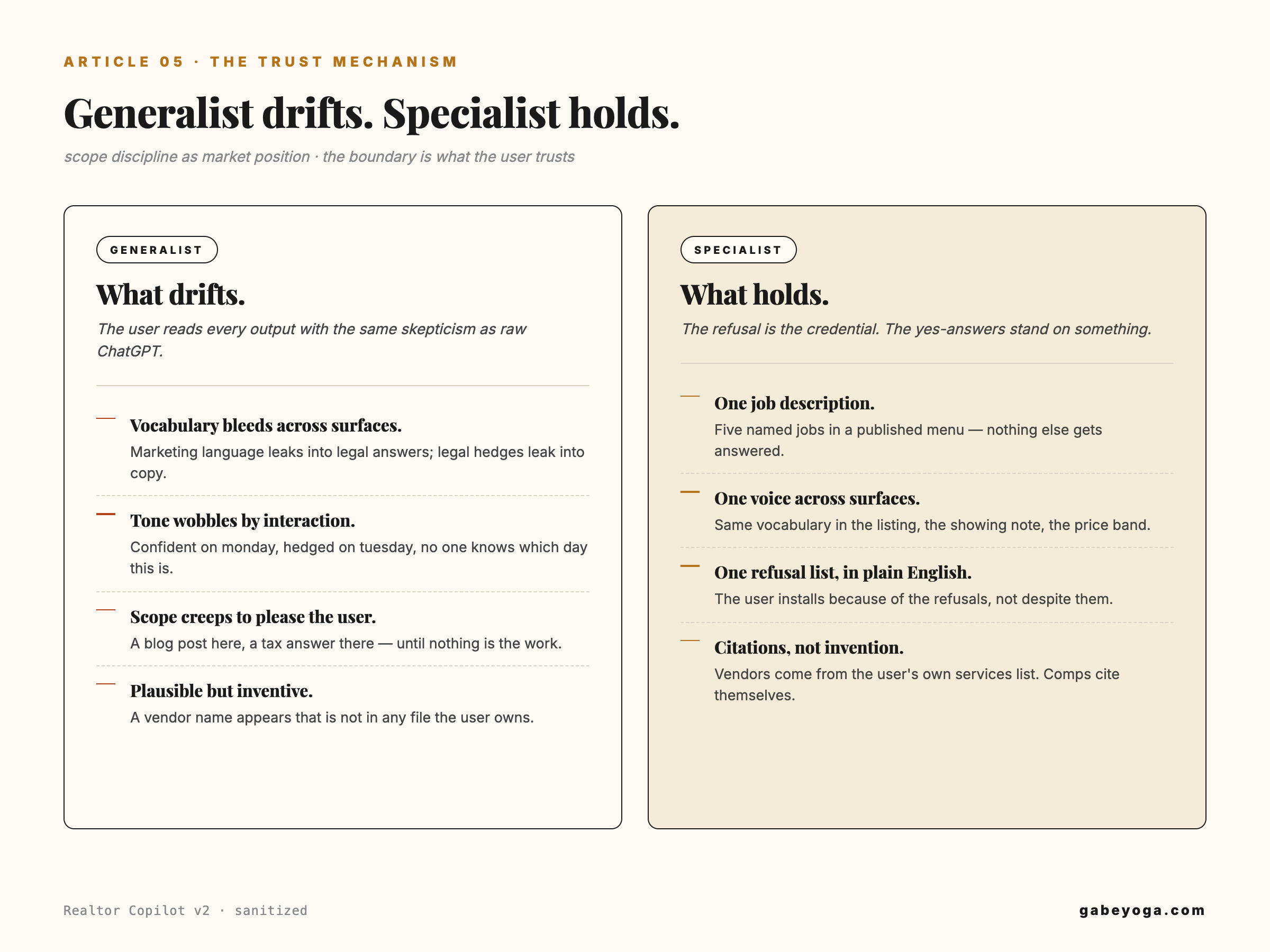
A generalist tool answers everything. The user has to know whether the answer is good. A specialist refuses some questions and answers a few of them well. The user does not have to know whether the answer is good, because the refusals do that work for them.
The boundary is the trust mechanism.
Drift kills trust
A specialist that occasionally drafts a marketing blog post when asked, occasionally answers a tax question, occasionally invents a vendor name when no real one is in the file — that specialist is a generalist with a logo. The user learns this on the third interaction. After that, every output is read with the same skepticism as raw ChatGPT, because the user no longer knows which mode they are in.
Constraint earns trust the same way that a doctor’s “I would refer you for that” earns trust. The refusal is the credential. A specialist that says no to four things in plain language gets believed when it says yes to the fifth.
The published refusal
Sanitized refusal list — printed in the README, visible to the buyer before install.
No binding legal or tax advice. Surfaces what to ask the lawyer or accountant.
No single list price. Always a band, with comps, with adjustment reasoning.
No client-facing emails (seller updates, buyer follow-ups). That is CRM territory.
No vendor recommendations that are not in the user’s own services list.
No drift outside the five named jobs.
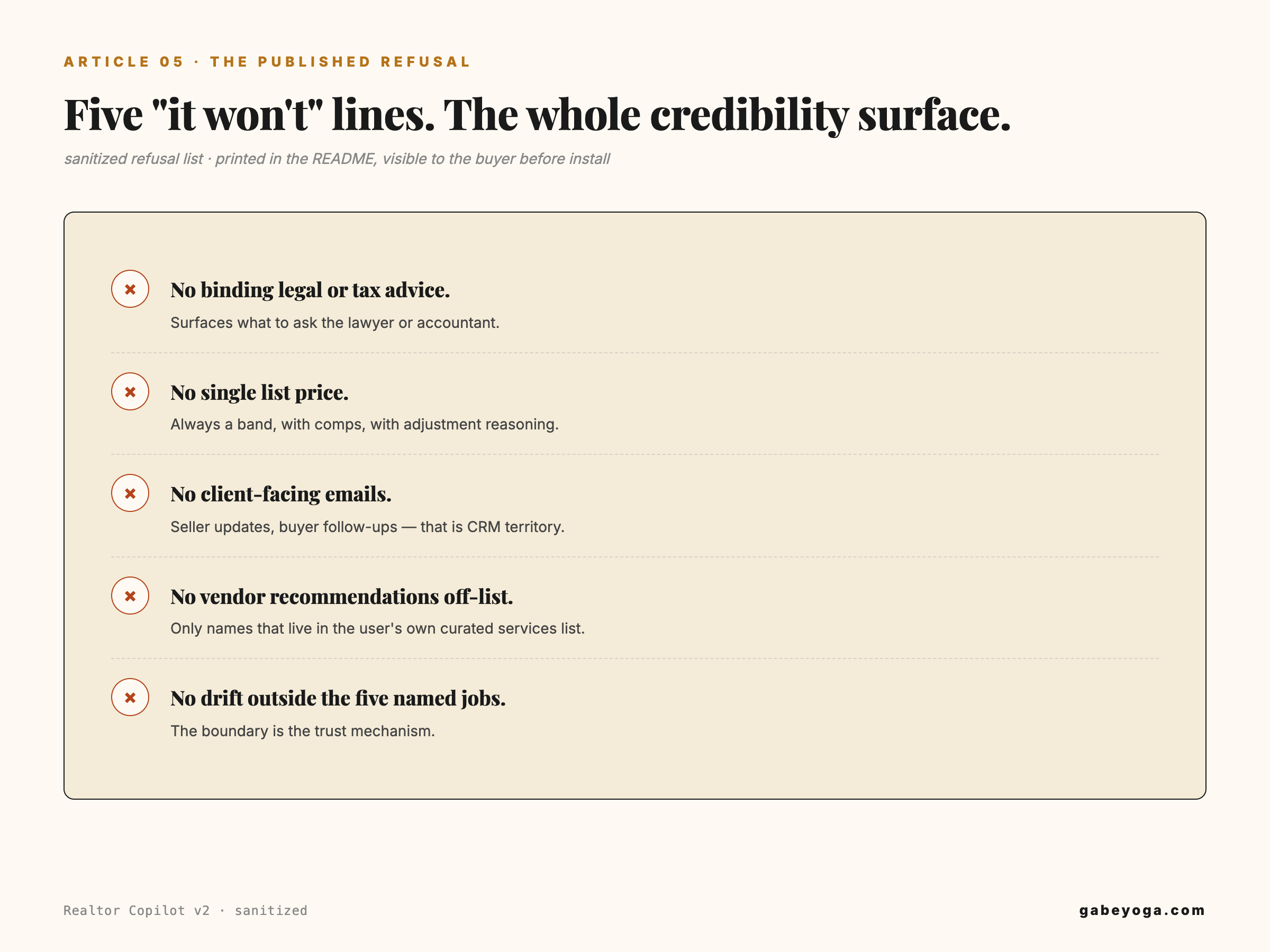
Five lines. Published in the README. Visible to the buyer before install. The user is not surprised when the specialist refuses; the user installed it because of the refusals. Realtor Copilot v2 builds the entire credibility surface from this.
Where the refusal earns the rest
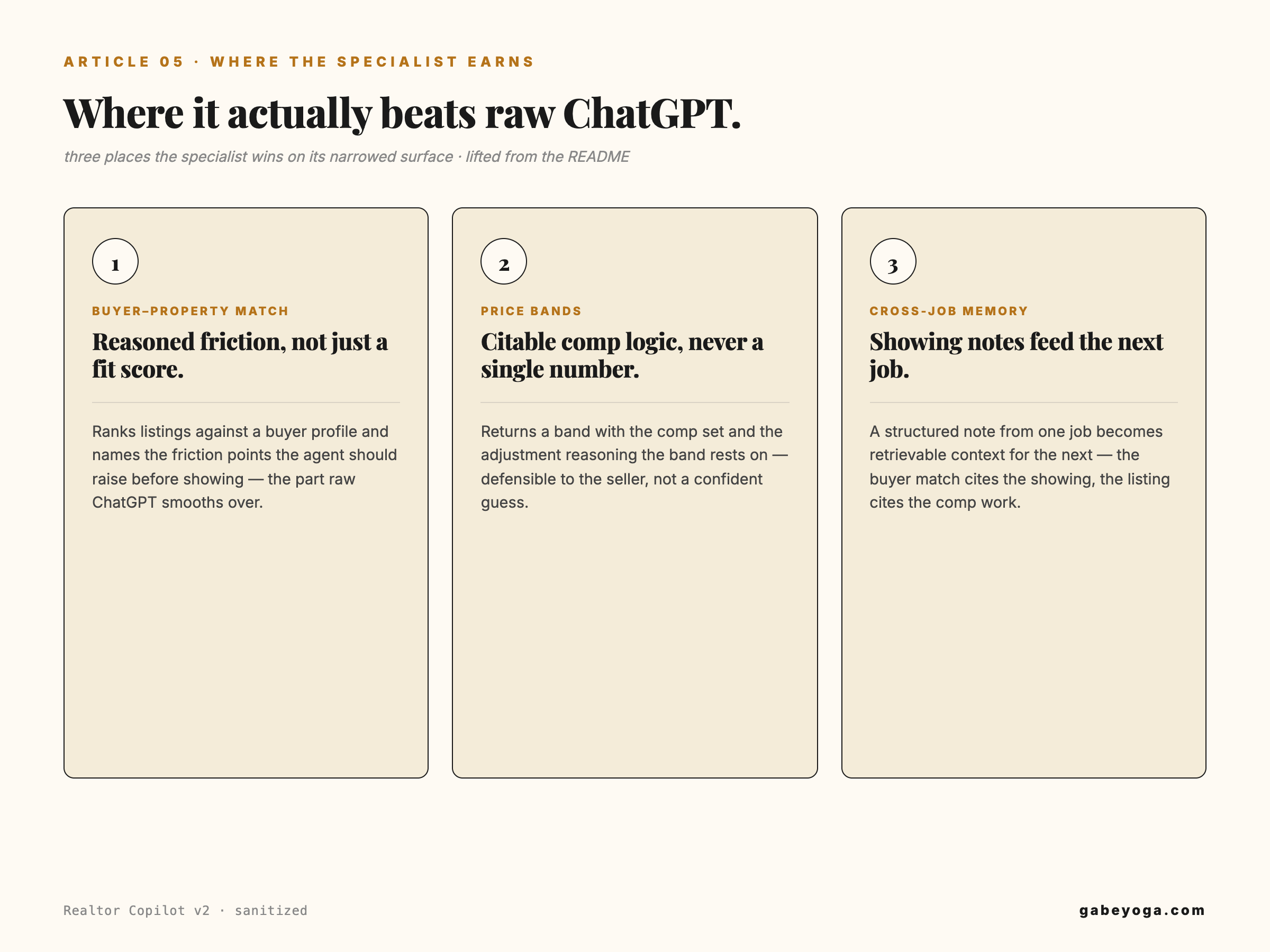
The honest comparison the README makes — the section titled “Where it actually beats raw ChatGPT (be honest about the others)” — is the same move at a different altitude. Three places where the specialist beats raw ChatGPT (buyer–property matching with reasoned friction; price bands with citable comp logic; cross-job memory) and an explicit acknowledgement that for short marketing blurbs, generic Q&A, and brainstorming, ChatGPT is fine. The specialist does not try to win on those.
The refusal list and the honest-about-the-others passage are the same architectural decision. Both narrow the surface deliberately. Both make the remaining yes-answers stand on something. A specialist that claims the whole surface claims none of it.
The reader’s exercise
The exercise is not “what could my specialist do.” The exercise is “what are the five questions my customers ask me daily that I currently answer with structure, judgment, and local context, and what are the seven questions that look related but are not actually my work.”
The first list becomes the job menu. The second list becomes the published refusal. The product is the boundary between them. A practitioner who cannot draw that boundary in plain English does not have a specialist; they have a generalist with their face on it, and the user will figure that out in three interactions.
What this is not
This is not scope discipline as a virtue. It is scope discipline as a market position. A copilot that refuses five things ships faster, holds quality longer, and gets quoted on more often than a copilot that promises to do everything for everyone in the domain. The refusal does work the marketing copy cannot do.
It is also not a permission system. The user can ask the specialist anything. The specialist will answer the five jobs and decline the rest in one sentence. No credentials, no tiering, no premium tier that adds the seventh job. The seventh job belongs to a different specialist or a different professional or to the user’s own judgment.
The cost of refusing in public
There is a real cost. A user arrives wanting the seventh job, hears no, and leaves. Some of those users will not come back. The specialist that promises everything captures more of that traffic on the first turn.
The cost is recovered later. The user who gets a clean refusal on the seventh job and a structured answer on the second one returns for the second job again. The user who gets a vague half-answer on the seventh and a vague half-answer on the second does not. Trust compounds where it is given honestly and decays where it is not. The published refusal is the slow trade — first-turn traffic for return rate.
A practitioner who has never run their work this way underestimates how much of the long-term value lives in the return. The refusal is a filter, and a filter is what makes the remaining traffic the right traffic.
Companions in this series: The orchestrator is not the worker · Five locked rules of daily dispatch · Three categories of external workers · The software is free. The fill-in is the product. · Ship one populated example, document the structure, let others fork.