
The Software Is Free. The Fill-In Is the Product.
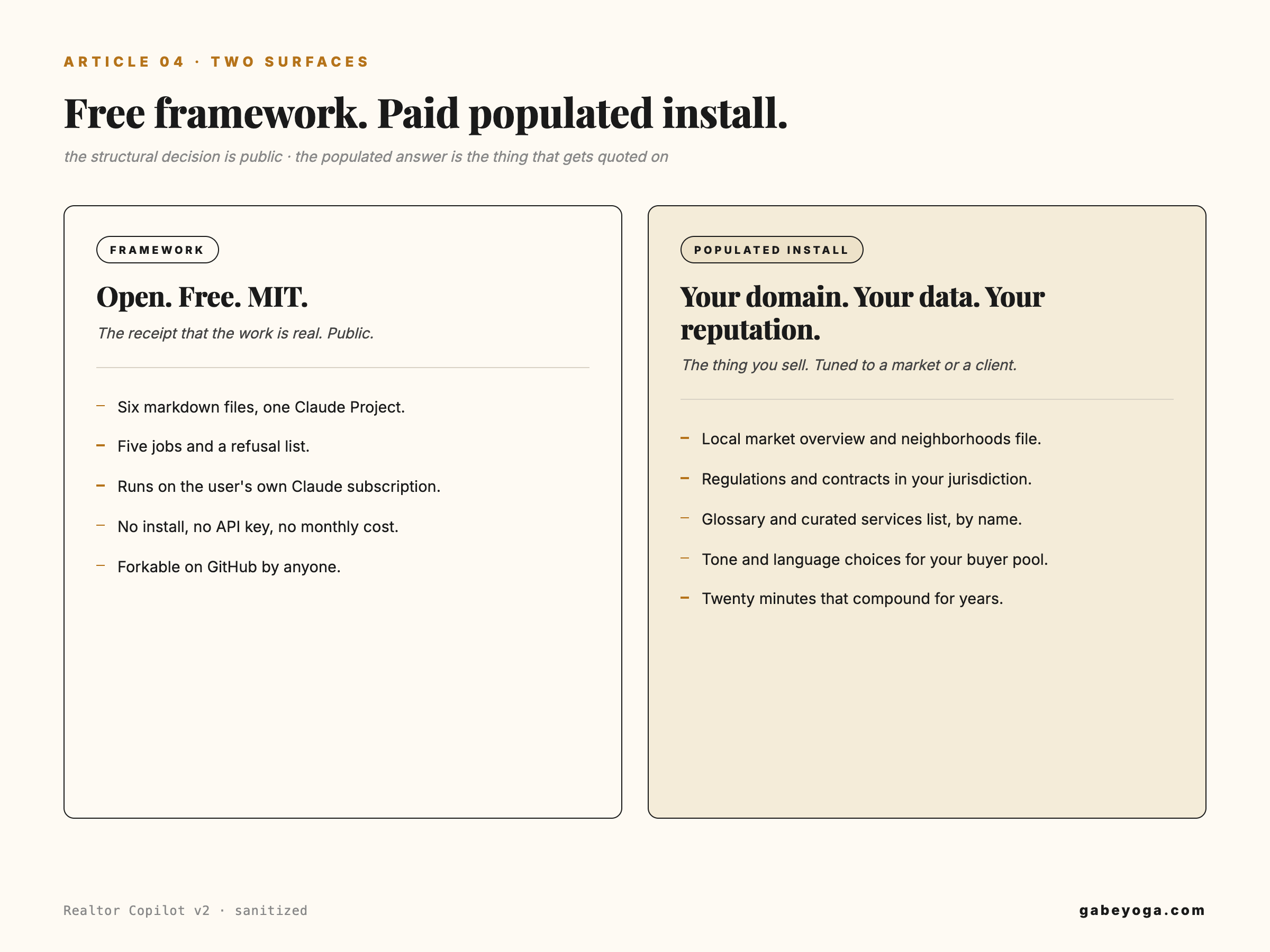
The framework is the receipt that the work is real. The populated version, tuned to a market or a client, is what gets quoted on.
A working real-estate agent in Jerusalem does not buy software. She subscribes to two SaaS tools her brokerage already pays for, half-uses both, and types into ChatGPT for the parts neither one covers. The output is generic because the input is generic. She knows this. She pays anyway, because the alternative is building something herself, and she sells houses for a living.
Realtor Copilot v2 is a free Claude-based specialist for that agent. It runs on her own Claude subscription, no install, no API key, no monthly cost. About twenty minutes to set up for her local market, then it is a chat away. The framework is MIT-licensed and on GitHub. The populated install for her market is the paid thing.
The framework is the receipt, not the product
The instinct of the solo practitioner with deep domain knowledge is to package that knowledge as a course, a book, or a SaaS subscription. All three are slow to build, slow to update, and slow to monetize. The framework-as-free posture inverts the funnel. The receipt that the work is real is public. The populated version, tuned to a market or a client, is what gets quoted on.
Free is also the only price that beats the default.
The default for the working professional is raw ChatGPT. Anything that costs money has to clear a bar that “open a new browser tab” does not. A free framework on the user’s own subscription clears that bar at zero, and the comparison shifts from “is this worth $39/month” to “is the populated version worth more than I can do myself in twenty minutes.”
What the populated thing actually does
Sanitized refusal-and-jobs surface — the whole product is these five rows.
| Job | What you ask | What you get back |
|---|---|---|
| Write a listing | “Write a listing for this 3-bed apartment. Audience: international investor.” | A finished listing tuned to that buyer pool, multiple languages on request. |
| Match a buyer to listings | “Here is the buyer profile. Here are four listings. Rank them.” | Ranked fit with reasoning, friction points called out, which to show first. |
| Price a property | “What should this list at? Specs follow.” | A defensible price band with comp set and adjustment reasoning. |
| Capture showing notes | “Showing was Saturday. Here is my dictation.” | A structured note tagged for retrieval by future jobs. |
| Look up a local service | “Who do we use for hillside foundation inspections?” | Top pick from the agent’s own curated list, with reasoning. |
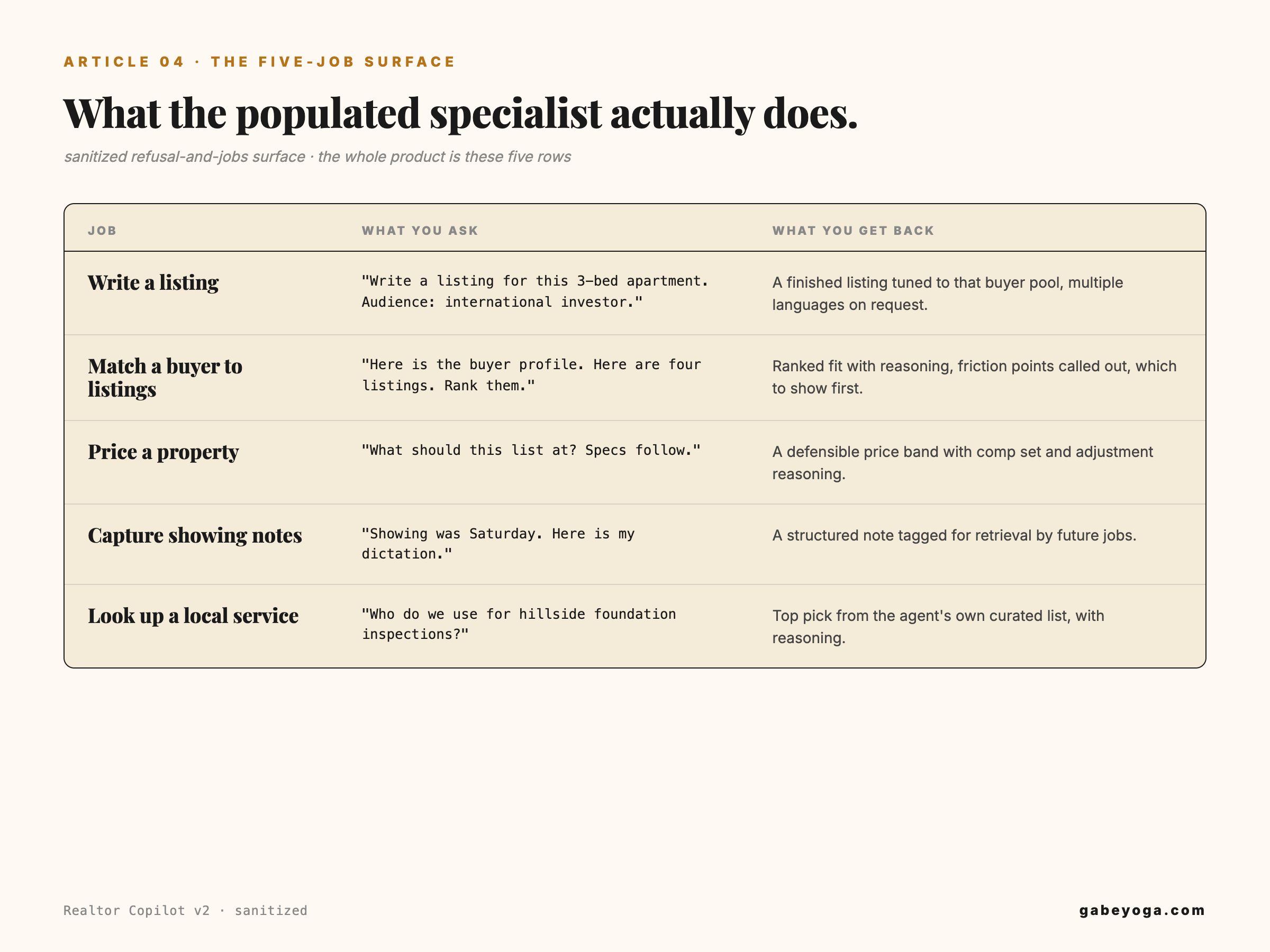
Five jobs. The whole product surface. The agent who installs this is not buying access to a chatbot. She is buying the structural decision that these five jobs are the ones worth doing this way, and the populated reference files that make her market the one the copilot reasons inside.
The reader’s translation
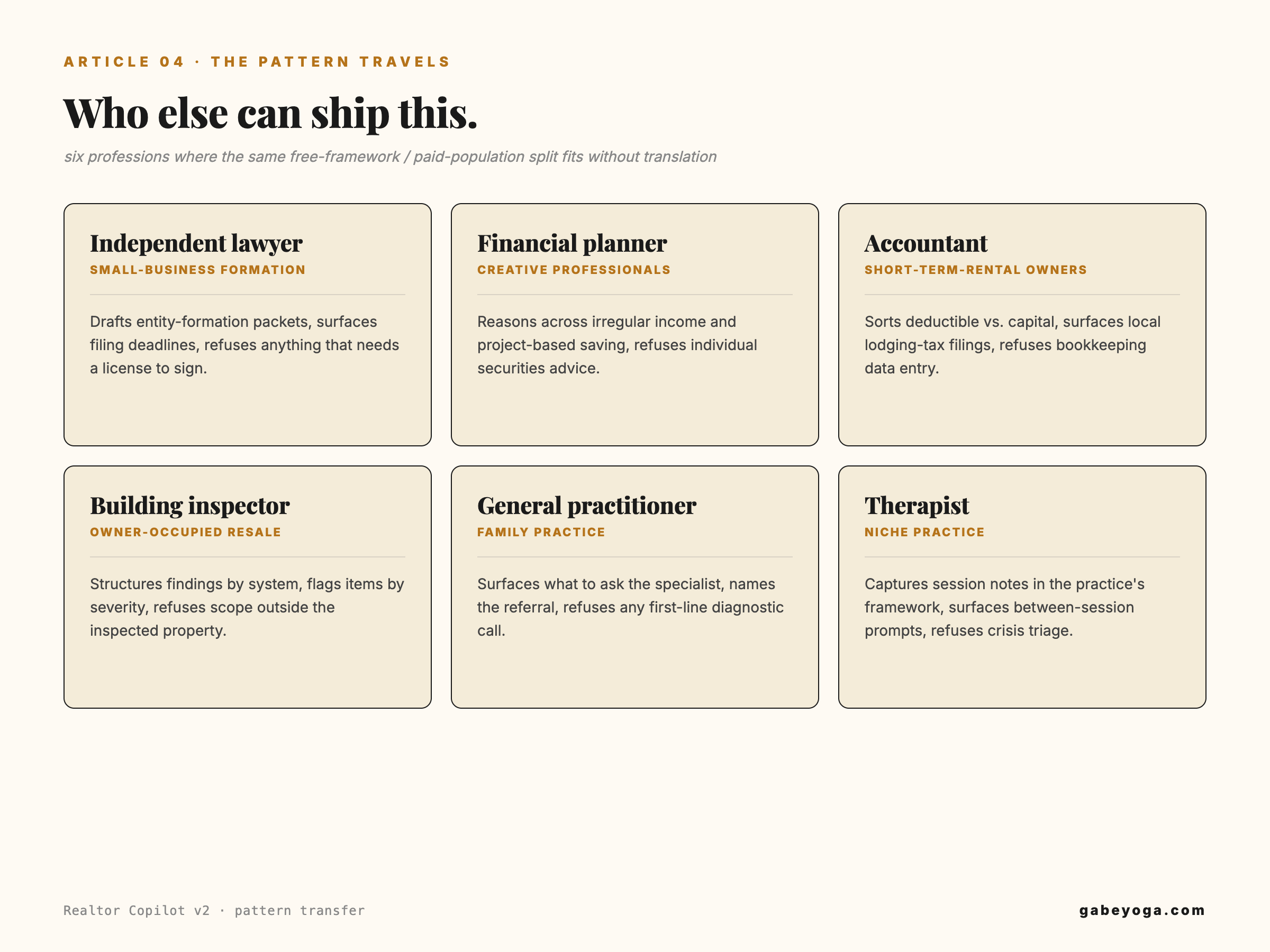
The pattern travels. A lawyer who handles small-business formation. A financial planner who works with creative professionals. An accountant whose clients are short-term-rental owners. A building inspector. A general practitioner. A therapist running a niche practice. Anyone whose customers currently watch raw ChatGPT generate plausible, generic answers in their domain.
The translation is structural. List the five jobs your audience asks you about most often. List the file structure that holds your local context. Decide, in advance, what the specialist will refuse to do. Ship the framework empty, populated for one market, with a contact line for the rest. Realtor Copilot v2 is the working example. The translation work is yours.
Why this is a contact-line product, not a download-link product
The framework is on GitHub. Anyone can fork it, populate it for their domain, and run it. Most readers will not. Reading the structure is faster than building it; building it is faster than tuning it; tuning it is faster than maintaining it. Each step costs more than the last.
The contact line is for the readers who get one paragraph in and recognize the shape of their own problem. They do not need the install. They need the populated version for their domain, and they want to talk to the person who built one.
What the user pays for is the population
The Realtor Copilot v2 setup is six markdown files inside specialist/reference/region/. A market overview, a neighborhoods file, a regulations file, a contracts file, a glossary, and a services list. The framework is the choice that those six files are the right six. The populated install is the answer to what goes in them.
A working agent in Jerusalem has the answers. So does a working agent in Lisbon, in Khao Lak, in Marin County. What none of them have, before this exists, is the structural decision that a market lives in exactly six files of those exact shapes, plus a Claude Project to load them into. That decision is the part that took the build. The fill-in is the part the practitioner already knows by heart.
The translation, again, is structural. A lawyer’s specialist needs the equivalent six files for a small-business-formation practice. A financial planner’s needs the equivalent six for retirement-stage creative professionals. The number six is not magic. The choice that these are the six is.
The free framework distributes the structural decision. The contact line monetizes the population. Two surfaces, neither of which makes sense without the other.
Companions in this series: The orchestrator is not the worker · Five locked rules of daily dispatch · Three categories of external workers · The “it won’t” list is the moat · Ship one populated example, document the structure, let others fork.