
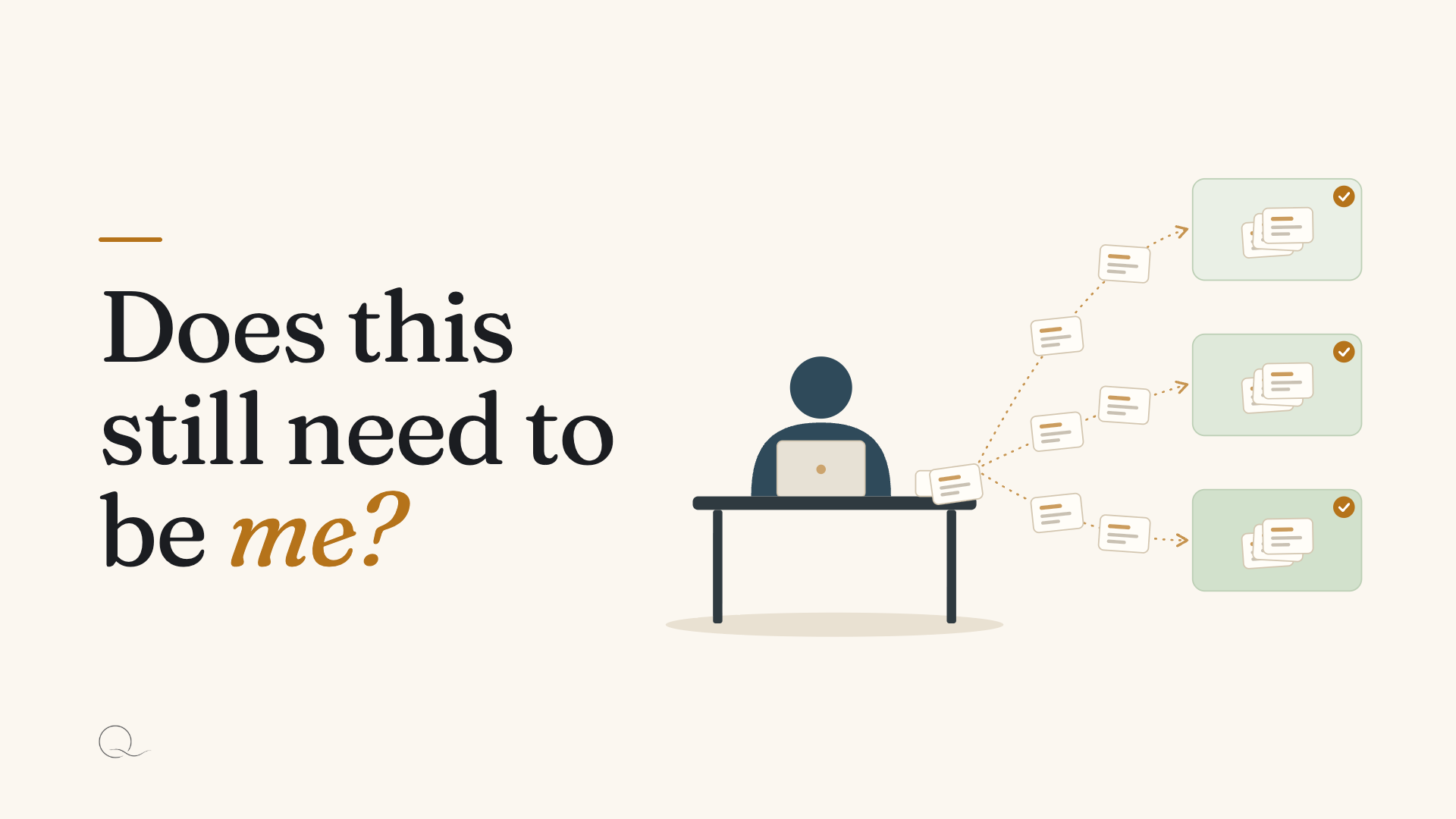
Does This Still Need to Be Me?
Hiring a virtual assistant taught a generation of small business owners that they didn’t have to do everything themselves. AI can teach that lesson again, at a bigger scale, but only to the people who stop treating it as a faster way to answer their own questions.
Years before any of this, I hired a virtual assistant.
There was nothing dramatic about it. I needed someone to handle the parts of running a small creative business that had nothing to do with the part I was good at: updating a spreadsheet, scheduling a post, chasing a small task that was never urgent and never finished. A VA cost less than local help, worked while I slept, and never needed a desk in my office. That was the whole appeal.
It’s easy to forget how strange that felt the first time. You didn’t need to do everything yourself anymore. The business hadn’t grown big enough to justify a team; the internet had made a team cheap enough for almost anyone. Remote work grew out of the same realization at a bigger scale. A lot of the digital work in a small business, the maintenance and the minutiae, the work that isn’t hard so much as constant, didn’t need to be done by you specifically. It needed to be done. Those are two different requirements, and the gap between them was the whole business model.
I think AI can teach that lesson again. I don’t think most people are using it that way yet.
Most of us still meet AI as a question box
Ask something. Get an answer. Copy it. Paste it somewhere else. Open another app. Ask again. Explain the context again, because the last conversation didn’t carry it forward. The loop is fast, and it helps: a rough draft stops eating an evening, and a messy idea gets untangled in a few exchanges instead of an afternoon.
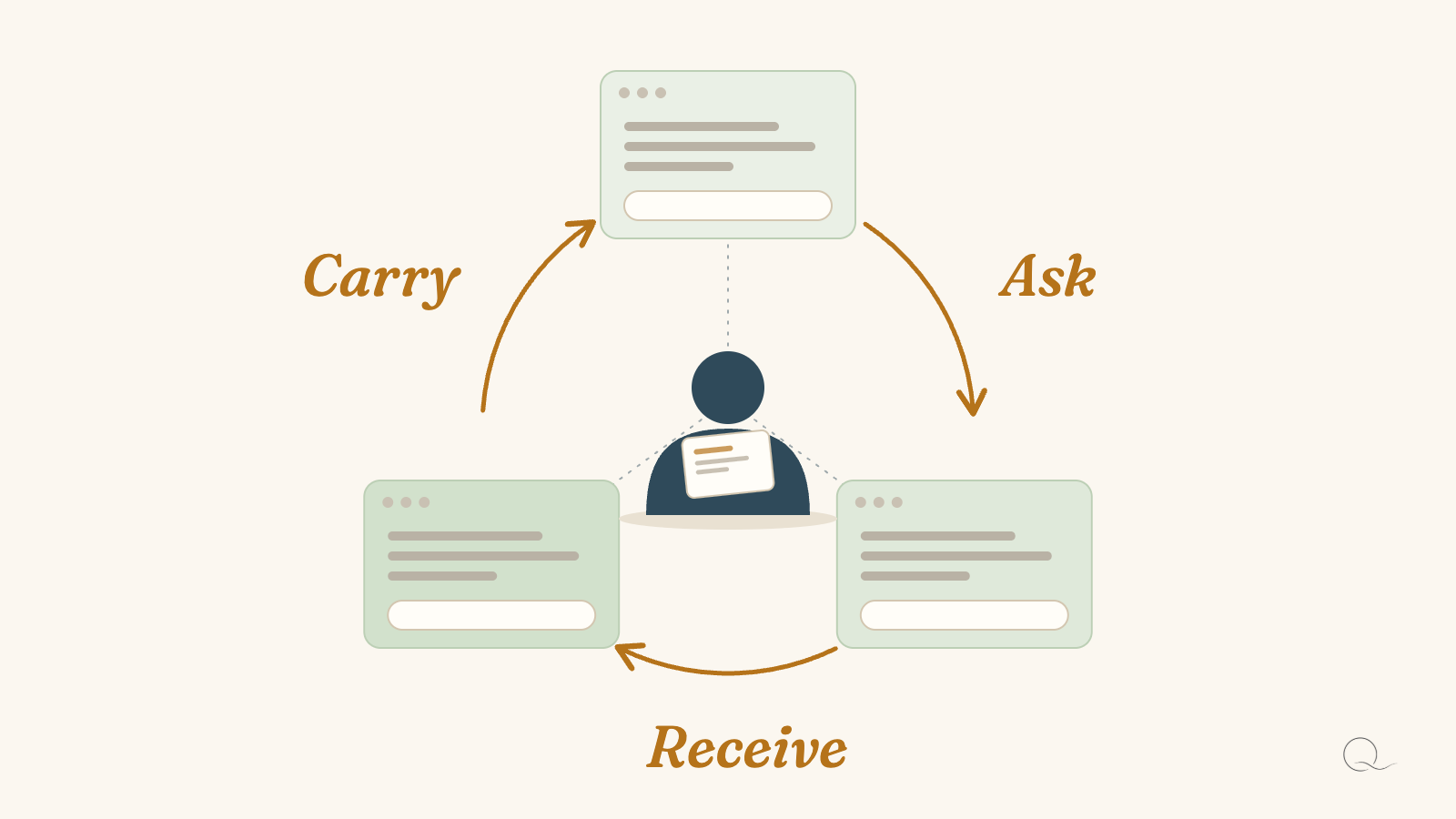
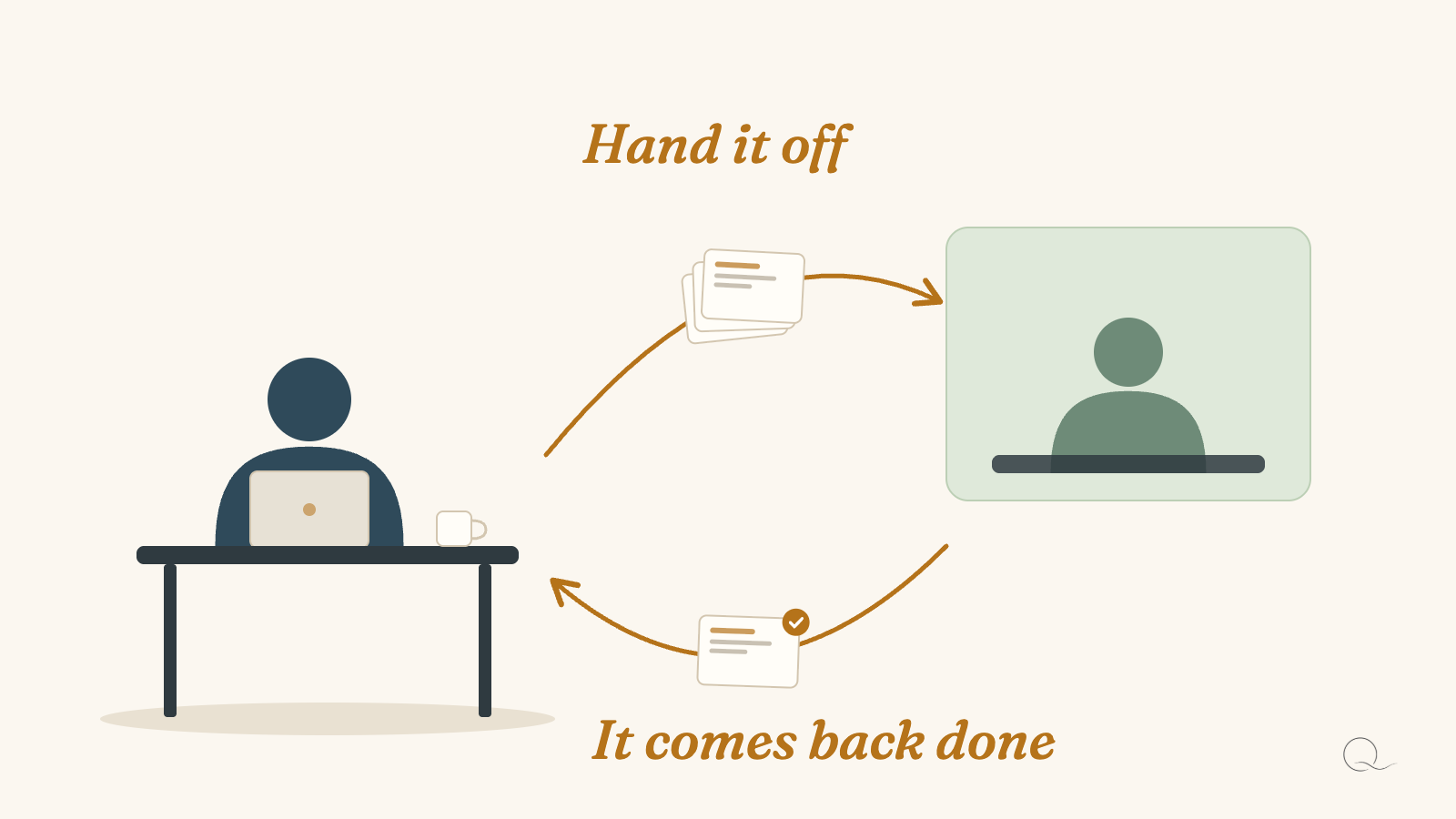
But look at where you’re standing while it happens. Ask, receive, carry. You’re in the middle of every exchange, moving the output from where it appeared to where it needs to live. A virtual assistant never asked that of you. You handed over a task, a calendar, a whole piece of the operation, and it came back finished. A chat window hands things back to you, one exchange at a time, and calls that help.
The companies selling it now say the same thing
This isn’t only my hunch. The companies that make these tools describe the same shift in their own numbers.
In June, OpenAI wrote about how its own tools were changing the way people work, starting with its own staff. Chatbot exchanges, it said, are often “short and self-contained,” and the unit of knowledge work is moving “from single interactions to delegated, long-horizon tasks.” In August it published enterprise figures to go with that. Since February, weekly enterprise users of Codex, its tool for handing off whole pieces of work, grew 108 times over in legal teams, 41 times in sales, 41 times in recruiting and 26 times in marketing. In engineering, where the tool started, growth was 5 times. That is OpenAI’s data about OpenAI’s products, and it is worth reading that way. It still shows where people are taking it.
Microsoft has spent 2026 making the same case from the other side. Across its Work Trend Index, its Build keynote and its new tools for running AI workers inside a company, the message repeats: before a business can trust these workers with real work, each one needs context, an identity, rules it follows and a person answerable for it.
Neither company is selling a smarter answer anymore. Both are describing a handoff.
I found this out trying to make a book
I’d been trying to turn years of real work into a finished nonfiction book, and a book is a bad test case for “AI makes things faster.” A book isn’t one task pretending to be difficult. It’s a stack of different jobs: writing, editing, research, design, fact-checking. Once the book exists, it keeps generating more of them, such as articles, posts, video and a website, and none of those have much to do with writing a book.
For a while I did what most people do. I opened one conversation and asked it to be my editor. Then my researcher. Then my designer. A week later I’d open a new one and explain who I was and what I was making all over again.
I wouldn’t run a business that way with people. I wouldn’t hire one person, hand them five job titles and expect them to remember nothing from yesterday. So I stopped asking one conversation to be everyone, and started building separate workers that each kept their own share of the material: one that knew the writing, one that knew the research, one that knew the design. None of them needed me to carry the context between them anymore.
That’s the shift. A worker that remembers what you told it yesterday, so you stop being the one carrying the memory around in your own head.
The same question kept showing up
Once I stopped asking and started building, the same question surfaced in different corners of one small operation. I’ve written up each time I chased it.
Some of those pieces are about the setup. What changed once several workers shared the same material instead of relaying it through me. What it costs to re-teach a chat window your business every morning. And why a job shouldn’t be automated until a person has taught it and run it often enough to find it boring.
Some are tests. I set out to have a worker publish my YouTube videos and found the interesting part was the moment after I said “approved”, when I was no longer the one carrying the file the last few feet. Less flatteringly, I wrote about an automation that had never once worked from the day I built it. Building something that can run without you is the easy half. Checking whether it does is the part almost nobody publishes, so I publish it: the week the method checked itself went out whichever way the test landed.
Different corners of one small business, and the same question every time: does this still need to be me?
Every one of those pieces, and the videos and pages around them, was made by the team of AI workers that became The Quiet Scribe Suite. It is the pattern this page describes, built and running.
The question worth asking about your own week
You don’t need a content operation for this to apply to you. A real estate office has a list of properties somebody keeps checking long after the checking stops turning up anything new. A law office has documents that need sorting and cross-referencing the same careful way every time. A clinic has follow-ups that keep arriving whether or not today’s queue has room for them. A design studio has files moving between people and platforms, and someone has to keep track of which version is the real one. Different piles, same shape: work that isn’t hard so much as constant, and constant enough to become the whole job.
The virtual assistant taught a lot of small business owners to ask whether a task needed them. AI can ask that question about a much wider share of your week, once you stop pointing it at your next question and start pointing it at your next handoff. Skip “help me write this.” Ask: who could do this completely, and not need to hear from me again until it’s done?
None of this is an argument for disappearing from your own business. It’s an argument for choosing where you show up. Decide on purpose which parts of your week need your judgment, instead of giving them your attention because that’s where attention has always gone. The parts that need you still get you. The rest was only ever borrowing your attention.
That’s the lens everything I publish here runs through. The internet already has plenty of “look what AI can do,” and none of it is short on impressive answers. I’m after the quieter question, one piece of my own small business at a time: how much of what I still do by hand doesn’t need to be me?
I work through it in the open, with anyone who wants to try it on their own week, in Wellness & AI SKOOL. Bring the task you’d hand off first.
Sources
- OpenAI, “How Agents Are Transforming Work,” June 2026. https://openai.com/index/how-agents-are-transforming-work/
- OpenAI, “From Assistance to Execution: How Enterprises Put AI to Work,” August 12, 2026, https://openai.com/index/how-enterprises-put-ai-to-work/ , and “Enterprise Signals,” https://openai.com/signals/enterprise-data/
- Microsoft: Jared Spataro, “How Frontier Firms are rebuilding the operating model for the age of AI,” May 5, 2026 (Work Trend Index 2026); Satya Nadella, Microsoft Build 2026 keynote; Microsoft Agent 365 / Entra Agent ID, https://www.microsoft.com/en-us/microsoft-agent-365